 Lunarya
Earth
Earth is the element of what can be touched, counted and relied upon. It thinks in consequences and timescales, builds things meant to outlast the enthusiasm that started them, and mistrusts anything that cannot be demonstrated. Slow to move, very hard to stop.
Earth is the element of the senses and of consequences. Its signs trust what can be touched, counted and kept, and they measure a plan by whether it will still be standing in ten years. Taurus is earth as possession and pleasure, fixed and patient; Virgo is earth as craft and order, mutable and exact; Capricorn is earth as structure and ambition, cardinal and long-sighted. Earth gives a chart its competence and staying power; its risk is caution that hardens into stubbornness, and a suspicion of anything it cannot use.
In short
- Polarity
- Yin, receptive
- Energy
- Receptive
When it is strong
- Practical, patient and reliable
- Comfort and security first
- Slow to change its mind
- Wary of what cannot be proved
When it is missing
- Ideas that never quite land
- Money and the body as afterthoughts
- Restless with routine
- Grateful for people who finish things
A chart's balance is counted from where the Sun, the Moon, the ascendant and the planets fall: an element or a modality with many of them is strong, one with none is missing. The lists are the tradition's rule of thumb, not a verdict.
The earth signs
Earth in stone
The stones the crystal books give to the element, whatever their sign. The element is also what makes a stone projective or receptive in magic.
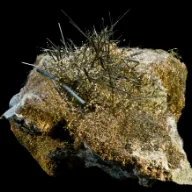 Actinolite
Green needles of amphibole, and the mineral half of all jade is made of.
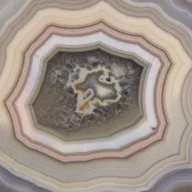 Agate
Chalcedony laid down in bands, one over the next, inside a bubble in old lava.
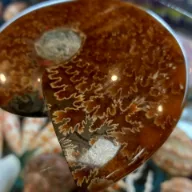 Ammonite
A shell that spiralled through the seas for three hundred million years, turned to stone.
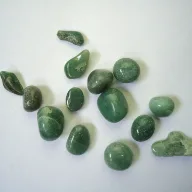 Aventurine
Quartz with a glitter of green mica through it, named by accident.
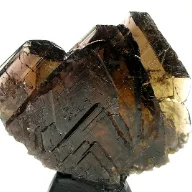 Axinite
Clove-brown wedges of a boron silicate, sharp enough to be named for an axe.
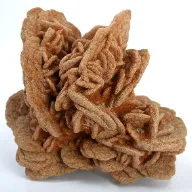 Baryte
The heavy stone: barium sulfate, and the reason a rose can grow in the desert.
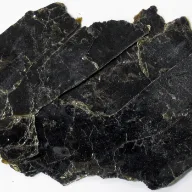 Biotite
Black mica: the flakes in every granite, and sheets big enough to roof a shed.
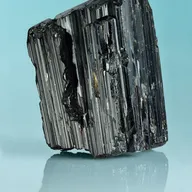 Black tourmaline
The stone that pulls ash out of a pipe when you warm it.
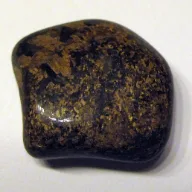 Bronzite
A dark pyroxene with a bronze sheen, from the same family the meteorites are full of.
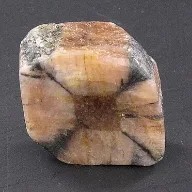 Chiastolite
An andalusite that grows a dark cross inside itself, and was sold for centuries as a Christian charm.
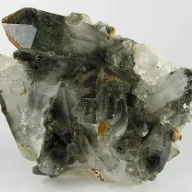 Chlorite
The green that gets into everything: a whole family of soft micaceous minerals, and the ghost inside phantom quartz.
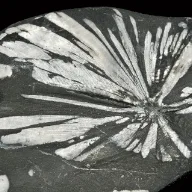 Chrysanthemum stone
Black rock with white mineral flowers that are not fossils.
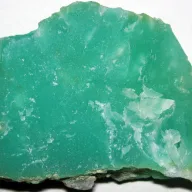 Chrysoprase
Apple-green chalcedony coloured by nickel, and the most valuable of all the quartzes.
Cradle of Humankind stone
Ordinary grey chalcedony from an extraordinary place outside Johannesburg.
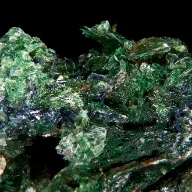 Fuchsite
Muscovite that took up chromium and turned green and glittering.
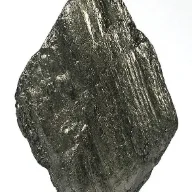 Graphite
Carbon in its soft form: the same element as diamond, stacked in sheets that slide.
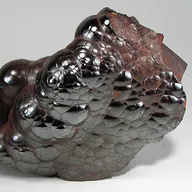 Hematite
Black as a mirror, and it leaves a blood-red line on anything you scratch it against.
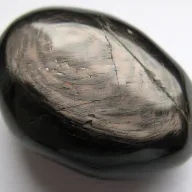 Hypersthene
A bronze-sheened pyroxene whose name the mineralogists retired.
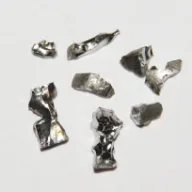 Iridium
The most corrosion-proof metal there is, and the layer that dates the end of the dinosaurs.
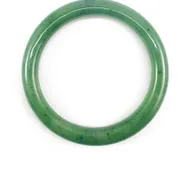 Jade
Two different minerals under one name, and the toughest stone on this page.
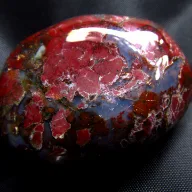 Jasper
Opaque chalcedony, stained by whatever the sediment happened to hold.
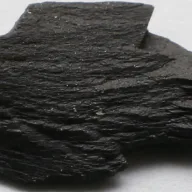 Jet
Fossil driftwood, black and warm in the hand, and Victorian mourning.
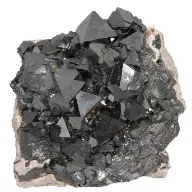 Magnetite
The most magnetic mineral there is, and the first compass.
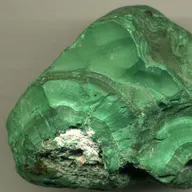 Malachite
Copper gone green, in bands you can read like tree rings.
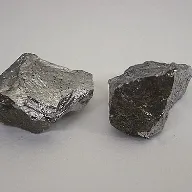 Manganese
The metal that makes steel tough, and that never occurs native.
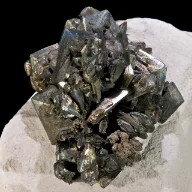 Marcasite
Pyrite's unstable twin, which eats itself in a damp drawer.
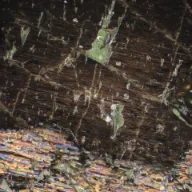 Nuummite
Three-billion-year-old Greenlandic rock that flashes gold and copper.
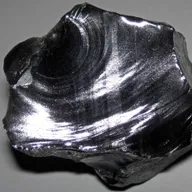 Obsidian
Volcanic glass with an edge finer than a surgical steel blade.
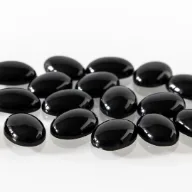 Onyx
Straight-banded chalcedony, and the black stone that is nearly always dyed.
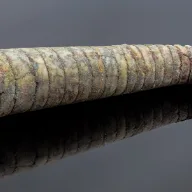 Orthoceras
A straight-shelled squid relative that died four hundred million years ago.
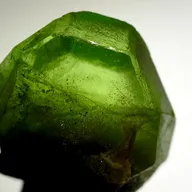 Peridot
Green olivine from the mantle, and occasionally from space.
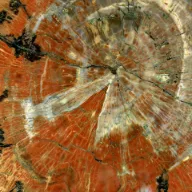 Petrified wood
A tree that became quartz cell by cell, and kept its grain.
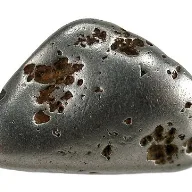 Platinum
Little silver, the Spanish called it, and threw it back in the river.
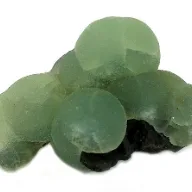 Prehnite
Green botryoidal crusts, usually with black epidote needles through them.
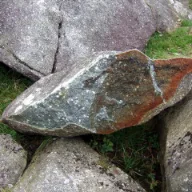 Preseli bluestone
The spotted dolerite of Stonehenge, from a Welsh hillside 250 kilometres away.
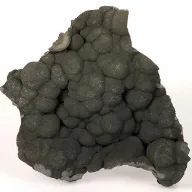 Psilomelane
A field name for the hard black manganese ores, kept alive by lapidaries.
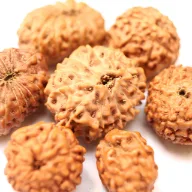 Rudraksha
The stone of a fruit, not of the ground, and the oldest prayer bead in India.
Saussurite
What a feldspar becomes when hot water gets at it for long enough.
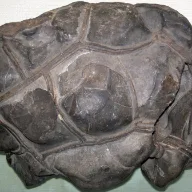 Septarian
A mud nodule that cracked from the inside and filled its own cracks with calcite.
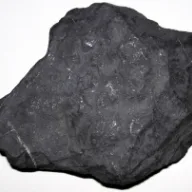 Shungite
Two-billion-year-old carbon rock from Karelia, and a great deal of nonsense.
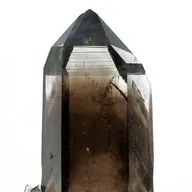 Smoky quartz
Quartz turned brown by the radioactivity of its own bedrock.
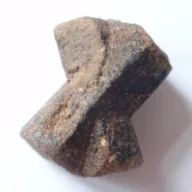 Staurolite
Two crystals grown through each other at sixty degrees, which comes out as a cross.
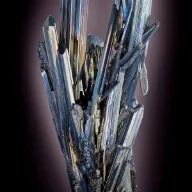 Stibnite
Steel-grey swords in a spray, soft enough to mark with a fingernail, and poisonous.
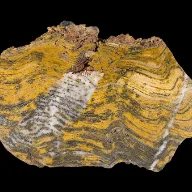 Stromatolite
Three and a half billion years of bacterial mats, turned to stone in layers.
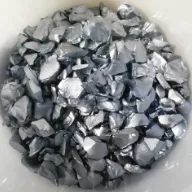 Terahertz stone
Furnace silicon, cut into beads and sold on a claim about radiation it does not emit.
 Tourmaline
Thirty-odd minerals sharing one crystal shape, and every colour there is.
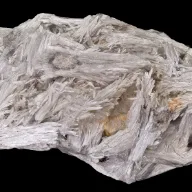 Tremolite
The white amphibole that makes nephrite jade, and, in its fibrous form, asbestos.
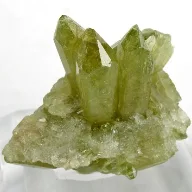 Vesuvianite
Named for the volcano that threw it out, and for looking like several other minerals at once.
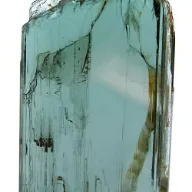 Zoisite
A grey-green rock mineral that produced two of the century's fashionable gems.