 Lunarya
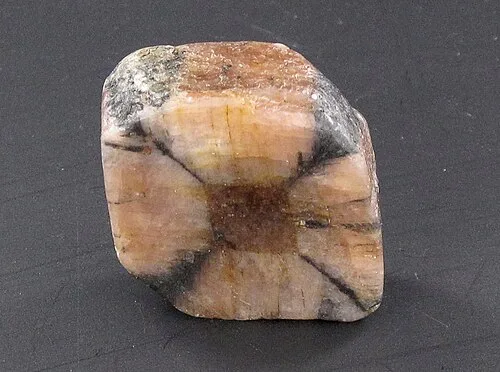
Chiastolite
Chiastolite is andalusite — aluminium silicate, Al₂SiO₅ — that grew with a cross of dark carbon inside it. Cut across the prism, a crystal shows a black cross on a pale brown ground, sharp enough that the stones were carved into pendants and sold at pilgrimage sites for hundreds of years. The name is from the Greek chiastos, arranged crosswise, after the letter chi.
The cross is not a coincidence or an inclusion that drifted in. As the crystal grows in a carbon-rich slate, the graphite dust in the rock is pushed ahead of the advancing faces; the corners of the square prism grow fastest and sweep the dust into the re-entrant angles between them, where it is trapped in four dark wedges. Keep growing and the wedges lengthen into arms. Cut the crystal lengthwise and the cross becomes four dark stripes, which is why the good specimens are always cut across.
In short
- Colour
- Dark
- Mineral
- Silicate
- Formula
- Al₂SiO₅
- Hardness
- 6.5–7.5 on the Mohs scale
- Crystal system
- Orthorhombic
- Found in
- Bimbowrie in South Australia, Lancaster in Massachusetts, Georgetown in California, Xinjiang in China, Brazil, Chile, and the Spanish localities that gave andalusite its name.
- Element
- Earth
- Planet
- Saturn
- Chakra
- Root
- Handling
- Water and light are both fine
How it forms
Andalusite is one of three minerals with the formula Al₂SiO₅ — the others are kyanite and sillimanite — and which one a rock grows tells a geologist the pressure and temperature it saw; the three meet at a single point on the phase diagram that every geology student learns. Andalusite is the low-pressure one, and it forms when an intrusion bakes a shale or slate at shallow depth. Where that mudstone was full of organic carbon, the growing crystals sort it into the cross. The rock around them, a spotted hornfels, is the tell-tale of contact metamorphism in the field.
In human hands
Spanish pilgrims carried chiastolite crosses from Santiago de Compostela, and the Jesuits sold them as lapis crucifer, the cross-bearing stone, as charms against storm, sickness and the evil eye; French and Breton sailors carried them too. The mineral was described scientifically in 1800, and the name andalusite is an error that stuck — the type material came from Guadalajara, not Andalusia. In the twentieth century andalusite became an industrial mineral, quarried by the hundred thousand tonnes for furnace linings, which is what almost all of it is used for today.
Varieties and trade names
- Andalusite
- The clear gem form, strongly pleochroic, flashing green and red-brown from different directions; cut for collectors.
- Viridine
- Green andalusite coloured by manganese, from Brazil and Sweden.
- Kyanite
- The same formula under higher pressure: blue blades, and its own page here.
- Sillimanite
- The third polymorph, fibrous and high-temperature; the fibrous variety is called fibrolite.
- Staurolite
- The other cross stone, and a different mineral: its cross is two crystals twinned together, not an inclusion pattern, and it has a page of its own here.
Telling it from a fake
A genuine cross runs through the whole crystal, so a cut or broken face shows it again in the same place; a painted or resin-cast cross sits on the surface and stops there. Real chiastolite is hard — it will not take a scratch from a knife — and the ground is grey to tan and slightly mottled, never uniform. Staurolite crosses are dark brown throughout, and the arms cross at sixty or ninety degrees on the outside of the crystal rather than inside it.
None of this needs a laboratory, and none of it is proof. A shop that will not say whether a stone is treated has answered the question; ask, and have the answer written on the receipt.
What it is said to do
The old use is protection, and it is one of the few crystal traditions with a real paper trail: cross stones were worn against lightning, the evil eye and misfortune on the road from the Middle Ages onward, and their Christian reading is obvious. Modern books keep the protection and add balance at a crossroads — the stone for a decision — and a grounding role. It is also a traditional charm for travellers, which follows from the pilgrims.
Living with it
Hard, tough and unbothered by water or sunlight, so it is a good stone to carry; that is what it was made for. Soap and a brush are enough. The dark cross can look dull on a weathered piece, and a little wax will bring it back.
In magic
Chiastolite has a real Christian folk magic behind it: cross stones were sold to pilgrims, at Santiago de Compostela among other places, and worn against lightning, fever and the evil eye. Modern practice keeps it for protection and for crossroads — a stone carried when a decision has to be made — and for grounding. Water and light do it no harm.
- Energy
- Receptive
- Day
- Saturday
- Worked for
- Protection · Grounding and endurance
More of this colour
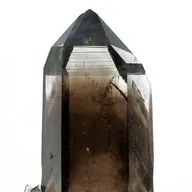 Smoky quartz
Quartz turned brown by the radioactivity of its own bedrock.
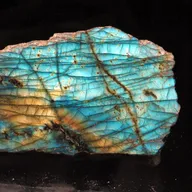 Labradorite
A dull grey stone until you turn it, and then it is peacock blue.
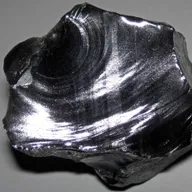 Obsidian
Volcanic glass with an edge finer than a surgical steel blade.
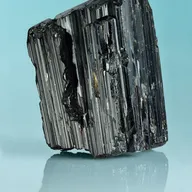 Black tourmaline
The stone that pulls ash out of a pipe when you warm it.
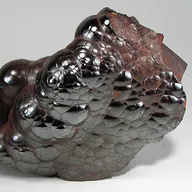 Hematite
Black as a mirror, and it leaves a blood-red line on anything you scratch it against.
Agni manitite
A black glass from Java, sold as a tektite; volcanic, as it turns out.
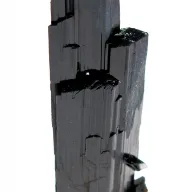 Arfvedsonite
A black amphibole with a blue flash, named for the man who found lithium.
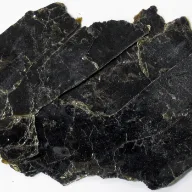 Biotite
Black mica: the flakes in every granite, and sheets big enough to roof a shed.
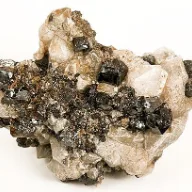 Brookite
Titanium dioxide in its rarest shape: thin red-brown blades grown in Alpine cracks.
Columbianite
Colombian volcanic glass, sold as a tektite it is not.
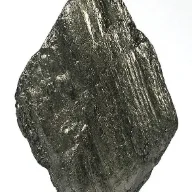 Graphite
Carbon in its soft form: the same element as diamond, stacked in sheets that slide.
 Aegirine
Black pyroxene needles from the strangest rocks on the planet.
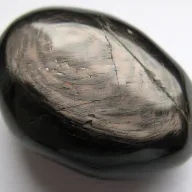 Hypersthene
A bronze-sheened pyroxene whose name the mineralogists retired.
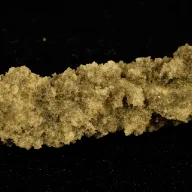 Fulgurite
Sand struck by lightning and fused, in a second, into hollow glass.
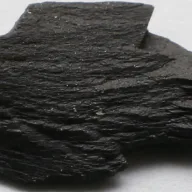 Jet
Fossil driftwood, black and warm in the hand, and Victorian mourning.
Indigo gabbro
A Madagascan rock sold under a wizard name it was given in 2010.
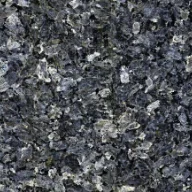 Larvikite
Norway's national rock, and the blue flash on half the shop fronts in Europe.
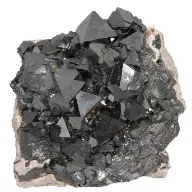 Magnetite
The most magnetic mineral there is, and the first compass.
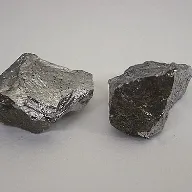 Manganese
The metal that makes steel tough, and that never occurs native.
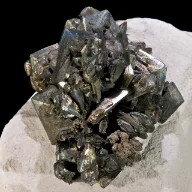 Marcasite
Pyrite's unstable twin, which eats itself in a damp drawer.
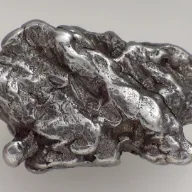 Campo del Cielo
An iron meteorite that fell on the Argentine Chaco four thousand years ago.
 Nuummite
Three-billion-year-old Greenlandic rock that flashes gold and copper.
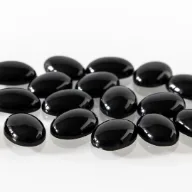 Onyx
Straight-banded chalcedony, and the black stone that is nearly always dyed.
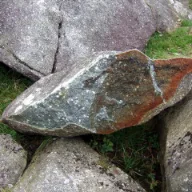 Preseli bluestone
The spotted dolerite of Stonehenge, from a Welsh hillside 250 kilometres away.
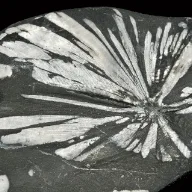 Chrysanthemum stone
Black rock with white mineral flowers that are not fossils.
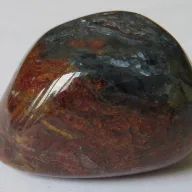 Pietersite
Tiger's eye smashed and cemented back together, so the light swirls.
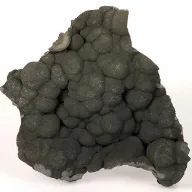 Psilomelane
A field name for the hard black manganese ores, kept alive by lapidaries.
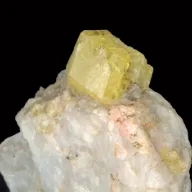 Rhodizite
A caesium borate as hard as topaz, and about as rare as minerals get.
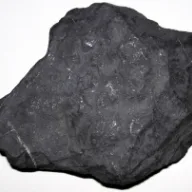 Shungite
Two-billion-year-old carbon rock from Karelia, and a great deal of nonsense.
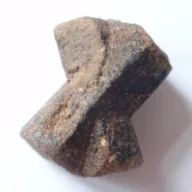 Staurolite
Two crystals grown through each other at sixty degrees, which comes out as a cross.
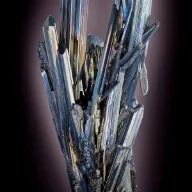 Stibnite
Steel-grey swords in a spray, soft enough to mark with a fingernail, and poisonous.
 Terahertz stone
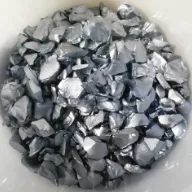
Furnace silicon, cut into beads and sold on a claim about radiation it does not emit.