 Lunarya
Ruby
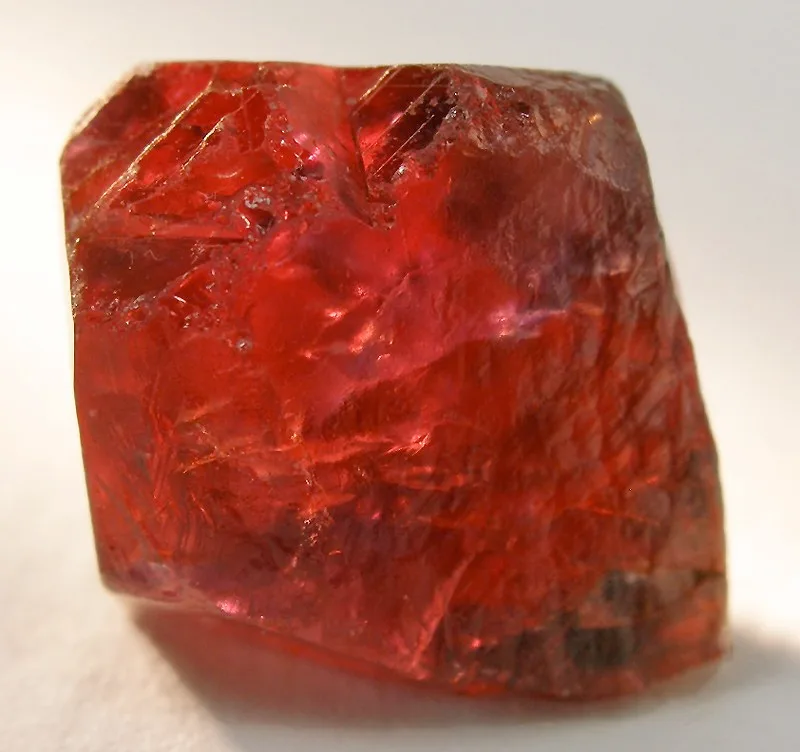
Ruby is corundum — aluminium oxide, Al₂O₃ — coloured red by chromium. Change the impurity and the same mineral becomes sapphire, which is why gemmology draws the line where it does: red corundum is ruby, and everything else is sapphire. At 9 on the Mohs scale it is the hardest thing in common jewellery after diamond, and it has no cleavage, which makes it about as durable as a gemstone gets.
Chromium does two things at once. It absorbs yellow-green light, which gives the red, and it fluoresces red under ultraviolet, so the finest rubies appear to glow in daylight — the quality Burmese dealers call pigeon's blood. Too much chromium and the crystal strains and cracks, which is why large clean rubies are rarer than large clean diamonds and, per carat at the top of the market, more expensive than any other coloured stone. Fine needles of rutile inside give the six-rayed star of a star ruby.
In short
- Colour
- Red, orange and gold
- Mineral
- Oxide
- Formula
- Al₂O₃
- Hardness
- 9 on the Mohs scale
- Crystal system
- Trigonal
- Found in
- Mogok in Myanmar is the classic source. Since 2009 Montepuez in Mozambique has become the largest, changing the market considerably. Others are Thailand, Sri Lanka, Madagascar, Tanzania, Afghanistan, Vietnam and Greenland.
- Birthstone of
- July
- Element
- Fire
- Planet
- The Sun
- Chakra
- Root
- Handling
- Water and light are both fine
How it forms
Corundum is aluminium oxide with no silicon in it, which means it can only grow where there is plenty of aluminium and almost no silica — an unusual combination. The Burmese rubies formed in marble, where limestone was metamorphosed with aluminous clay and the chromium came from nearby rocks. Others grow in basalt-hosted deposits and in aluminous metamorphic rocks, and weathering releases them into the gem gravels that most mining actually works.
In human hands
Ruby is the ratnaraj, the king of gems, in Sanskrit texts, and was carried into battle across Asia and Europe. Burmese kings claimed all large stones by right. Its modern history includes a technological chapter: Verneuil learned to grow synthetic ruby in a flame in 1902, which collapsed the market for small stones, and in 1960 Theodore Maiman built the first working laser from a ruby rod. It is July's birthstone and the fortieth-anniversary stone.
Varieties and trade names
- Pigeon's blood
- The trade's name for the finest Burmese red, slightly purplish and strongly fluorescent; a grading term, not a species.
- Star ruby
- Cut as a cabochon so that fine rutile needles inside throw a six-rayed star across the dome.
- Trapiche ruby
- Crystals with a six-spoke pattern of dark inclusions, like a cartwheel; scarce and strange.
- Glass-filled ruby
- Heavily fractured material with lead glass melted into the cracks; cheap, fragile, and legally required to be disclosed.
- Synthetic ruby
- Grown since 1902 and chemically identical; used in watch bearings, lasers and jewellery, and worth a fraction of natural stone.
Telling it from a fake
Hardness and weight rule out most imitations: ruby scratches every common red stone and is heavier than garnet or spinel of the same size. Red spinel fooled Europe for centuries — the Black Prince's Ruby in the British crown is a spinel — and tells apart by being singly refractive, where ruby doubles an image. The real modern issue is treatment rather than imitation: almost all commercial ruby is heated, which is accepted, while lead-glass filling is a different matter and must be disclosed. A laboratory report is the only answer above a modest price.
None of this needs a laboratory, and none of it is proof. A shop that will not say whether a stone is treated has answered the question; ask, and have the answer written on the receipt.
What it is said to do
Ruby has the longest and least ambiguous tradition of any stone here: life, blood, courage, desire, and the vitality of the body. Indian tradition gives it to the Sun and reads it as the king's stone; European lapidaries have it warning of danger by darkening. It is given to the Sun, to Leo, Aries and Scorpio, and to the root. Very little of this is modern invention, which sets it apart from most of the pages on this site.
Living with it
One of the easiest gems to own. Water, sunlight, heat and daily wear do nothing to natural or heated ruby, and warm soapy water with a soft brush cleans it. The exceptions are the treated ones: glass-filled stones are damaged by ultrasonic cleaners, by steam, by jeweller's pickle and even by lemon juice, so if a ruby was cheap, treat it as fragile.
In magic
Ruby is the Sun's gem in Vedic astrology and the centre of the navaratna, worn for power, courage and a strong heart. European magic said the same in its own way: the lapidaries claimed a ruby darkened to warn its owner of danger, and Kunz recorded Burmese soldiers who set rubies under their skin to make themselves unwoundable. Modern witches use it in workings for passion, courage and protection.
- Energy
- Projective
- Day
- Sunday
- Worked for
- Courage and drive · Love and friendship · Protection
More of this colour
 Garnet
Not one mineral but a whole family, and half of it ends up as sandpaper.
 Carnelian
Orange chalcedony, and the stone hot wax will not stick to.
 Citrine
Yellow quartz, except that most of it is amethyst that has been in an oven.
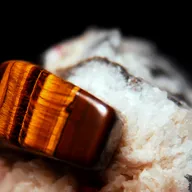 Tiger's eye
A stripe of light that slides across the stone when you tilt it.
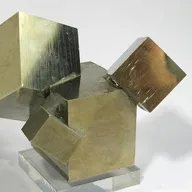 Pyrite
Fool's gold, in cubes so sharp they look machined.
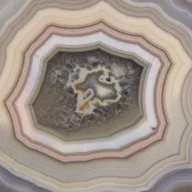 Agate
Chalcedony laid down in bands, one over the next, inside a bubble in old lava.
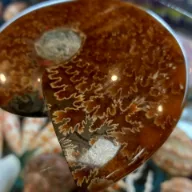 Ammonite
A shell that spiralled through the seas for three hundred million years, turned to stone.
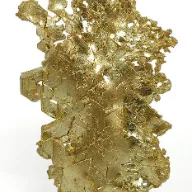 Gold
The one metal that comes out of the ground already finished.
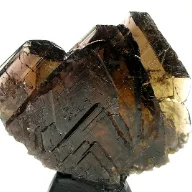 Axinite
Clove-brown wedges of a boron silicate, sharp enough to be named for an axe.
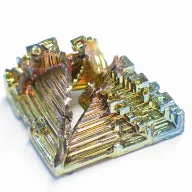 Bismuth
A metal that grows in rainbow staircases — in a saucepan, mostly.
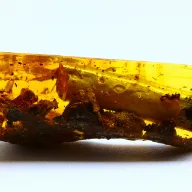 Amber
Not a stone at all: tree resin that leaked out forty million years ago and went hard.
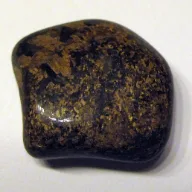 Bronzite
A dark pyroxene with a bronze sheen, from the same family the meteorites are full of.
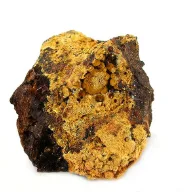 Cacoxenite
Golden needles in iron ore, named the bad guest because they ruined the smelt.
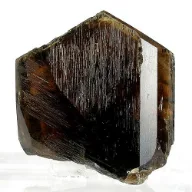 Chrysoberyl
The third hardest gem there is, no relation to beryl, and the only true cat's eye.
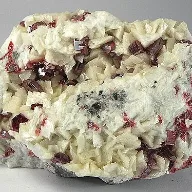 Cinnabar
Mercury ore, the red of every Chinese seal, and the most dangerous mineral in the cabinet.
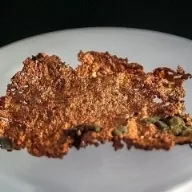 Copper
The first metal anyone ever worked, and one of the few that turns up ready to use.
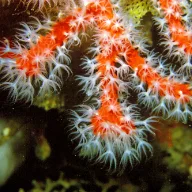 Red coral
The skeleton of a slow-growing animal, worn as a gem for five thousand years.
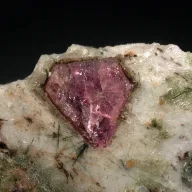 Eudialyte
Raspberry grains in grey Arctic rock, named for dissolving easily.
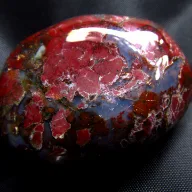 Jasper
Opaque chalcedony, stained by whatever the sediment happened to hold.
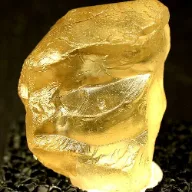 Golden labradorite
Bytownite: a calcium feldspar that cuts into clear champagne gold.
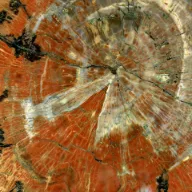 Petrified wood
A tree that became quartz cell by cell, and kept its grain.
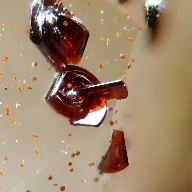 Lepidocrocite
The red half of rust, and the red flecks inside amethyst.
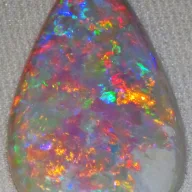 Opal
Water and silica in tiny stacked spheres, splitting light into colour.
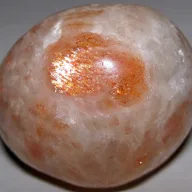 Sunstone
Feldspar full of metal flakes, throwing back the light in orange sparks.
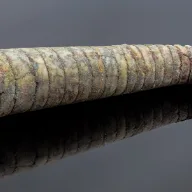 Orthoceras
A straight-shelled squid relative that died four hundred million years ago.
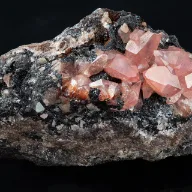 Rhodochrosite
Manganese carbonate in rose red, banded in caves and crystallised in mines.
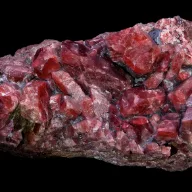 Rhodonite
Pink manganese silicate veined with the black oxide it turns into.
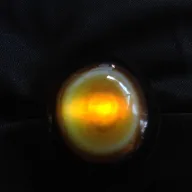 Sardonyx
Red-brown and white in straight bands, and the Roman world's seal stone.
 Scheelite
The tungsten ore that glows electric blue under a lamp in the dark.
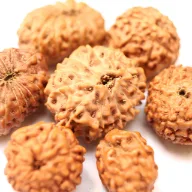 Rudraksha
The stone of a fruit, not of the ground, and the oldest prayer bead in India.
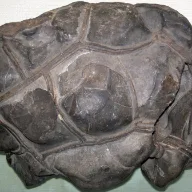 Septarian
A mud nodule that cracked from the inside and filled its own cracks with calcite.
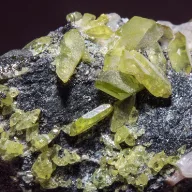 Sphene
Titanite, which throws more fire than a diamond and is far too soft to wear.
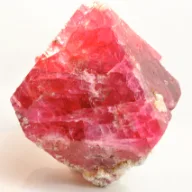 Spinel
Eight hundred years of crown jewels called it a ruby.
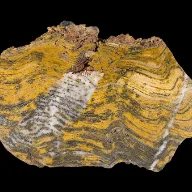 Stromatolite
Three and a half billion years of bacterial mats, turned to stone in layers.
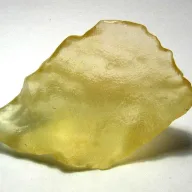 Libyan desert glass
Pale yellow glass lying loose in the Sahara, and a scarab in Tutankhamun's tomb cut from it.
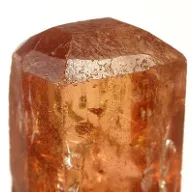 Topaz
Eight on the Mohs scale by definition, and it splits like slate if you hit it right.
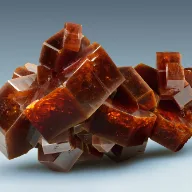 Vanadinite
Hexagonal barrels of orange-red lead vanadate, and the mineral vanadium was found in.
 Zircon
The oldest thing on earth is a grain of it, and no, it is not cubic zirconia.