 Lunarya
Fire
Fire is enthusiasm, appetite and self-assertion: the impulse that moves before it has all the information. It is warm, direct and tiring, generous with energy and careless with detail, and it needs something to burn — a project, an audience, an argument worth having.
Fire is the element of the will. Its three signs share a forward lean — they want, they start, they say so — and a warmth that draws people in and can scorch them. Aries is fire at its first spark, cardinal and headlong; Leo is fire held steady, a hearth that wants to be seen; Sagittarius is fire spread wide, a blaze that travels. What fire gives a chart is courage, optimism and the energy to begin; what it costs is patience, and the attention to see a thing through once it has stopped being exciting.
In short
- Signs
- Aries · Leo · Sagittarius
- Polarity
- Yang, outgoing
- Energy
- Projective
When it is strong
- Enthusiasm that outruns the plan
- Quick anger, quickly over
- Restless when nothing is happening
- Generous, and careless of detail
When it is missing
- Slow to start, and to believe in itself
- Energy that has to be summoned
- Warmth felt more easily than shown
- Drawn to people who have the spark
A chart's balance is counted from where the Sun, the Moon, the ascendant and the planets fall: an element or a modality with many of them is strong, one with none is missing. The lists are the tradition's rule of thumb, not a verdict.
The fire signs
Fire in stone
The stones the crystal books give to the element, whatever their sign. The element is also what makes a stone projective or receptive in magic.
 Aegirine
Black pyroxene needles from the strangest rocks on the planet.
Agni manitite
A black glass from Java, sold as a tektite; volcanic, as it turns out.
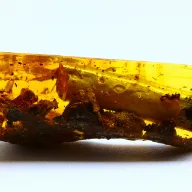 Amber
Not a stone at all: tree resin that leaked out forty million years ago and went hard.
 Bloodstone
Dark green chalcedony spotted with red, and one of the two birthstones of March.
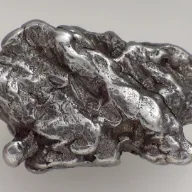 Campo del Cielo
An iron meteorite that fell on the Argentine Chaco four thousand years ago.
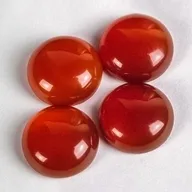 Carnelian
Orange chalcedony, and the stone hot wax will not stick to.
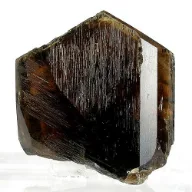 Chrysoberyl
The third hardest gem there is, no relation to beryl, and the only true cat's eye.
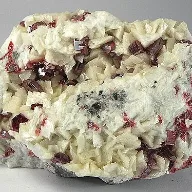 Cinnabar
Mercury ore, the red of every Chinese seal, and the most dangerous mineral in the cabinet.
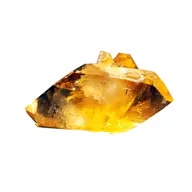 Citrine
Yellow quartz, except that most of it is amethyst that has been in an oven.
Columbianite
Colombian volcanic glass, sold as a tektite it is not.
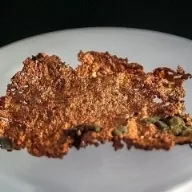 Copper
The first metal anyone ever worked, and one of the few that turns up ready to use.
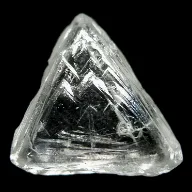 Diamond
Carbon, arranged the hard way, and carried up from two hundred kilometres down.
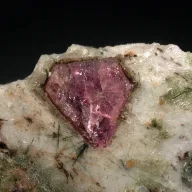 Eudialyte
Raspberry grains in grey Arctic rock, named for dissolving easily.
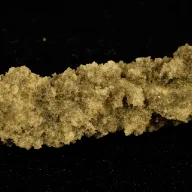 Fulgurite
Sand struck by lightning and fused, in a second, into hollow glass.
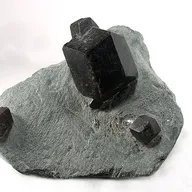 Garnet
Not one mineral but a whole family, and half of it ends up as sandpaper.
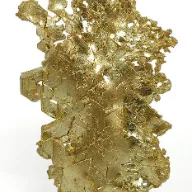 Gold
The one metal that comes out of the ground already finished.
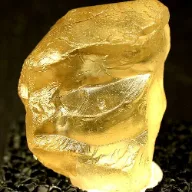 Golden labradorite
Bytownite: a calcium feldspar that cuts into clear champagne gold.
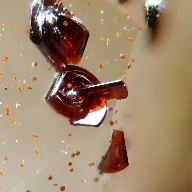 Lepidocrocite
The red half of rust, and the red flecks inside amethyst.
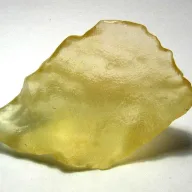 Libyan desert glass
Pale yellow glass lying loose in the Sahara, and a scarab in Tutankhamun's tomb cut from it.
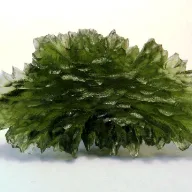 Moldavite
Bohemian glass made by an asteroid hitting Germany fifteen million years ago.
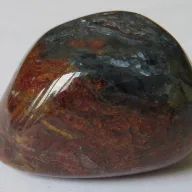 Pietersite
Tiger's eye smashed and cemented back together, so the light swirls.
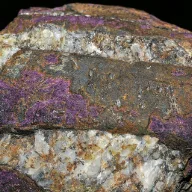 Purpurite
A pegmatite phosphate that rusted purple instead of brown.
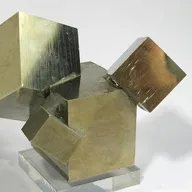 Pyrite
Fool's gold, in cubes so sharp they look machined.
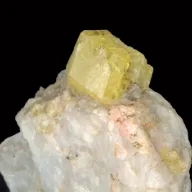 Rhodizite
A caesium borate as hard as topaz, and about as rare as minerals get.
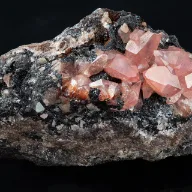 Rhodochrosite
Manganese carbonate in rose red, banded in caves and crystallised in mines.
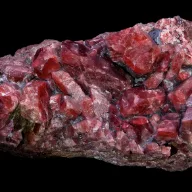 Rhodonite
Pink manganese silicate veined with the black oxide it turns into.
 Ruby
Corundum with chromium in it, and for centuries the most expensive stone on earth.
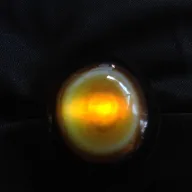 Sardonyx
Red-brown and white in straight bands, and the Roman world's seal stone.
 Scheelite
The tungsten ore that glows electric blue under a lamp in the dark.
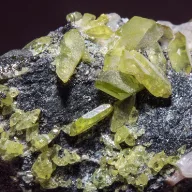 Sphene
Titanite, which throws more fire than a diamond and is far too soft to wear.
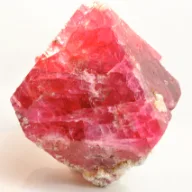 Spinel
Eight hundred years of crown jewels called it a ruby.
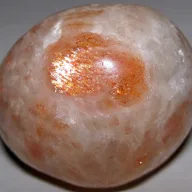 Sunstone
Feldspar full of metal flakes, throwing back the light in orange sparks.
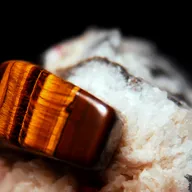 Tiger's eye
A stripe of light that slides across the stone when you tilt it.
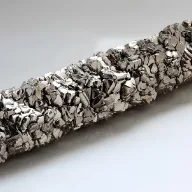 Titanium
The ninth commonest element in the crust, and almost never found as a metal.
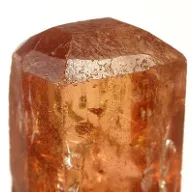 Topaz
Eight on the Mohs scale by definition, and it splits like slate if you hit it right.
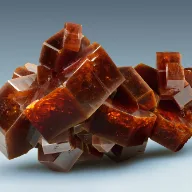 Vanadinite
Hexagonal barrels of orange-red lead vanadate, and the mineral vanadium was found in.
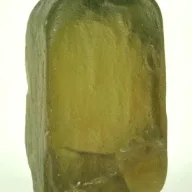 Zircon
The oldest thing on earth is a grain of it, and no, it is not cubic zirconia.