 Lunarya
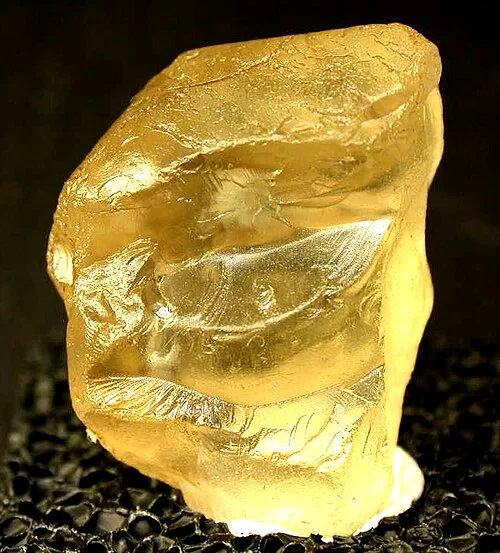
Golden labradorite
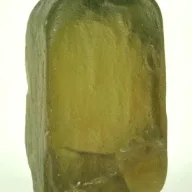
Golden labradorite is the gem trade name for bytownite, a plagioclase feldspar lying between labradorite and anorthite on the calcium-rich side of the series: (Ca,Na)(Si,Al)₄O₈. Facet-quality material is transparent and coloured a champagne to deep honey gold by a trace of iron. It has none of the blue flash that labradorite is famous for, which makes the trade name confusing, and it is one of the cleanest gems a cutter ever gets to work with.
The name is a misnomer twice over. Most faceted golden labradorite is bytownite by composition, not labradorite; and bytownite itself was named for Bytown, the old name of Ottawa, after a rock from there that later analysis showed was not bytownite. Hardness 6 to 6.5 with two good cleavages meeting at a right angle, so it needs a careful hand at the wheel and a protective setting afterwards. Oregon material that carries copper platelets shows aventurescence and belongs with sunstone rather than here.
In short
- Colour
- Red, orange and gold
- Mineral
- Feldspar
- Formula
- (Ca,Na)(Si,Al)₄O₈
- Hardness
- 6–6.5 on the Mohs scale
- Crystal system
- Triclinic
- Found in
- Chihuahua in Mexico supplies most facet rough. Oregon in the United States produces both gem bytownite and the copper-bearing sunstone; other sources are India, Scotland on the Isle of Rùm, Canada, and Ethiopia.
- Element
- Fire
- Planet
- Jupiter
- Chakra
- Solar plexus
- Handling
- Water and light are both fine
How it forms
Calcium-rich plagioclase crystallises early and hot from basaltic magma, which makes bytownite a rock-forming mineral of gabbro, norite and anorthosite. The clear gem crystals grew as phenocrysts in a lava flow — large crystals already formed when the lava erupted, carried along in it, and released one by one as the basalt weathers away. That is why the rough arrives as loose crystals in soil rather than in a vein.
In human hands
Thomas Thomson named bytownite in 1835. As a gem it is recent: Mexican rough appeared in quantity in the 1990s, and the crystal trade renamed it golden labradorite and filed it with the solar plexus stones, where it has stayed. Cut stones remain inexpensive for their size and clarity, largely because the feldspars have never carried the prestige of the beryls and corundums.
Varieties and trade names
- Mexican golden labradorite
- Chihuahua rough, champagne to honey, clean enough for stones of ten carats and more.
- Oregon sunstone
- Labradorite with copper platelets, which glitters and can be red or green; a different stone.
- Labradorite
- The sodium-richer member with the blue and green flash, which has a page of its own here.
- Anorthite
- The calcium end member, white to grey and rarely transparent; the far end of the same series.
- Rough bytownite
- Uncut crystals with weathered faces, sold as specimens and as cutting material.
Telling it from a fake
The cleavage is the test: two flat directions meeting at a right angle, visible as a step on any broken edge. Citrine is quartz, harder, and has no cleavage at all. Golden beryl and heliodor are harder and hexagonal. Topaz has one perfect cleavage, is much heavier, and feels cold. Glass has no cleavage, often shows bubbles or swirl, and warms quickly in the hand. Golden labradorite is also noticeably light for its size.
None of this needs a laboratory, and none of it is proof. A shop that will not say whether a stone is treated has answered the question; ask, and have the answer written on the receipt.
What it is said to do
Read as a solar plexus stone: confidence, warmth, the will to act, and a reputation for the kind of honesty that comes from not being anxious. It is given to Jupiter, to Leo and Sagittarius. The colour does most of the arguing, as it usually does with gold-coloured stones, and the reading is modern, dating from when the Mexican material arrived.
Living with it
Cleaves, so protect the corners of a cut stone, avoid ultrasonic and steam cleaning, and do not subject it to sudden changes in temperature. Water and sunlight are harmless. A pendant or earrings will outlast a ring, and warm soapy water with a soft cloth is all the cleaning it needs.
In magic
A modern solar stone, used in workings for confidence and for the will to act: carried to an audition or a first day, set beside a yellow candle on a Sunday. Nothing older is attached to it, and the books that use it borrow the Sun's general correspondences. Water and light do it no harm, but it cleaves, so it is a stone for the hand rather than the bottom of a ritual bag.
- Energy
- Projective
- Day
- Thursday
- Worked for
- Courage and drive
More of this colour
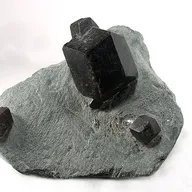 Garnet
Not one mineral but a whole family, and half of it ends up as sandpaper.
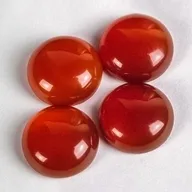 Carnelian
Orange chalcedony, and the stone hot wax will not stick to.
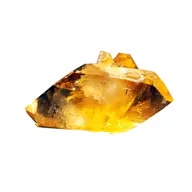 Citrine
Yellow quartz, except that most of it is amethyst that has been in an oven.
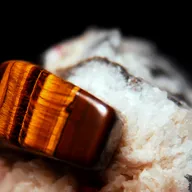 Tiger's eye
A stripe of light that slides across the stone when you tilt it.
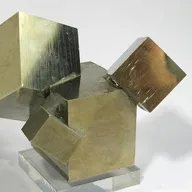 Pyrite
Fool's gold, in cubes so sharp they look machined.
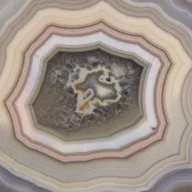 Agate
Chalcedony laid down in bands, one over the next, inside a bubble in old lava.
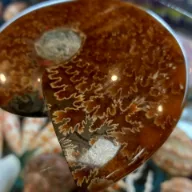 Ammonite
A shell that spiralled through the seas for three hundred million years, turned to stone.
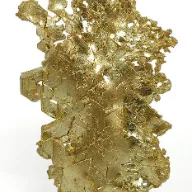 Gold
The one metal that comes out of the ground already finished.
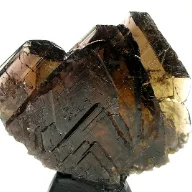 Axinite
Clove-brown wedges of a boron silicate, sharp enough to be named for an axe.
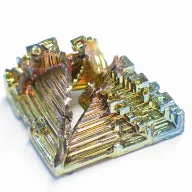 Bismuth
A metal that grows in rainbow staircases — in a saucepan, mostly.
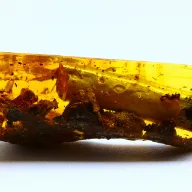 Amber
Not a stone at all: tree resin that leaked out forty million years ago and went hard.
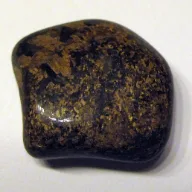 Bronzite
A dark pyroxene with a bronze sheen, from the same family the meteorites are full of.
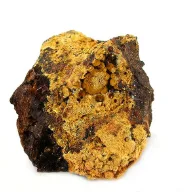 Cacoxenite
Golden needles in iron ore, named the bad guest because they ruined the smelt.
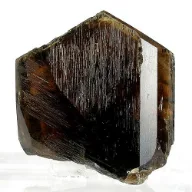 Chrysoberyl
The third hardest gem there is, no relation to beryl, and the only true cat's eye.
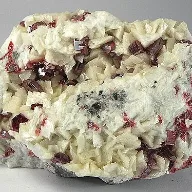 Cinnabar
Mercury ore, the red of every Chinese seal, and the most dangerous mineral in the cabinet.
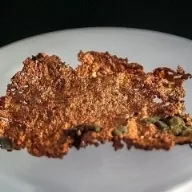 Copper
The first metal anyone ever worked, and one of the few that turns up ready to use.
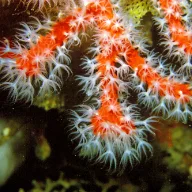 Red coral
The skeleton of a slow-growing animal, worn as a gem for five thousand years.
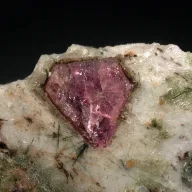 Eudialyte
Raspberry grains in grey Arctic rock, named for dissolving easily.
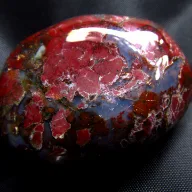 Jasper
Opaque chalcedony, stained by whatever the sediment happened to hold.
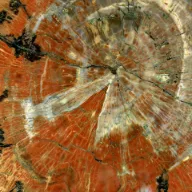 Petrified wood
A tree that became quartz cell by cell, and kept its grain.
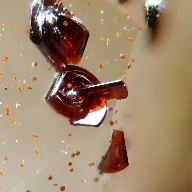 Lepidocrocite
The red half of rust, and the red flecks inside amethyst.
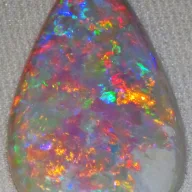 Opal
Water and silica in tiny stacked spheres, splitting light into colour.
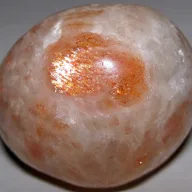 Sunstone
Feldspar full of metal flakes, throwing back the light in orange sparks.
 Orthoceras
A straight-shelled squid relative that died four hundred million years ago.
 Rhodochrosite
Manganese carbonate in rose red, banded in caves and crystallised in mines.
 Rhodonite
Pink manganese silicate veined with the black oxide it turns into.
 Ruby
Corundum with chromium in it, and for centuries the most expensive stone on earth.
 Sardonyx
Red-brown and white in straight bands, and the Roman world's seal stone.
 Scheelite
The tungsten ore that glows electric blue under a lamp in the dark.
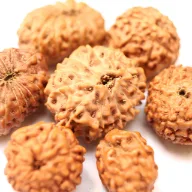 Rudraksha
The stone of a fruit, not of the ground, and the oldest prayer bead in India.
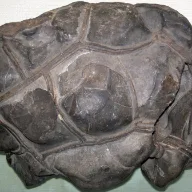 Septarian
A mud nodule that cracked from the inside and filled its own cracks with calcite.
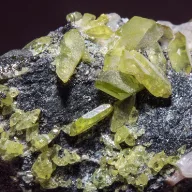 Sphene
Titanite, which throws more fire than a diamond and is far too soft to wear.
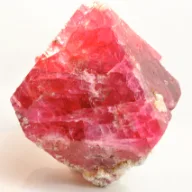 Spinel
Eight hundred years of crown jewels called it a ruby.
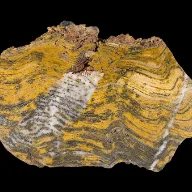 Stromatolite
Three and a half billion years of bacterial mats, turned to stone in layers.
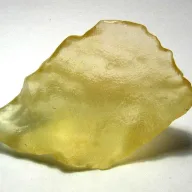 Libyan desert glass
Pale yellow glass lying loose in the Sahara, and a scarab in Tutankhamun's tomb cut from it.
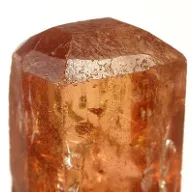 Topaz
Eight on the Mohs scale by definition, and it splits like slate if you hit it right.
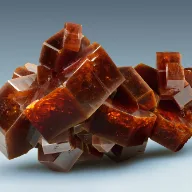 Vanadinite
Hexagonal barrels of orange-red lead vanadate, and the mineral vanadium was found in.
 Zircon
The oldest thing on earth is a grain of it, and no, it is not cubic zirconia.