 Lunarya
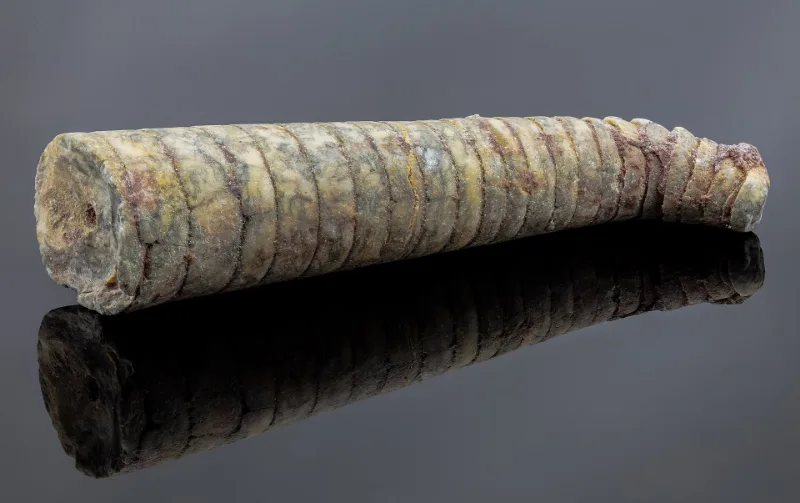
Orthoceras
An orthoceras is the fossilised shell of a nautiloid cephalopod — a relative of the modern nautilus, squid and octopus — that lived in a straight cone instead of a coiled one. The animal occupied the wide end; behind it the shell was divided into gas-filled chambers by curved walls, joined by a tube that let it adjust its buoyancy. Those chambers are what a polished specimen shows, a row of chevrons running the length of the cone.
The name deserves a caveat. Orthoceras proper is a genus from Ordovician rocks in the Baltic, and most of the fossils sold under the name, including nearly all the Moroccan ones, belong to other orthocerid genera that are only distantly related. The trade uses the word the way it uses jade: as a shape rather than a species. The shell is calcium carbonate, replaced and recrystallised in the ground, which makes it soft — 3 to 4 — and much softer than the dark limestone it usually sits in.
In short
- Colour
- Red, orange and gold
- Mineral
- A fossil, not a mineral
- Formula
- CaCO₃
- Hardness
- 3–4 on the Mohs scale
- Crystal system
- None — it is a fossil
- Found in
- The Anti-Atlas around Erfoud and Rissani in Morocco supplies almost everything sold, from Devonian limestone. Orthocerid fossils also occur in Sweden and Estonia, in Baltic Ordovician limestone quarried as a building stone, and in China, the Czech Republic and North America.
- Element
- Earth
- Planet
- Saturn
- Chakra
- Root
- Handling
- Water and light are both fine
How it forms
The animals died and sank, and their shells settled on a muddy sea floor that was quiet enough not to break them up. Sediment filled the chambers, calcite crystallised inside, and the shell and its filling were buried and lithified together. Because the chamber fill is often a different colour and texture from the shell wall, cutting and polishing the rock reveals the internal architecture of an animal whose kind has been extinct for two hundred million years.
In human hands
The Moroccan trade is modern and substantial: whole villages in the Erfoud area quarry, cut and polish the fossiliferous limestone into plates, table tops, sinks, bookends and clock faces, and it is a significant local industry. Baltic orthoceras limestone has been a building and paving stone in Sweden and Estonia since the Middle Ages, and a Stockholm pavement will often have a fossil in it. Fossil sales are regulated in Morocco, and reconstruction of damaged specimens is common.
Varieties and trade names
- Polished plates
- Slabs of limestone cut through several shells and polished, so the chambers show in section; the commonest form.
- Free-standing cones
- Individual shells prepared out of the rock and stood on end; usually partly reconstructed.
- Orthoceras limestone
- The Baltic building stone, grey-red and full of sections, used across Sweden and Estonia for eight centuries.
- Ammonite
- The coiled cousin, from much later in the same story; it has a page of its own here.
- Composite and carved pieces
- Sinks, tables and eggs made from fossil-bearing stone, often with the fossils enhanced or added.
Telling it from a fake
The chambers should be irregular in a way nothing manufactured manages: the spacing changes along the shell, the walls curve, and the siphuncle tube shows as a line off centre. Carved imitations have evenly spaced straight partitions. Resin casts are light and warm. Restoration is not fraud if it is declared, but on a polished plate look for paint following the outline of a shell, and for chambers that end where the slab does rather than running out of the rock.
None of this needs a laboratory, and none of it is proof. A shop that will not say whether a stone is treated has answered the question; ask, and have the answer written on the receipt.
What it is said to do
The reading is the obvious one and it is reasonable: the long view, ancestry, seeing where one comes from, and the patience of something that lay in mud for four hundred million years. It is given to Saturn, to Capricorn and Scorpio, and to the root. Nothing older exists, since nobody knew what these were until the nineteenth century.
Living with it
The fossil is calcite and soft, so a knife will mark it and vinegar or lemon will etch it. Keep it away from acids and from ultrasonic cleaners, dust it with a soft brush, and wipe with a barely damp cloth. Polished plates are generally waxed or resin-finished; hot water will dull that finish.
In magic
Orthoceras plates are used in modern practice for ancestor work and for the long view: set on an altar for the dead, held while tracing a family tree, or placed under a candle in workings for patience. There is no older magic behind them, but few objects say 'long ago' as plainly as a creature four hundred million years dead. Keep salt and vinegar away from the calcite.
- Energy
- Receptive
- Day
- Saturday
- Worked for
- Grounding and endurance
More of this colour
 Garnet
Not one mineral but a whole family, and half of it ends up as sandpaper.
 Carnelian
Orange chalcedony, and the stone hot wax will not stick to.
 Citrine
Yellow quartz, except that most of it is amethyst that has been in an oven.
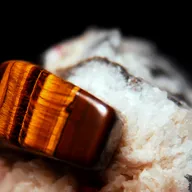 Tiger's eye
A stripe of light that slides across the stone when you tilt it.
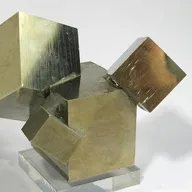 Pyrite
Fool's gold, in cubes so sharp they look machined.
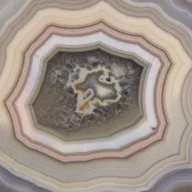 Agate
Chalcedony laid down in bands, one over the next, inside a bubble in old lava.
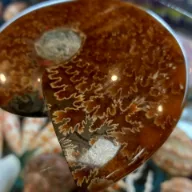 Ammonite
A shell that spiralled through the seas for three hundred million years, turned to stone.
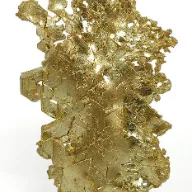 Gold
The one metal that comes out of the ground already finished.
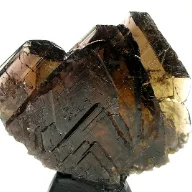 Axinite
Clove-brown wedges of a boron silicate, sharp enough to be named for an axe.
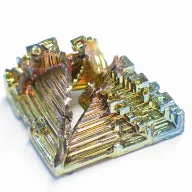 Bismuth
A metal that grows in rainbow staircases — in a saucepan, mostly.
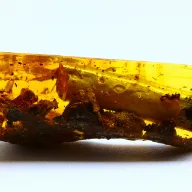 Amber
Not a stone at all: tree resin that leaked out forty million years ago and went hard.
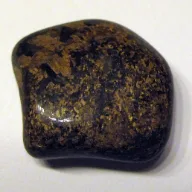 Bronzite
A dark pyroxene with a bronze sheen, from the same family the meteorites are full of.
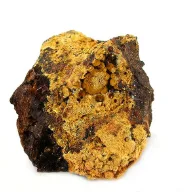 Cacoxenite
Golden needles in iron ore, named the bad guest because they ruined the smelt.
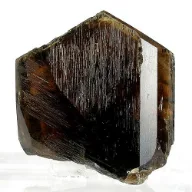 Chrysoberyl
The third hardest gem there is, no relation to beryl, and the only true cat's eye.
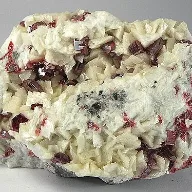 Cinnabar
Mercury ore, the red of every Chinese seal, and the most dangerous mineral in the cabinet.
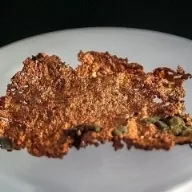 Copper
The first metal anyone ever worked, and one of the few that turns up ready to use.
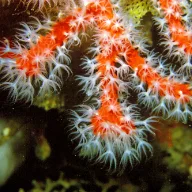 Red coral
The skeleton of a slow-growing animal, worn as a gem for five thousand years.
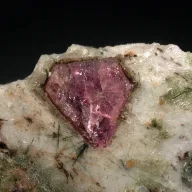 Eudialyte
Raspberry grains in grey Arctic rock, named for dissolving easily.
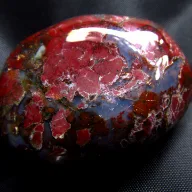 Jasper
Opaque chalcedony, stained by whatever the sediment happened to hold.
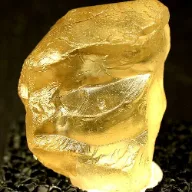 Golden labradorite
Bytownite: a calcium feldspar that cuts into clear champagne gold.
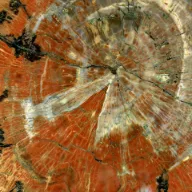 Petrified wood
A tree that became quartz cell by cell, and kept its grain.
 Lepidocrocite
The red half of rust, and the red flecks inside amethyst.
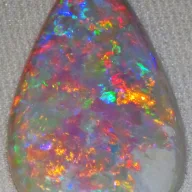 Opal
Water and silica in tiny stacked spheres, splitting light into colour.
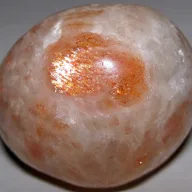 Sunstone
Feldspar full of metal flakes, throwing back the light in orange sparks.
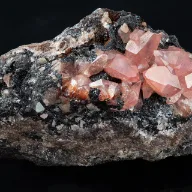 Rhodochrosite
Manganese carbonate in rose red, banded in caves and crystallised in mines.
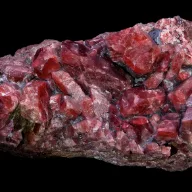 Rhodonite
Pink manganese silicate veined with the black oxide it turns into.
 Ruby
Corundum with chromium in it, and for centuries the most expensive stone on earth.
 Sardonyx
Red-brown and white in straight bands, and the Roman world's seal stone.
 Scheelite
The tungsten ore that glows electric blue under a lamp in the dark.
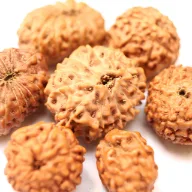 Rudraksha
The stone of a fruit, not of the ground, and the oldest prayer bead in India.
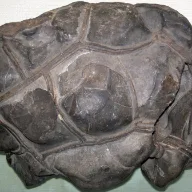 Septarian
A mud nodule that cracked from the inside and filled its own cracks with calcite.
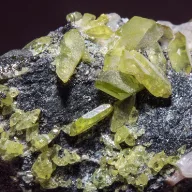 Sphene
Titanite, which throws more fire than a diamond and is far too soft to wear.
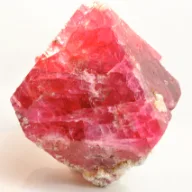 Spinel
Eight hundred years of crown jewels called it a ruby.
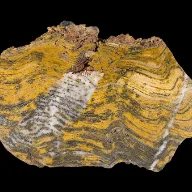 Stromatolite
Three and a half billion years of bacterial mats, turned to stone in layers.
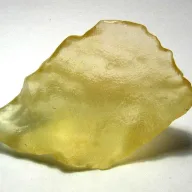 Libyan desert glass
Pale yellow glass lying loose in the Sahara, and a scarab in Tutankhamun's tomb cut from it.
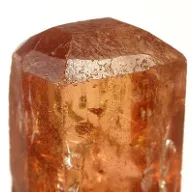 Topaz
Eight on the Mohs scale by definition, and it splits like slate if you hit it right.
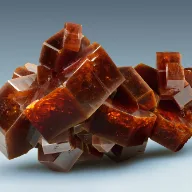 Vanadinite
Hexagonal barrels of orange-red lead vanadate, and the mineral vanadium was found in.
 Zircon
The oldest thing on earth is a grain of it, and no, it is not cubic zirconia.