 Lunarya
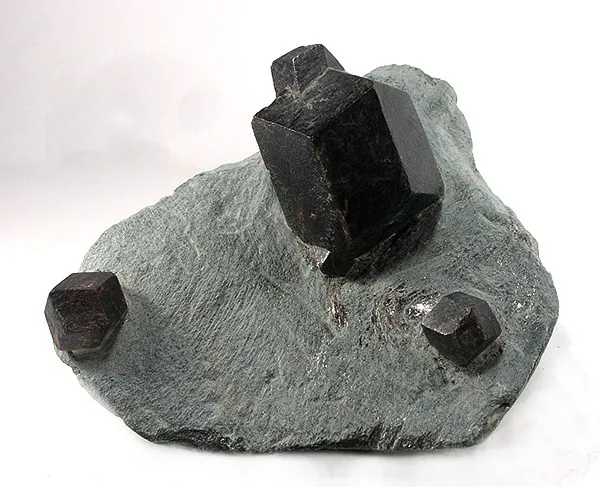
Garnet
Garnet is a group rather than a species: almandine, pyrope, spessartine, grossular and andradite all share the same cubic structure with different metals swapped into it, and they run from the familiar deep red through orange and green to colourless. The red ones owe their colour to iron and chromium.
The name comes from the Latin granatum, pomegranate, for the colour and the way crystals sit clustered in their rock. Bohemian pyrope was mined and cut by the thousand in the nineteenth century and set into the dense, dark red jewellery that still turns up in antique shops. Most garnet mined today never gets near a jeweller: it is crushed for abrasive paper and for waterjet cutting, which is a strange second career for January's birthstone.
In short
- Colour
- Red, orange and gold
- Mineral
- Silicate
- Formula
- Fe₃Al₂(SiO₄)₃
- Hardness
- 6.5–7.5 on the Mohs scale
- Crystal system
- Cubic
- Found in
- India, Brazil, Madagascar, Czechia and Tanzania.
- Birthstone of
- January
- Element
- Fire
- Planet
- Mars
- Chakra
- Root
- Handling
- Water and light are both fine
How it forms
Garnet is a family rather than a mineral: six common species share one structure and mix freely, and the dark red one on this page, almandine, is the iron member. It grows in metamorphic rock, when a mudstone buried deep enough is squeezed and heated into schist; the garnet crystallises in rounded dodecahedra that the rest of the rock wraps itself around, and geologists use its appearance to read how deep the rock went. Pyrope, the magnesium member, comes up from the mantle with diamonds and is what prospectors look for. Garnet outlasts the rocks it grows in, so most gem garnet is picked out of river gravel and beach sand.
In human hands
The name is from the pomegranate, for the seeds, and the stone has been worn since the Bronze Age. Its great period was the Dark Ages: the goldsmiths of the Anglo-Saxons and Merovingians set thousands of thin garnet slices, cut from stones brought from India and Sri Lanka, into gold cells over patterned foil, and the purses and sword fittings of Sutton Hoo and the Staffordshire Hoard are the result. Bohemian pyrope filled the jewellery boxes of the eighteenth and nineteenth centuries. Most garnet mined today is crushed for sandpaper and water-jet cutting, and January has it for its birthstone.
Varieties and trade names
- Pyrope
- The magnesium garnet, blood-red with a trace of chromium; the Bohemian garnet of Victorian jewellery and the indicator mineral of diamond country.
- Almandine
- The iron garnet and much the commonest: deep red to brownish red, the garnet of schists, of most garnet sand on earth, and of garnet abrasive paper.
- Spessartine
- The manganese garnet, in orange; the bright mandarin garnets of Namibia and Nigeria are this.
- Grossular
- The calcium aluminium garnet, which comes in nearly every colour but red — green, cinnamon, white, pink; tsavorite and hessonite are both grossular.
- Hessonite
- Cinnamon to honey-orange grossular, full of swirling inclusions jewellers call treacle; the gomedha of Indian astrology, worn for Rahu.
- Melanite
- Black andradite, glossy and opaque, coloured by titanium; carved in the nineteenth century for mourning jewellery alongside jet.
- Rhodolite
- A raspberry-coloured mix of pyrope and almandine, named in 1898 in North Carolina, and the garnet most often faceted today.
- Tsavorite and demantoid
- The green garnets: tsavorite is grossular from Kenya and Tanzania, demantoid is andradite from the Urals with horsetail inclusions, and both cost more than most emeralds.
Telling it from a fake
Garnet is singly refractive like glass, so the usual tricks do not separate them, but it is much denser, so a stone that feels light for its size is suspect, and almandine and spessartine are faintly magnetic: a strong neodymium magnet will drag a loose garnet across a smooth surface and leave glass alone. Victorian garnet-topped doublets fused a thin slice of garnet onto coloured glass, and the join shows under a loupe as a line around the girdle. Garnet is almost never heated or treated, which is rare among gems: what you see is what grew.
None of this needs a laboratory, and none of it is proof. A shop that will not say whether a stone is treated has answered the question; ask, and have the answer written on the receipt.
What it is said to do
A stone of drive and endurance, given for the long middle of things rather than the start: the classical sources make it a travelling companion and a protector on the road, and it has kept its reputation for loyalty and for stubborn energy.
Living with it
Hard, tough and dependable — garnet takes daily wear, soap and water without trouble. Traditionally worn where it can be seen rather than kept in a drawer.
In magic
Garnet is the traveller's stone of the old magic: the medieval lapidaries promised it would keep its wearer safe on the road, and it was a stone of loyalty, said to be given to someone leaving so that they would come back. Modern practice keeps both, putting garnet in protection bags for journeys and in workings for faithfulness, and adds courage for a long effort. The carbuncle that glowed in the dark in medieval stories was, as often as not, a red garnet.
- Energy
- Projective
- Day
- Tuesday
- Worked for
- Protection · Courage and drive · Love and friendship
More of this colour
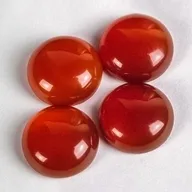 Carnelian
Orange chalcedony, and the stone hot wax will not stick to.
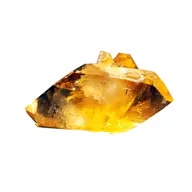 Citrine
Yellow quartz, except that most of it is amethyst that has been in an oven.
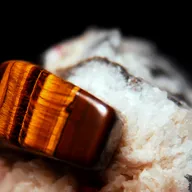 Tiger's eye
A stripe of light that slides across the stone when you tilt it.
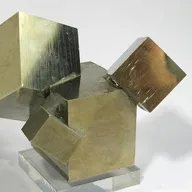 Pyrite
Fool's gold, in cubes so sharp they look machined.
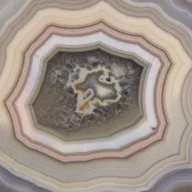 Agate
Chalcedony laid down in bands, one over the next, inside a bubble in old lava.
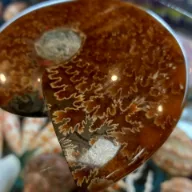 Ammonite
A shell that spiralled through the seas for three hundred million years, turned to stone.
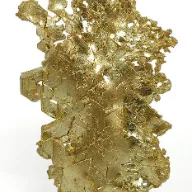 Gold
The one metal that comes out of the ground already finished.
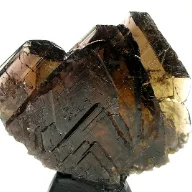 Axinite
Clove-brown wedges of a boron silicate, sharp enough to be named for an axe.
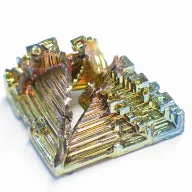 Bismuth
A metal that grows in rainbow staircases — in a saucepan, mostly.
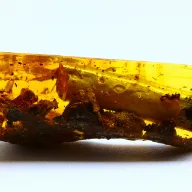 Amber
Not a stone at all: tree resin that leaked out forty million years ago and went hard.
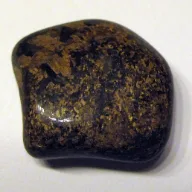 Bronzite
A dark pyroxene with a bronze sheen, from the same family the meteorites are full of.
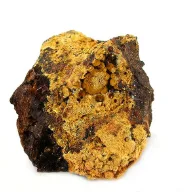 Cacoxenite
Golden needles in iron ore, named the bad guest because they ruined the smelt.
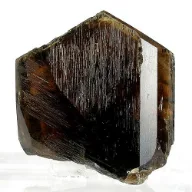 Chrysoberyl
The third hardest gem there is, no relation to beryl, and the only true cat's eye.
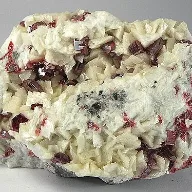 Cinnabar
Mercury ore, the red of every Chinese seal, and the most dangerous mineral in the cabinet.
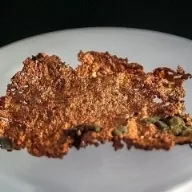 Copper
The first metal anyone ever worked, and one of the few that turns up ready to use.
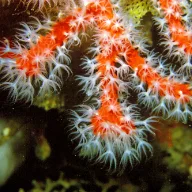 Red coral
The skeleton of a slow-growing animal, worn as a gem for five thousand years.
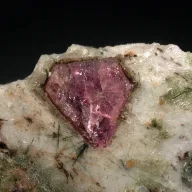 Eudialyte
Raspberry grains in grey Arctic rock, named for dissolving easily.
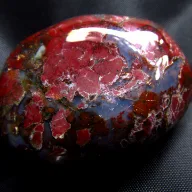 Jasper
Opaque chalcedony, stained by whatever the sediment happened to hold.
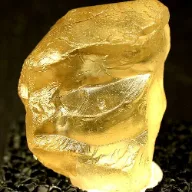 Golden labradorite
Bytownite: a calcium feldspar that cuts into clear champagne gold.
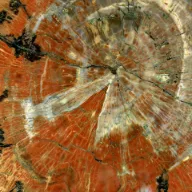 Petrified wood
A tree that became quartz cell by cell, and kept its grain.
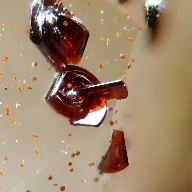 Lepidocrocite
The red half of rust, and the red flecks inside amethyst.
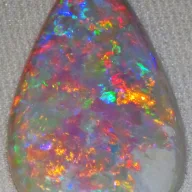 Opal
Water and silica in tiny stacked spheres, splitting light into colour.
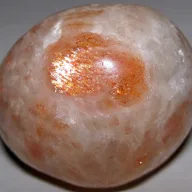 Sunstone
Feldspar full of metal flakes, throwing back the light in orange sparks.
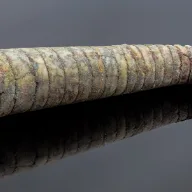 Orthoceras
A straight-shelled squid relative that died four hundred million years ago.
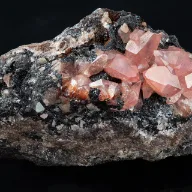 Rhodochrosite
Manganese carbonate in rose red, banded in caves and crystallised in mines.
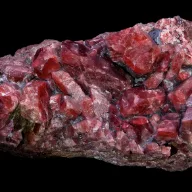 Rhodonite
Pink manganese silicate veined with the black oxide it turns into.
 Ruby
Corundum with chromium in it, and for centuries the most expensive stone on earth.
 Sardonyx
Red-brown and white in straight bands, and the Roman world's seal stone.
 Scheelite
The tungsten ore that glows electric blue under a lamp in the dark.
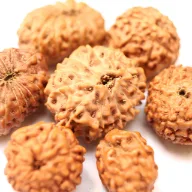 Rudraksha
The stone of a fruit, not of the ground, and the oldest prayer bead in India.
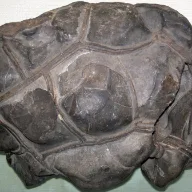 Septarian
A mud nodule that cracked from the inside and filled its own cracks with calcite.
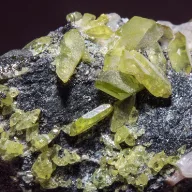 Sphene
Titanite, which throws more fire than a diamond and is far too soft to wear.
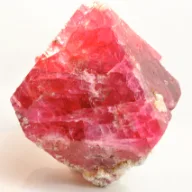 Spinel
Eight hundred years of crown jewels called it a ruby.
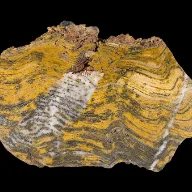 Stromatolite
Three and a half billion years of bacterial mats, turned to stone in layers.
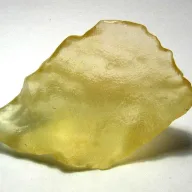 Libyan desert glass
Pale yellow glass lying loose in the Sahara, and a scarab in Tutankhamun's tomb cut from it.
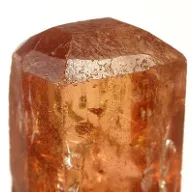 Topaz
Eight on the Mohs scale by definition, and it splits like slate if you hit it right.
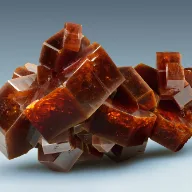 Vanadinite
Hexagonal barrels of orange-red lead vanadate, and the mineral vanadium was found in.
 Zircon
The oldest thing on earth is a grain of it, and no, it is not cubic zirconia.