 Lunarya
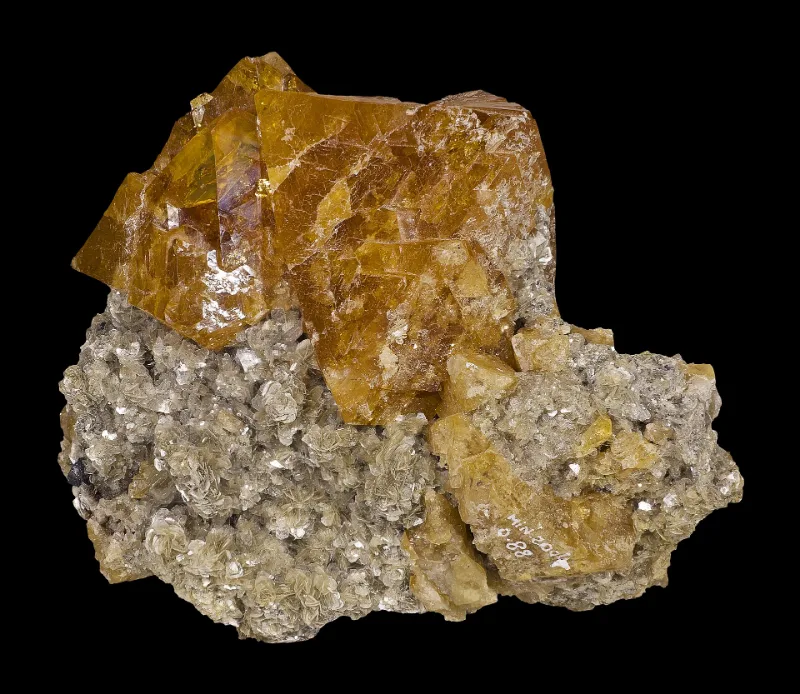
Scheelite
Scheelite is calcium tungstate, CaWO₄, and it is the reason anybody has tungsten. It grows as pale orange, honey, cream and brown crystals shaped like blunt double pyramids, is soft for an ore mineral at 4.5 to 5, and is surprisingly heavy — about six times the weight of water, which is the first thing a prospector notices about it.
The second thing is the fluorescence. Under shortwave ultraviolet, scheelite glows an intense blue-white, and the more molybdenum it contains the yellower the glow. Prospectors have worked tungsten ground at night with ultraviolet lamps since the 1930s, walking over outcrops and watching for the flare. The mineral is named after Carl Wilhelm Scheele, who in 1781 showed that the heavy stone the Swedes called tung sten contained a new acid, from which tungsten metal was later isolated.
In short
- Colour
- Red, orange and gold
- Mineral
- Tungstate
- Formula
- CaWO₄
- Hardness
- 4.5–5 on the Mohs scale
- Crystal system
- Tetragonal
- Found in
- China dominates world production. Other significant deposits are Sangdong in South Korea, Mittersill in Austria, Panasqueira in Portugal, Cantung in Canada, Bolivia, Peru and the Erzgebirge. Fine crystals come from China, Korea, Japan, Brazil and Mexico.
- Element
- Fire
- Planet
- The Sun
- Chakra
- Solar plexus
- Handling
- Water and light are both fine
How it forms
Scheelite forms where a granite meets limestone and cooks it: in contact skarns, alongside garnet, diopside, vesuvianite and fluorite. It also grows in high-temperature quartz veins and in some greisens. Tungsten is an incompatible element that stays in the melt until late, so it ends up in the fluids a cooling granite sheds, and scheelite is where it settles when those fluids hit calcium-bearing rock.
In human hands
Tungsten made scheelite strategic. Tungsten carbide cutting tools, armour-piercing cores and the filaments of every incandescent bulb of the twentieth century all depended on it, and control of tungsten supply mattered enough in both world wars to reshape the economies of Portugal and Spain. As a gem it is marginal: cut scheelite has nearly the fire of diamond and less hardness than window glass, so it is bought by collectors and almost never worn.
Varieties and trade names
- Gem scheelite
- Transparent orange to yellow faceted stones, dazzling and far too soft to wear; a collector's stone.
- Fluorescent specimens
- Crystals sold to be looked at under a lamp; the blue-white glow is as bright as the mineral gets.
- Skarn scheelite
- Massive ore-grade material in garnet rock, grey and unremarkable until you turn a lamp on it.
- Powellite
- The molybdenum equivalent, which glows yellow; the two form a series and mixed crystals glow in between.
- Wolframite
- The other tungsten ore, black and heavy and not fluorescent; the two are mined together.
Telling it from a fake
An ultraviolet lamp is decisive: a blue-white flare under shortwave is scheelite and almost nothing else. Weight helps too, since it is far heavier than a quartz or calcite crystal of the same size. The crystal shape — blunt pyramidal, with a square cross-section — is distinctive. Fluorite is lighter, cleaves into octahedra and glows violet-blue; barite is heavy but cleaves in three directions and is softer.
None of this needs a laboratory, and none of it is proof. A shop that will not say whether a stone is treated has answered the question; ask, and have the answer written on the receipt.
What it is said to do
A recent and rather literal reading: light appearing where nothing was visible, attention, and value that has to be looked for in the right conditions. It is given to the Sun, to Leo and Aries, and to the solar plexus. The fluorescence is doing all the work here, and it is a fair enough image for a stone that a prospector finds by walking over it in the dark.
Living with it
Soft and cleavable, so it scratches and chips easily; keep it away from harder stones and out of pockets. Water is harmless but ultrasonic cleaners are not. If you are using a shortwave ultraviolet lamp to look at it, wear eye protection and keep it off your skin — shortwave is the part of the spectrum that burns.
In magic
Scheelite has no magical tradition. The few practitioners who use it borrow its real trick, the blue-white glow under shortwave ultraviolet, for workings of finding: lost things, the answer in a muddle, a nerve that was there all along. As an image it is a good one. As a practice it involves an ultraviolet lamp, which needs more care than the stone does.
- Energy
- Projective
- Day
- Sunday
- Worked for
- Study and clear thinking
More of this colour
 Garnet
Not one mineral but a whole family, and half of it ends up as sandpaper.
 Carnelian
Orange chalcedony, and the stone hot wax will not stick to.
 Citrine
Yellow quartz, except that most of it is amethyst that has been in an oven.
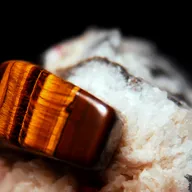 Tiger's eye
A stripe of light that slides across the stone when you tilt it.
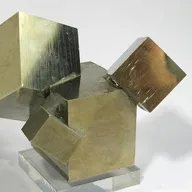 Pyrite
Fool's gold, in cubes so sharp they look machined.
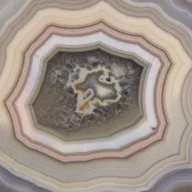 Agate
Chalcedony laid down in bands, one over the next, inside a bubble in old lava.
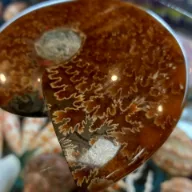 Ammonite
A shell that spiralled through the seas for three hundred million years, turned to stone.
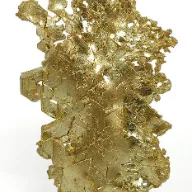 Gold
The one metal that comes out of the ground already finished.
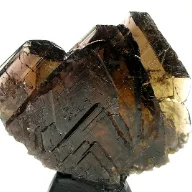 Axinite
Clove-brown wedges of a boron silicate, sharp enough to be named for an axe.
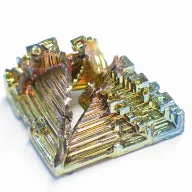 Bismuth
A metal that grows in rainbow staircases — in a saucepan, mostly.
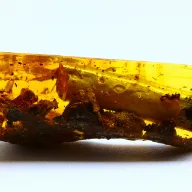 Amber
Not a stone at all: tree resin that leaked out forty million years ago and went hard.
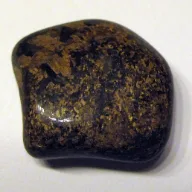 Bronzite
A dark pyroxene with a bronze sheen, from the same family the meteorites are full of.
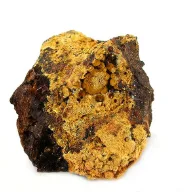 Cacoxenite
Golden needles in iron ore, named the bad guest because they ruined the smelt.
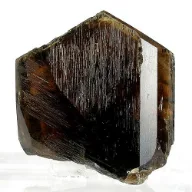 Chrysoberyl
The third hardest gem there is, no relation to beryl, and the only true cat's eye.
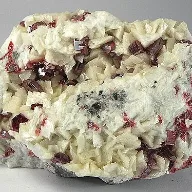 Cinnabar
Mercury ore, the red of every Chinese seal, and the most dangerous mineral in the cabinet.
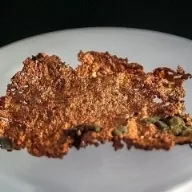 Copper
The first metal anyone ever worked, and one of the few that turns up ready to use.
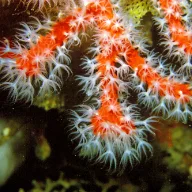 Red coral
The skeleton of a slow-growing animal, worn as a gem for five thousand years.
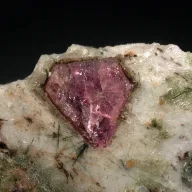 Eudialyte
Raspberry grains in grey Arctic rock, named for dissolving easily.
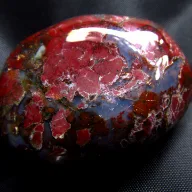 Jasper
Opaque chalcedony, stained by whatever the sediment happened to hold.
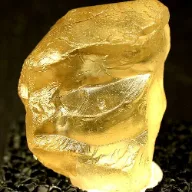 Golden labradorite
Bytownite: a calcium feldspar that cuts into clear champagne gold.
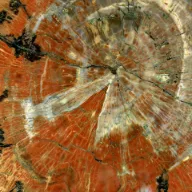 Petrified wood
A tree that became quartz cell by cell, and kept its grain.
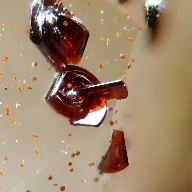 Lepidocrocite
The red half of rust, and the red flecks inside amethyst.
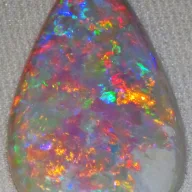 Opal
Water and silica in tiny stacked spheres, splitting light into colour.
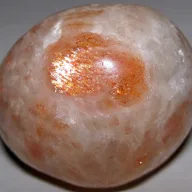 Sunstone
Feldspar full of metal flakes, throwing back the light in orange sparks.
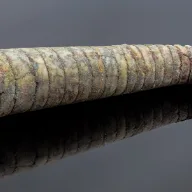 Orthoceras
A straight-shelled squid relative that died four hundred million years ago.
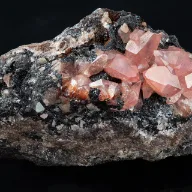 Rhodochrosite
Manganese carbonate in rose red, banded in caves and crystallised in mines.
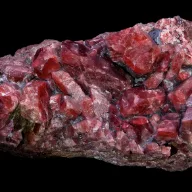 Rhodonite
Pink manganese silicate veined with the black oxide it turns into.
 Ruby
Corundum with chromium in it, and for centuries the most expensive stone on earth.
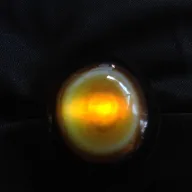 Sardonyx
Red-brown and white in straight bands, and the Roman world's seal stone.
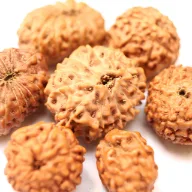 Rudraksha
The stone of a fruit, not of the ground, and the oldest prayer bead in India.
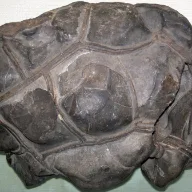 Septarian
A mud nodule that cracked from the inside and filled its own cracks with calcite.
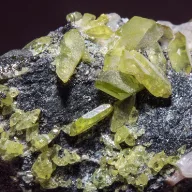 Sphene
Titanite, which throws more fire than a diamond and is far too soft to wear.
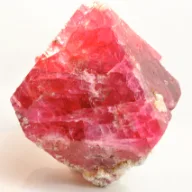 Spinel
Eight hundred years of crown jewels called it a ruby.
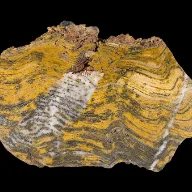 Stromatolite
Three and a half billion years of bacterial mats, turned to stone in layers.
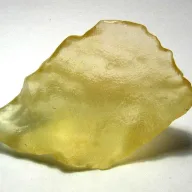 Libyan desert glass
Pale yellow glass lying loose in the Sahara, and a scarab in Tutankhamun's tomb cut from it.
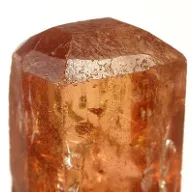 Topaz
Eight on the Mohs scale by definition, and it splits like slate if you hit it right.
 Vanadinite
Hexagonal barrels of orange-red lead vanadate, and the mineral vanadium was found in.
 Zircon
The oldest thing on earth is a grain of it, and no, it is not cubic zirconia.