 Lunarya
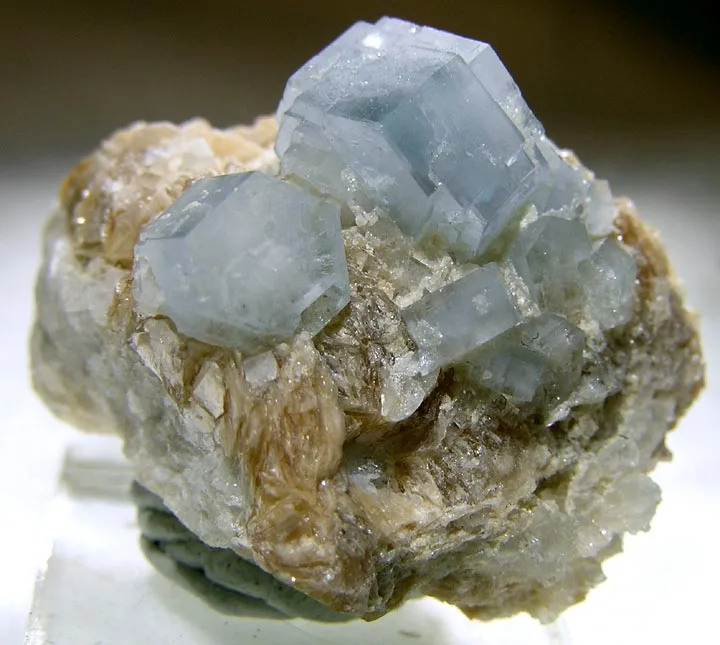
Apatite
Apatite is calcium phosphate, and it is in you: the mineral of tooth enamel and bone is the hydroxyl kind of it. In rock it grows as six-sided prisms in green, blue, yellow and violet, glassy and well-formed, and it is the mineral Mohs chose to stand for 5 on his scale, so everything softer than a knife and harder than a coin is measured against it.
Werner named it in 1786 from the Greek apatao, to deceive, because it had been passing for beryl, tourmaline and other gems for as long as anyone had been collecting, and it still does — the neon blue-green apatite of Madagascar is regularly sold as Paraíba tourmaline to people who do not know the difference. It is mostly a fertiliser: the phosphate rock of Morocco and the apatite of the Kola peninsula feed a good part of the world, and the apatite in Apollo's moon rocks turned out to hold water, which rewrote the moon.
In short
- Colour
- Blue
- Mineral
- Phosphate
- Formula
- Ca₅(PO₄)₃(F,Cl,OH)
- Hardness
- 5 on the Mohs scale
- Crystal system
- Hexagonal
- Found in
- Madagascar, Mexico (Durango), Brazil, Myanmar, Pakistan, Canada, Russia (Kola); Morocco for the rock.
- Element
- Air
- Planet
- Mercury
- Chakra
- Throat
- Handling
- Water and light are both fine
How it forms
Apatite forms almost everywhere a little phosphorus is present, which is nearly everywhere: as tiny crystals in most igneous rocks, as beds of phosphate rock made from the shells and bones of the sea, and as the fine gem crystals in pegmatites and marbles and in the iron ore of Durango, where the yellow-green prisms grow to the size of a finger. Living things make it too, out of the same calcium and phosphate — a tooth is apatite laid down by cells, and so is a bone, and so is a fossil once the bone has had its organic part replaced. That is why the mineral is used to date rocks: the tracks left in it by uranium decay heal at a known rate.
In human hands
It had no history under its own name until Werner sorted it out of the gems it was hiding among in 1786, and by the nineteenth century it was being mined for phosphorus, first as guano and bone and then as rock, when the chemists worked out that a plant needs it. The Kola deposits in Russia, found in the 1920s, and the great phosphate beds of Morocco, worked since 1921, are what most of the world's crops are grown on. The gem story is small and recent — Durango yellow in the nineteenth century, Brazilian and Madagascan blues in the 1990s, cat's-eyes from Myanmar — because at 5 on the scale apatite is too soft to be a ring stone and has stayed a collector's one.
Varieties and trade names
- Blue and green apatite
- The neon blue-green of Madagascar and the teal of Brazil, the shades most sold and most confused with tourmaline.
- Yellow apatite
- The greenish-yellow prisms of Cerro de Mercado in Durango, Mexico, grown in iron ore; called asparagus stone in the old books.
- Cat's-eye apatite
- Fibrous stones from Myanmar and Sri Lanka, cut in a dome to show a moving line of light.
- Moroxite
- An old name for the deep blue-green apatite of Norway and Canada, the kind that grows in marble; still on museum labels.
Telling it from a fake
The hardness gives it away: a steel knife scratches apatite and does not scratch tourmaline, beryl or quartz, which is the whole reason for the name. Its crystals are hexagonal prisms with flat ends, like a pencil, where tourmaline's are triangular in section and beryl's are longer and harder. Faceted blue apatite sold as Paraíba tourmaline is the common fraud, and the price is the clue before the knife is. Most blue-green apatite has been heated to improve the colour, which is accepted and rarely declared; glass imitations are warm and bubbled; there is no synthetic on the market.
None of this needs a laboratory, and none of it is proof. A shop that will not say whether a stone is treated has answered the question; ask, and have the answer written on the receipt.
What it is said to do
The pun is the tradition: a stone for appetite, which the name sounds like and does not mean — given for wanting things again, for motivation, and, in the diet books, for wanting less. The bone connection gives it a reading of growth and structure, and the blue kind gets the throat, for speaking clearly, as most blue stones do.
Living with it
A pocket stone rather than a ring: it scratches. Wash it in water; keep it from heat, which can shift the colour, and from the harder stones in the same bag.
In magic
Apatite has no older magic. Modern practice makes it a stone of appetite and motivation, from a pun on its name, and uses the blue kind for speaking clearly: a piece goes into a charm bag for a project that has lost its drive, as the moon waxes. It is soft and scratches, so it travels apart from harder stones.
- Energy
- Projective
- Day
- Wednesday
- Worked for
- Courage and drive · Speaking and being heard
More of this colour
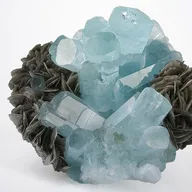 Aquamarine
Beryl the colour of shallow water, in crystals a metre long.
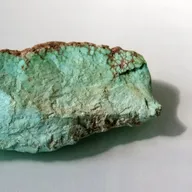 Turquoise
The stone that takes up whatever you soak it in, including your hand cream.
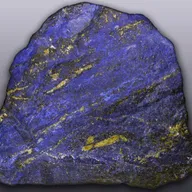 Lapis lazuli
A blue rock with gold in it, mined in one valley for six thousand years.
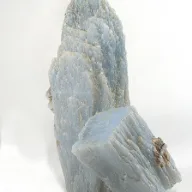 Angelite
Blue anhydrite from Peru: gypsum with the water taken out, and a name the trade gave it.
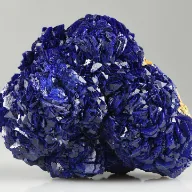 Azurite
The deep blue of copper, and the blue of half the paintings in Europe before 1700.
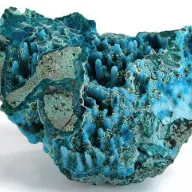 Chrysocolla
Copper turned to blue-green paste, and the flux that Bronze Age goldsmiths soldered with.
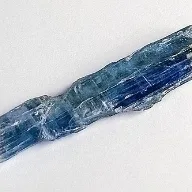 Kyanite
Blue blades with two hardnesses: soft along their length, hard across it.
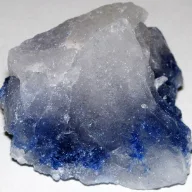 Dumortierite
A blue borosilicate that reaches the shops disguised as quartz.
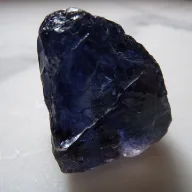 Iolite
Cordierite: violet-blue from one side, straw yellow from another.
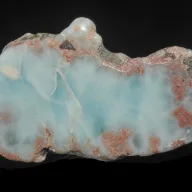 Larimar
Blue pectolite from one hillside in the Dominican Republic and nowhere else.
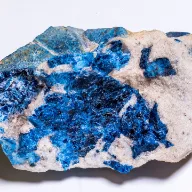 Lazulite
An azure phosphate with a name one letter away from lapis lazuli.
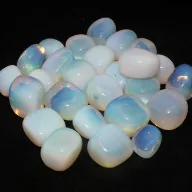 Opalite
Man-made glass, sold as a stone, and honestly rather pretty.
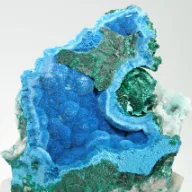 Shattuckite
A copper silicate in a blue that only copper manages, from a mine in Arizona.
 Sodalite
Royal blue veined with white, and the lapis on the shelf that is not lapis.