 Lunarya
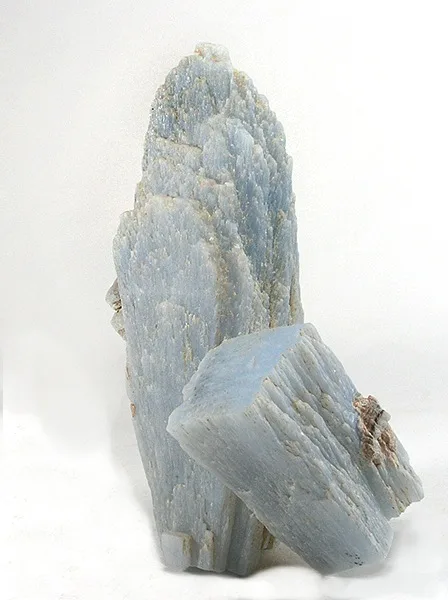
Angelite
Angelite is the trade name, since 1987, of a soft, opaque, lilac-blue anhydrite from Peru. Anhydrite is calcium sulfate without the water that makes gypsum — the name is Werner's, from 1804, and means exactly that — and given the chance it will take the water back, which is why a lump left in a bowl slowly turns into something else.
It is mostly an industrial rock: it fills the cap rock of salt domes, it is ground into cement, and it is the reason the German town of Staufen has been cracking since 2007, when a geothermal borehole let water into an anhydrite bed under the old centre and the bed began to swell into gypsum, lifting the streets. The blue Peruvian material from near Lima is a small and gentle exception, cut into spheres, hearts and worry stones and sold, on the strength of the colour, as the stone of angels.
In short
- Colour
- Blue
- Mineral
- Sulfate
- Formula
- CaSO₄
- Hardness
- 3.5 on the Mohs scale
- Crystal system
- Orthorhombic
- Found in
- Peru (the Lima region) for the blue; Naica in Mexico, Stassfurt in Germany and the Swiss Alps for crystals.
- Element
- Air
- Planet
- Uranus
- Chakra
- Throat
- Handling
- Keep out of water
How it forms
Anhydrite is an evaporite: it comes out of seawater in a drying lagoon after the carbonates and before the salt, wherever the brine is warm enough — above about 40°C, or saltier than usual — for the sulfate to settle without its water. Buried and pressed, gypsum turns into it too, giving up its water to the rock around; brought back up into the rain, it goes the other way and swells by more than half its volume as it does, which is why anhydrite beds heave and why the mineral is rarely found at the surface in one piece. The Peruvian blue is a massive form, fine-grained and coloured, the trade says, by a trace of strontium, though nobody has published the analysis.
In human hands
The mineral has a plain history — named by Werner at Freiberg in 1804, quarried for plaster and sulfuric acid, mapped by oil geologists because the cap rock of a salt dome is where the oil collects — and the stone has almost none. Angelite was named at the Tucson show in 1987, the year of the Harmonic Convergence, when a Peruvian dealer brought the blue material north and it was sold into the New Age market under a name chosen for it. It has been a fixture of that market since, one of the few stones whose entire tradition can be dated to a week.
Varieties and trade names
- Peruvian angelite
- The lilac-blue massive stone, opaque and fine-grained, cut into every shape the shops sell; the only kind called by this name.
- Naica anhydrite
- Pale blue transparent crystals from the Mexican mine famous for its giant gypsum, and the form collectors want.
- Vulpinite
- A scaly grey-white anhydrite from Vulpino in Italy, cut and polished as an ornamental stone since the eighteenth century.
- Cap-rock anhydrite
- The grey massive rock on top of salt domes, of interest to oilmen and to nobody else.
Telling it from a fake
Angelite is soft enough to scratch with a copper coin, it is opaque, and it often shows a rust-red spot or vein where a little iron has come through. Blue calcite is the usual confusion; it is a shade softer, it fizzes in vinegar, and angelite does not. Blue howlite is dyed, shows grey veins, and gives its colour up to a cotton bud with acetone. Celestine is the same colour and heavier and grows as clear crystals rather than a chalky mass. There is no synthetic; a lump that looks like angelite almost always is.
None of this needs a laboratory, and none of it is proof. A shop that will not say whether a stone is treated has answered the question; ask, and have the answer written on the receipt.
What it is said to do
The name is the tradition: a stone for the gentle end of things — comfort, quiet, the kind of speech that does not raise its voice — and, in the shops that sold it first, for talking to angels, which the stone is not on record as having done. It is given to people under strain and to people who grieve, as a thing to hold.
Living with it
Keep it dry. Water turns it slowly into gypsum, first at the surface, where it goes chalky, and washing it is the one thing not to do; wipe it with a cloth and keep it from knocks, because it is soft.
In magic
Angelite is a trade name given to blue anhydrite in the 1980s, and its practice follows the name: calling on angels and guides, comfort in grief, gentle speech. It is set on devotional altars and held during prayers for the dead. Water slowly turns anhydrite into gypsum, so this is a stone never to put in a bowl, a bath or moon water.
- Energy
- Projective
- Day
- Saturday
- Worked for
- Comfort and recovery · Calm and peace · Speaking and being heard
More of this colour
 Aquamarine
Beryl the colour of shallow water, in crystals a metre long.
 Turquoise
The stone that takes up whatever you soak it in, including your hand cream.
 Lapis lazuli
A blue rock with gold in it, mined in one valley for six thousand years.
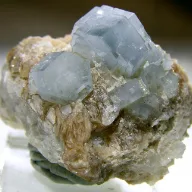 Apatite
The mineral teeth are made of, and the one that gives 5 on the Mohs scale its meaning.
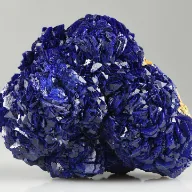 Azurite
The deep blue of copper, and the blue of half the paintings in Europe before 1700.
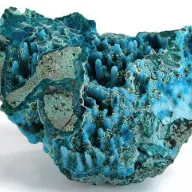 Chrysocolla
Copper turned to blue-green paste, and the flux that Bronze Age goldsmiths soldered with.
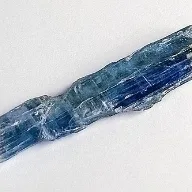 Kyanite
Blue blades with two hardnesses: soft along their length, hard across it.
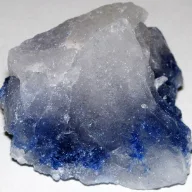 Dumortierite
A blue borosilicate that reaches the shops disguised as quartz.
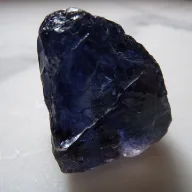 Iolite
Cordierite: violet-blue from one side, straw yellow from another.
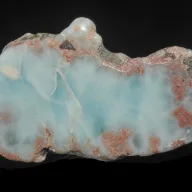 Larimar
Blue pectolite from one hillside in the Dominican Republic and nowhere else.
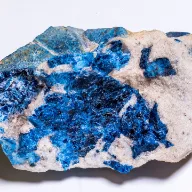 Lazulite
An azure phosphate with a name one letter away from lapis lazuli.
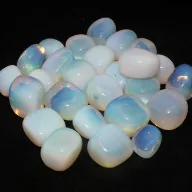 Opalite
Man-made glass, sold as a stone, and honestly rather pretty.
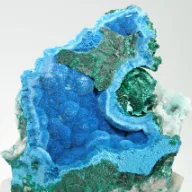 Shattuckite
A copper silicate in a blue that only copper manages, from a mine in Arizona.
 Sodalite
Royal blue veined with white, and the lapis on the shelf that is not lapis.