 Lunarya
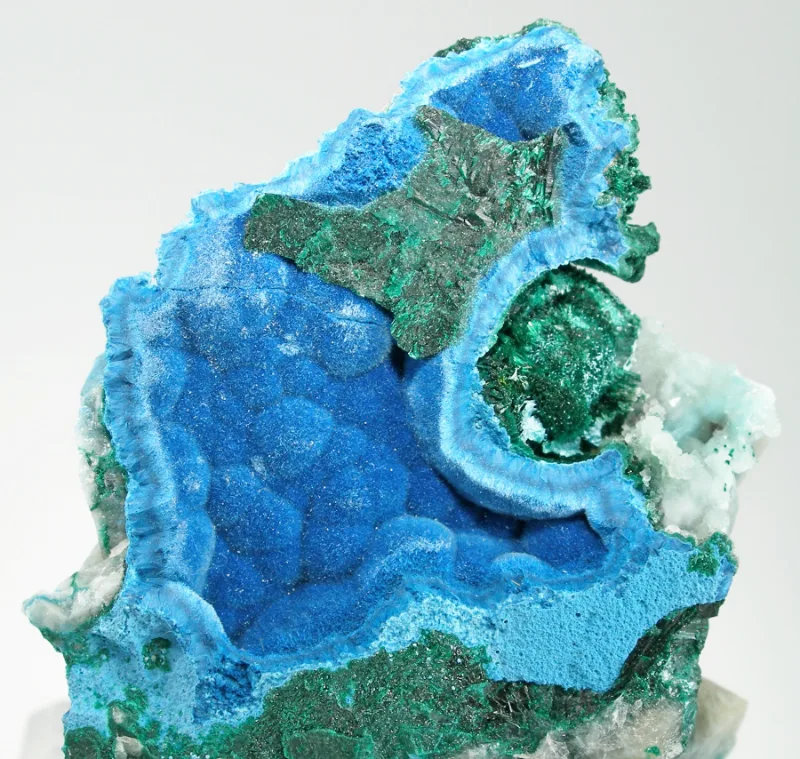
Shattuckite
Shattuckite is a hydrated copper silicate, Cu₅(SiO₃)₄(OH)₂, and it is one of the strong blues of the copper family — a deep azure to sky blue, usually in fibrous crusts, radiating sprays and botryoidal masses rather than in crystals anyone can see. It is soft, 3.5 to 4, and it almost never occurs alone: malachite, chrysocolla, plancheite, dioptase and quartz are its usual neighbours, and a good specimen is often three colours at once.
It was found in 1915 at the Shattuck Mine in Bisbee, Arizona, and named after it. Its close relative plancheite has a nearly identical look and a very similar formula, and the two were muddled for decades; a great deal of what is labelled shattuckite in older collections is plancheite and the other way round. Both are secondary copper minerals, which means both are products of an ore body rotting in air and water rather than of anything that grew hot.
In short
- Colour
- Blue
- Mineral
- Silicate
- Formula
- Cu₅(SiO₃)₄(OH)₂
- Hardness
- 3.5–4 on the Mohs scale
- Crystal system
- Orthorhombic
- Found in
- Bisbee in Arizona, the type locality, where the mine is long closed. Namibia, at the Kandesei and Tantara workings in the Kunene region, supplies almost everything sold today, usually as polished pieces with malachite and chrysocolla. Also the Democratic Republic of the Congo, Greece and Argentina.
- Element
- Water
- Planet
- Mercury
- Chakra
- Throat
- Handling
- Keep out of water
How it forms
A copper sulfide ore body is exposed to oxygen and groundwater and begins to break down. The copper goes into solution and reprecipitates, near the surface, as a suite of brightly coloured secondary minerals: carbonates like malachite and azurite, and silicates like chrysocolla, dioptase and shattuckite where dissolved silica is available. Shattuckite grows in the cavities and fractures of that oxidised zone, often replacing earlier malachite fibre for fibre.
In human hands
Bisbee was one of the great copper camps of the American southwest, and its oxidised zone produced a run of minerals that made the district famous among collectors as much as among mining engineers. Shattuckite is one of them. Commercially it has no use — there is far too little of it to be an ore — and it entered the crystal trade in the 1990s on the back of Namibian material, where it is usually sold as a throat-chakra stone.
Varieties and trade names
- Namibian shattuckite
- Blue fibrous masses with malachite and chrysocolla, polished into cabochons and palm stones; most of the market.
- Bisbee shattuckite
- From the type locality; scarce, historic and collected as much for the label as for the mineral.
- Shattuckite with quartz
- Blue fibres included in clear quartz, which protects them completely and makes a durable stone.
- Plancheite
- The near-identical relative, often paler and more silky; the two are routinely mislabelled for each other.
- Chrysocolla
- The other blue-green copper silicate it grows with, softer and more porous; it has a page of its own here.
Telling it from a fake
Blue copper minerals are a crowded field. Azurite is a carbonate and fizzes in acid; shattuckite does not. Chrysocolla is softer, more porous and usually greener. Lapis lazuli is a rock with pyrite in it and is much harder. Turquoise is harder and never fibrous. Under a loupe, shattuckite shows radiating fibre bundles, and that silky, spray-like texture in a strong blue is the best single indication.
None of this needs a laboratory, and none of it is proof. A shop that will not say whether a stone is treated has answered the question; ask, and have the answer written on the receipt.
What it is said to do
Read as a throat stone: speaking clearly, saying what is true, and the kind of communication that connects rather than performs. Several books also give it to psychic work, which is the usual fate of a deep blue mineral. It is given to Mercury, to Gemini and Pisces, and to the throat. The tradition is recent and follows the colour, as it does for most of the blue copper minerals.
Living with it
Soft and porous. Keep it out of water, which works into the fibres and dulls it, and away from acids, oils and perfume. No ultrasonic. Polished pieces are frequently stabilised with resin and should still be treated gently. Light does no harm. Handle specimens by the matrix, because the fibrous crusts crumble under a thumbnail.
In magic
Shattuckite is used in modern practice for the voice and for intuition: worn at the throat for speaking truthfully, held in meditation before divination. It is a recent addition with no older lore. It is soft and porous, so it is kept dry, and as a copper mineral it is never ground or made into an elixir.
- Energy
- Receptive
- Day
- Wednesday
- Worked for
- Speaking and being heard · Divination and intuition
More of this colour
 Aquamarine
Beryl the colour of shallow water, in crystals a metre long.
 Turquoise
The stone that takes up whatever you soak it in, including your hand cream.
 Lapis lazuli
A blue rock with gold in it, mined in one valley for six thousand years.
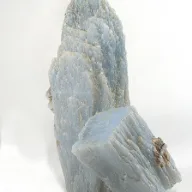 Angelite
Blue anhydrite from Peru: gypsum with the water taken out, and a name the trade gave it.
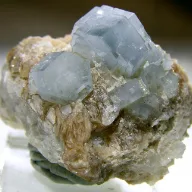 Apatite
The mineral teeth are made of, and the one that gives 5 on the Mohs scale its meaning.
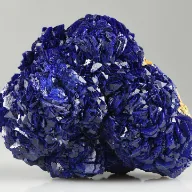 Azurite
The deep blue of copper, and the blue of half the paintings in Europe before 1700.
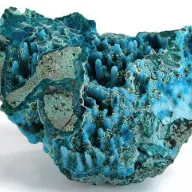 Chrysocolla
Copper turned to blue-green paste, and the flux that Bronze Age goldsmiths soldered with.
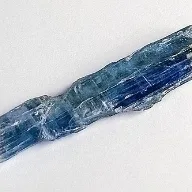 Kyanite
Blue blades with two hardnesses: soft along their length, hard across it.
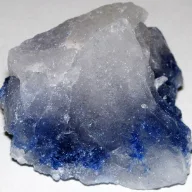 Dumortierite
A blue borosilicate that reaches the shops disguised as quartz.
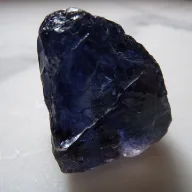 Iolite
Cordierite: violet-blue from one side, straw yellow from another.
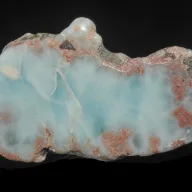 Larimar
Blue pectolite from one hillside in the Dominican Republic and nowhere else.
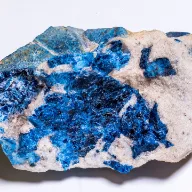 Lazulite
An azure phosphate with a name one letter away from lapis lazuli.
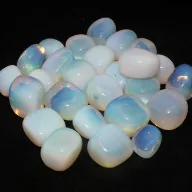 Opalite
Man-made glass, sold as a stone, and honestly rather pretty.
 Sodalite
Royal blue veined with white, and the lapis on the shelf that is not lapis.