 Lunarya
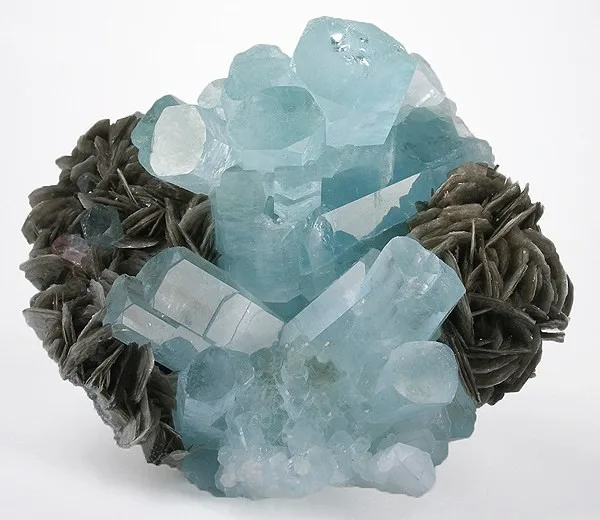
Aquamarine
Aquamarine is beryl — the same mineral as emerald — coloured pale blue to blue-green by iron in two different states. It grows in six-sided prisms with flat ends, is unusually clean for a gemstone, and at 7.5 to 8 on the Mohs scale it takes daily wear better than almost anything else this colour.
The crystals can be enormous: the Marambaia stone found in Brazil in 1910 weighed over a hundred kilograms and was clear enough to cut nearly all of it. Most of what is sold is heated to around 400°C, which turns the greenish iron blue and is permanent and universal enough that nobody treats it as a secret. The name is Latin — aqua marina, sea water — and Roman sailors carried it as insurance against a bad crossing.
In short
- Colour
- Blue
- Mineral
- Beryl
- Formula
- Be₃Al₂Si₆O₁₈
- Hardness
- 7.5–8 on the Mohs scale
- Crystal system
- Hexagonal
- Found in
- Brazil, Pakistan, Nigeria, Madagascar and Mozambique.
- Birthstone of
- March
- Element
- Water
- Planet
- Neptune
- Chakra
- Throat
- Handling
- Water and light are both fine
How it forms
Beryl needs beryllium, a rare element that is left in the last dregs of a cooling granite, so it grows in pegmatites, the coarse veins where those dregs crystallise, as six-sided prisms that can run to metres. Aquamarine is beryl coloured blue by iron in one state; iron in another adds yellow, and most crystals come out of the ground blue-green. Nearly all commercial aquamarine is heated to around 400 °C to burn the yellow off and leave a clean blue, which makes the untreated sea-green colour rarer in shops than the treated one. Brazil, Pakistan, Nigeria, Mozambique and Madagascar supply most of it.
In human hands
Pliny thought the best beryl was the one that copied the pure green of the sea, and the Romans cut it for intaglios; the name, sea water, was given in 1609. Beryl is why glasses are called Brille in German: the first lenses were ground from it. The element beryllium was found in it in 1798. Brazil gave a parure of aquamarines to Elizabeth II in 1953, and its Pedra Azul mine produced, in the 1980s, the crystal that became the Dom Pedro, a ten-thousand-carat obelisk cut by Bernd Munsteiner that stands in the Smithsonian beside the Hope diamond.
Varieties and trade names
- Santa Maria
- The deepest and most saturated blue, named for a mine in Ceará, Brazil, and now a grade applied to African stones too.
- Maxixe
- A deep blue from Minas Gerais whose colour comes from radiation and fades in daylight; keep the receipt.
- Cat's-eye aquamarine
- Cut as a dome, with a line of light from hollow tubes running the length of the crystal.
- Moss aquamarine
- The included, cloudy, cheap end, sold as beads and tumbles; real beryl, without the clarity.
Telling it from a fake
The usual substitute is blue topaz, which is heated and irradiated to a brighter blue, costs a fraction and is nearly indistinguishable by eye: topaz is heavier, so a loose stone that feels heavy for its size is topaz, and a deep, vivid blue with high clarity at a low price is too. Aquamarine shows two colours: turn it against the light and it shifts between blue and almost colourless, which glass and synthetic spinel never do. Natural stones carry long hollow tubes, called rain, running parallel to the crystal's length; glass carries bubbles.
None of this needs a laboratory, and none of it is proof. A shop that will not say whether a stone is treated has answered the question; ask, and have the answer written on the receipt.
What it is said to do
The stone of composure and of speaking plainly: traditionally a sailor's protection, and now more often given for the nerve to say a difficult thing calmly. It is the classic throat-centre stone.
Living with it
Hard and safe in soapy water, and ordinary aquamarine keeps its colour in daylight, since it is iron that makes the blue. The exception is Maxixe-type beryl, a deep blue made by irradiation, which fades after a few days in the sun — so an aquamarine darker than aquamarine usually comes is worth asking about before it goes on a windowsill.
In magic
Aquamarine is the sailor's stone in every tradition that knew it: Roman and medieval sailors are said to have carried it against drowning and seasickness. Modern practice uses it for protection on water and on journeys, for calm, and in throat work for speaking plainly. It is a natural stone for moon water and sea rituals, and ordinary aquamarine keeps its colour in daylight.
- Energy
- Receptive
- Day
- Thursday
- Worked for
- Speaking and being heard · Calm and peace · Protection
More of this colour
 Turquoise
The stone that takes up whatever you soak it in, including your hand cream.
 Lapis lazuli
A blue rock with gold in it, mined in one valley for six thousand years.
 Angelite
Blue anhydrite from Peru: gypsum with the water taken out, and a name the trade gave it.
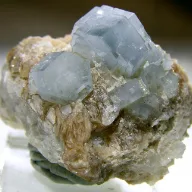 Apatite
The mineral teeth are made of, and the one that gives 5 on the Mohs scale its meaning.
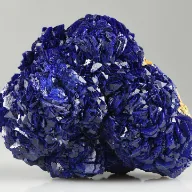 Azurite
The deep blue of copper, and the blue of half the paintings in Europe before 1700.
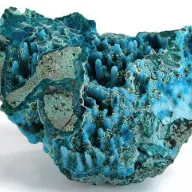 Chrysocolla
Copper turned to blue-green paste, and the flux that Bronze Age goldsmiths soldered with.
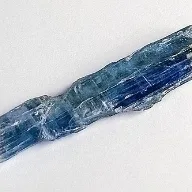 Kyanite
Blue blades with two hardnesses: soft along their length, hard across it.
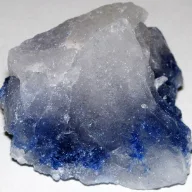 Dumortierite
A blue borosilicate that reaches the shops disguised as quartz.
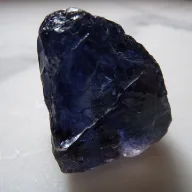 Iolite
Cordierite: violet-blue from one side, straw yellow from another.
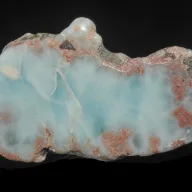 Larimar
Blue pectolite from one hillside in the Dominican Republic and nowhere else.
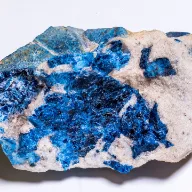 Lazulite
An azure phosphate with a name one letter away from lapis lazuli.
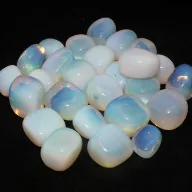 Opalite
Man-made glass, sold as a stone, and honestly rather pretty.
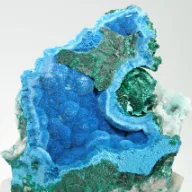 Shattuckite
A copper silicate in a blue that only copper manages, from a mine in Arizona.
 Sodalite
Royal blue veined with white, and the lapis on the shelf that is not lapis.