 Lunarya
Topaz
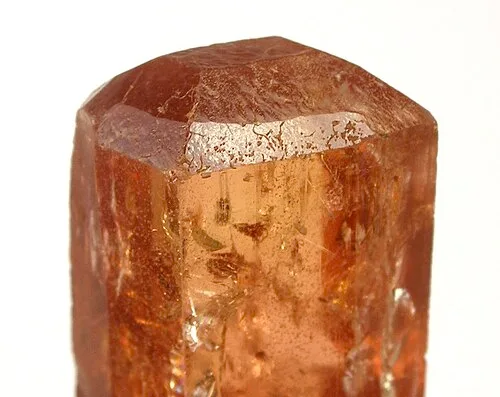
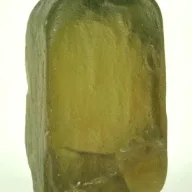
Topaz is aluminium fluorosilicate, Al₂SiO₄(F,OH)₂. It is the mineral that defines 8 on the Mohs scale, it grows in stubby to elongated prisms with a lozenge-shaped cross-section and fine grooves down the length, and it has one perfect cleavage straight across the crystal. That combination — very hard and easily split — is the whole practical story of the stone.
Colour is where most of the confusion lives. Natural topaz is commonly colourless, pale blue, yellow, brown or sherry-orange; the saturated golden-orange to pinkish red called imperial topaz comes almost entirely from Ouro Preto in Brazil and is genuinely scarce. The bright blues that fill every shop window are not natural. They are colourless topaz irradiated and then heated, a treatment developed in the 1970s that turned a cheap stone into a staple. It is stable and permanent, and the trade names — sky blue, Swiss blue, London blue — describe the treatment, not the source.
In short
- Colour
- Red, orange and gold
- Mineral
- Silicate
- Formula
- Al₂SiO₄(F,OH)₂
- Hardness
- 8 on the Mohs scale
- Crystal system
- Orthorhombic
- Found in
- Ouro Preto in Minas Gerais, Brazil, for imperial topaz, and the Brazilian pegmatites for enormous colourless crystals. Katlang in Pakistan for natural pink. The Thomas Range in Utah for sherry topaz that fades in the sun. Volodarsk-Volynskyi in Ukraine, the Urals, Schneckenstein in Saxony, Mexico, Nigeria, Madagascar and Sri Lanka.
- Birthstone of
- November
- Element
- Fire
- Planet
- Jupiter
- Chakra
- Solar plexus
- Handling
- Fades in sunlight
How it forms
Topaz needs fluorine, and fluorine is concentrated in the last hot vapours a granite gives off. It grows in pegmatite pockets, in the cavities of rhyolite lavas, and in greisen — granite altered by its own escaping fluid — alongside beryl, tourmaline, fluorite and cassiterite. Because pegmatite pockets can be large, topaz crystals can be enormous: the Ukrainian mines have produced single crystals over a hundred kilograms, and cut stones of several thousand carats sit in museums, which tells you about the size of the rough rather than the rarity of the mineral.
In human hands
The name probably comes from Topazios, an island in the Red Sea that Pliny says produced the stone. It produced peridot, and the names were only sorted out much later. The Braganza, a 1,680-carat stone in the Portuguese crown jewels long described as a diamond, is generally now thought to be topaz. In the nineteenth century the sherry-coloured Russian material from the Urals was the emperor's stone, and imperial topaz takes its name either from that or from Dom Pedro II of Brazil, depending on which dealer you ask.
Varieties and trade names
- Imperial topaz
- Golden orange through peach to a reddish pink, from Ouro Preto. The most valuable kind, and the term is loose enough that it is worth asking what a seller means by it.
- Irradiated blue topaz
- Colourless topaz treated to blue: sky, Swiss and London blue in ascending depth. Legitimate, and it should be disclosed, since untreated blue topaz of that intensity effectively does not exist.
- Mystic topaz
- Colourless topaz with a thin metallic film on the back, giving an oil-slick rainbow. The coating is on the surface and wears off at the girdle.
- Pink topaz
- Mostly imperial topaz heated to drive off the yellow. Natural pink comes from Katlang in Pakistan and is rare enough to be certificated.
- Smoky topaz
- Not topaz. The name is used in shops for smoky quartz and, as Madeira topaz, for citrine; both are quartz, and the word is there to raise the price.
Telling it from a fake
Topaz is heavy for its size — noticeably denser than quartz — and slippery to the touch, with a cool, soapy feel that cutters recognise immediately. Look for the one perfect cleavage: a flat, pearly, perfectly planar surface across the crystal, which quartz never shows. Citrine and smoky quartz, sold under topaz names, are lighter, softer and have no cleavage. A blue stone with no inclusions at all and a price that makes no sense is usually irradiated topaz, which is fine, or blue glass, which is not.
None of this needs a laboratory, and none of it is proof. A shop that will not say whether a stone is treated has answered the question; ask, and have the answer written on the receipt.
What it is said to do
The tradition gives topaz warmth and confidence, and in the golden varieties abundance — it was one of the standard prosperity stones long before that word was used for it. The Renaissance lapidaries gave it the power to cool anger and to make the wearer eloquent. It goes with fire, with Jupiter, with Sagittarius and Scorpio, and with the solar plexus. Blue topaz, being a 1970s product, has picked up a separate and much calmer reading around speech and the throat.
Living with it
Hard, and still fragile. The perfect basal cleavage means a sharp knock on the right plane will split a topaz cleanly in two no matter how well it resists scratching, so avoid rough wear and set it carefully. Never use ultrasonic or steam cleaning: warm soapy water and a brush. Keep it out of strong sunlight — the sherry topaz from Utah fades visibly in days, imperial topaz fades slowly, and heat can alter the colour of both. Water does no harm.
In magic
Medieval lapidaries claimed topaz could take the heat out of boiling water, and out of a temper too, which is why it was worn by people prone to anger. Modern practice uses golden topaz in workings for prosperity and success on a Thursday, and blue topaz, a product of the 1970s, for calm and for speaking well. Keep the golden ones out of the sun.
- Energy
- Projective
- Day
- Thursday
- Worked for
- Money and luck · Calm and peace · Speaking and being heard
More of this colour
 Garnet
Not one mineral but a whole family, and half of it ends up as sandpaper.
 Carnelian
Orange chalcedony, and the stone hot wax will not stick to.
 Citrine
Yellow quartz, except that most of it is amethyst that has been in an oven.
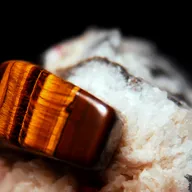 Tiger's eye
A stripe of light that slides across the stone when you tilt it.
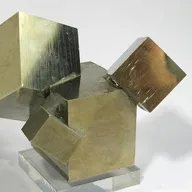 Pyrite
Fool's gold, in cubes so sharp they look machined.
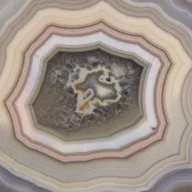 Agate
Chalcedony laid down in bands, one over the next, inside a bubble in old lava.
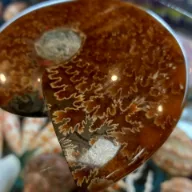 Ammonite
A shell that spiralled through the seas for three hundred million years, turned to stone.
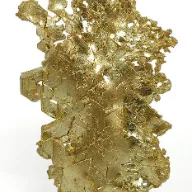 Gold
The one metal that comes out of the ground already finished.
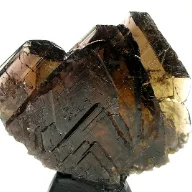 Axinite
Clove-brown wedges of a boron silicate, sharp enough to be named for an axe.
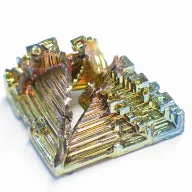 Bismuth
A metal that grows in rainbow staircases — in a saucepan, mostly.
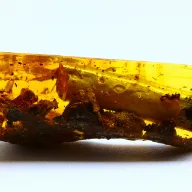 Amber
Not a stone at all: tree resin that leaked out forty million years ago and went hard.
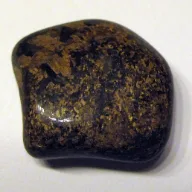 Bronzite
A dark pyroxene with a bronze sheen, from the same family the meteorites are full of.
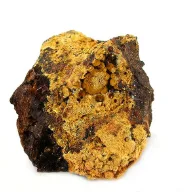 Cacoxenite
Golden needles in iron ore, named the bad guest because they ruined the smelt.
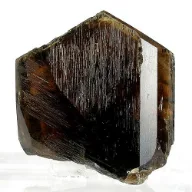 Chrysoberyl
The third hardest gem there is, no relation to beryl, and the only true cat's eye.
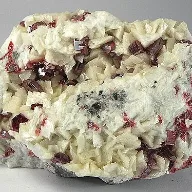 Cinnabar
Mercury ore, the red of every Chinese seal, and the most dangerous mineral in the cabinet.
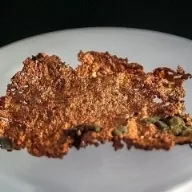 Copper
The first metal anyone ever worked, and one of the few that turns up ready to use.
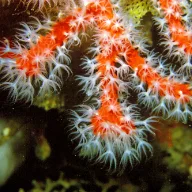 Red coral
The skeleton of a slow-growing animal, worn as a gem for five thousand years.
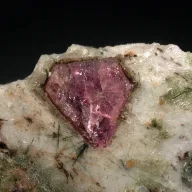 Eudialyte
Raspberry grains in grey Arctic rock, named for dissolving easily.
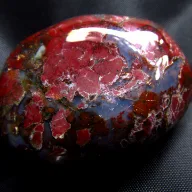 Jasper
Opaque chalcedony, stained by whatever the sediment happened to hold.
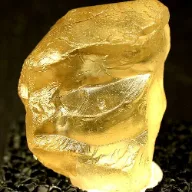 Golden labradorite
Bytownite: a calcium feldspar that cuts into clear champagne gold.
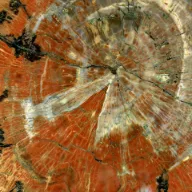 Petrified wood
A tree that became quartz cell by cell, and kept its grain.
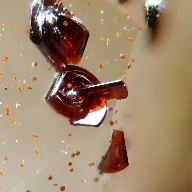 Lepidocrocite
The red half of rust, and the red flecks inside amethyst.
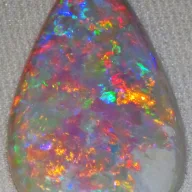 Opal
Water and silica in tiny stacked spheres, splitting light into colour.
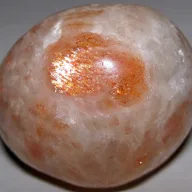 Sunstone
Feldspar full of metal flakes, throwing back the light in orange sparks.
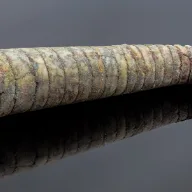 Orthoceras
A straight-shelled squid relative that died four hundred million years ago.
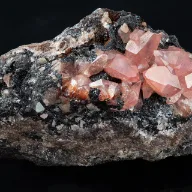 Rhodochrosite
Manganese carbonate in rose red, banded in caves and crystallised in mines.
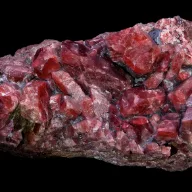 Rhodonite
Pink manganese silicate veined with the black oxide it turns into.
 Ruby
Corundum with chromium in it, and for centuries the most expensive stone on earth.
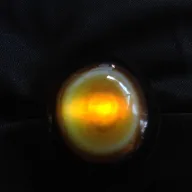 Sardonyx
Red-brown and white in straight bands, and the Roman world's seal stone.
 Scheelite
The tungsten ore that glows electric blue under a lamp in the dark.
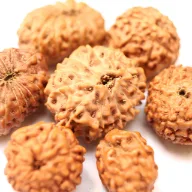 Rudraksha
The stone of a fruit, not of the ground, and the oldest prayer bead in India.
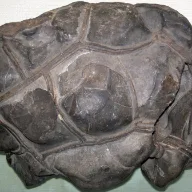 Septarian
A mud nodule that cracked from the inside and filled its own cracks with calcite.
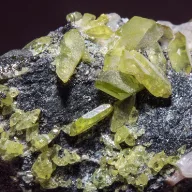 Sphene
Titanite, which throws more fire than a diamond and is far too soft to wear.
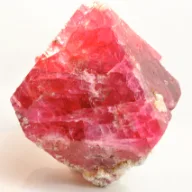 Spinel
Eight hundred years of crown jewels called it a ruby.
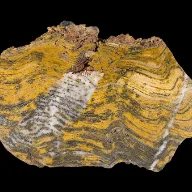 Stromatolite
Three and a half billion years of bacterial mats, turned to stone in layers.
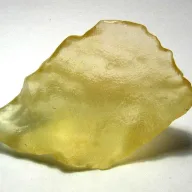 Libyan desert glass
Pale yellow glass lying loose in the Sahara, and a scarab in Tutankhamun's tomb cut from it.
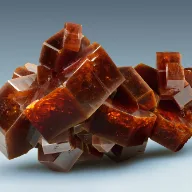 Vanadinite
Hexagonal barrels of orange-red lead vanadate, and the mineral vanadium was found in.
 Zircon
The oldest thing on earth is a grain of it, and no, it is not cubic zirconia.