 Lunarya
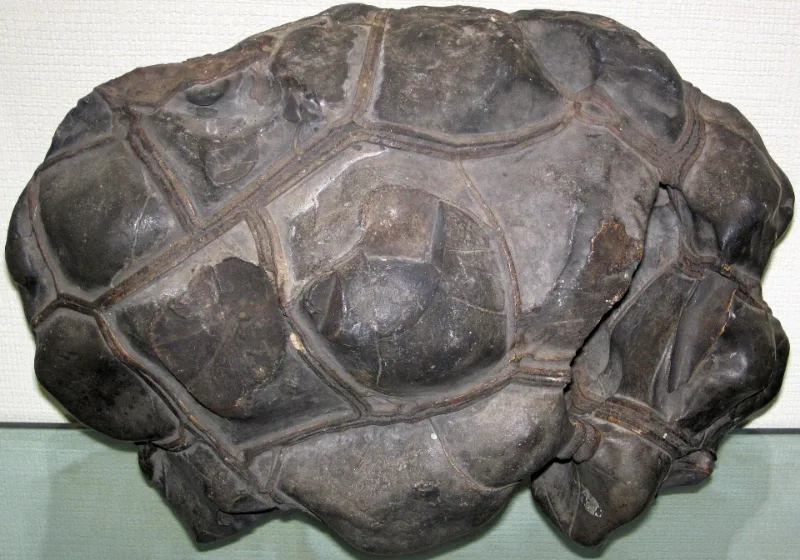
Septarian
A septarian is a concretion: a lump of mud or clay that hardened around something, from the inside out, on an ancient sea floor. What makes it septarian is what happened next — the inside shrank and cracked in a pattern of radiating and concentric fissures, and mineral-rich water later filled those cracks, usually with yellow or honey calcite and sometimes with aragonite, barite or pyrite. Cut one open and you get a mosaic: brown mud panels separated by bright veins.
The name is from the Latin septum, a partition, for those dividing walls. Why the cracking happens is still argued — drying and shrinkage of a clay gel, the decay of organic matter inside, or the expansion of the concretion's own crystallising cement have all been proposed, and different nodules probably did different things. The trade calls it dragon stone. It is soft, 3 to 4, being mostly calcite and mudstone, and it fizzes in acid.
In short
- Colour
- Red, orange and gold
- Mineral
- A rock, not one mineral
- Formula
- CaCO₃ + Fe₂O₃ + SiO₂
- Hardness
- 3–4 on the Mohs scale
- Crystal system
- None — it is a rock
- Found in
- Utah, from Cretaceous shales, supplies most of the polished material; Madagascar produces large decorative pieces; also Morocco, England on the Isle of Sheppey, New Zealand, where the Moeraki boulders are giant septarian concretions, and Canada.
- Element
- Earth
- Planet
- Saturn
- Chakra
- Root
- Handling
- Keep out of water
How it forms
Something organic — a shell, a fish, a piece of wood — settles into soft mud and starts to decay. The chemistry around it changes, carbonate precipitates in the pore spaces, and a hard ball grows outward through the sediment while the mud around it is still soft. Later the ball cracks internally, and groundwater moving through the rock crystallises calcite into the openings over a very long time. The whole thing is then compacted, buried and eventually weathered out.
In human hands
Septarian nodules have been collected as curiosities for centuries and turn up in early cabinet collections as sports of nature. Their interpretation took much longer: the Moeraki boulders were explained by Māori tradition as the gourds and eel baskets washed ashore from the wrecked canoe Arai-te-uru, and by nineteenth-century geologists as concretions, and both accounts have been handed down. The crystal trade's dragon stone name and its associated readings date from the 1990s.
Varieties and trade names
- Utah septarian
- Brown mud with yellow calcite veins and grey aragonite rims; the material of almost all eggs and bowls.
- Moeraki boulders
- Spherical septarian concretions up to two metres across on a New Zealand beach; protected, not collectable.
- Whole nodules
- Uncut, showing the crack pattern on the outside like a turtle's shell; the form the name comes from.
- Barite-filled septarian
- Nodules where the veins are white barite rather than calcite; heavier and less colourful.
- Fossil-cored nodules
- Ones that grew around an ammonite or a fish, which is worth far more opened than closed.
Telling it from a fake
The vein pattern is unmistakable and hard to fake: cracks that radiate from the centre and curve concentrically, all filled with a different material from the body. It is soft, so a pin marks the veins, and a drop of vinegar fizzes on the calcite. Resin imitations are light, warm to the touch and have veins of even width. Cut and polished pieces are usually waxed, which makes them look glossier than the raw stone ever does.
None of this needs a laboratory, and none of it is proof. A shop that will not say whether a stone is treated has answered the question; ask, and have the answer written on the receipt.
What it is said to do
The modern reading follows the structure: something that broke and was filled in, so repair, holding together, and old grievances that have healed over. Some books add the trade name's dragon associations. It is given to Saturn, to Taurus and Capricorn, and to the root. Nothing older attaches to it outside New Zealand, where the Moeraki tradition is about a canoe rather than about the stone.
Living with it
Soft and full of calcite, so keep it away from acids, from vinegar and lemon in a kitchen, and from long soaking. Wipe with a barely damp cloth. Most polished pieces are waxed and hot water will dull that finish. Sunlight does no harm, but a dropped septarian egg will break along one of the veins, which is where it is weakest.
In magic
Septarian is used in modern practice as a stone for holding things together: workings for a family or a group going through a difficult patch, and for mending an old quarrel, with the cracks the calcite filled read as wounds that healed. The trade name, dragon stone, has given it a little dragon magic as well. It is veined with calcite, so no vinegar, salt or long baths.
- Energy
- Receptive
- Day
- Saturday
- Worked for
- Comfort and recovery · Grounding and endurance
More of this colour
 Garnet
Not one mineral but a whole family, and half of it ends up as sandpaper.
 Carnelian
Orange chalcedony, and the stone hot wax will not stick to.
 Citrine
Yellow quartz, except that most of it is amethyst that has been in an oven.
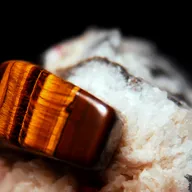 Tiger's eye
A stripe of light that slides across the stone when you tilt it.
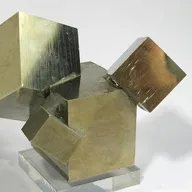 Pyrite
Fool's gold, in cubes so sharp they look machined.
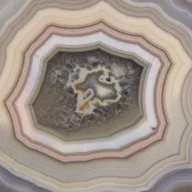 Agate
Chalcedony laid down in bands, one over the next, inside a bubble in old lava.
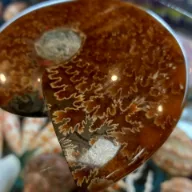 Ammonite
A shell that spiralled through the seas for three hundred million years, turned to stone.
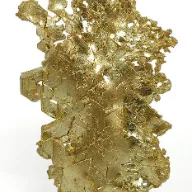 Gold
The one metal that comes out of the ground already finished.
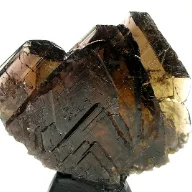 Axinite
Clove-brown wedges of a boron silicate, sharp enough to be named for an axe.
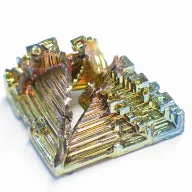 Bismuth
A metal that grows in rainbow staircases — in a saucepan, mostly.
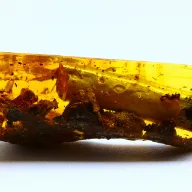 Amber
Not a stone at all: tree resin that leaked out forty million years ago and went hard.
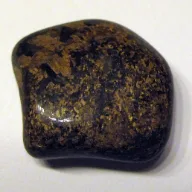 Bronzite
A dark pyroxene with a bronze sheen, from the same family the meteorites are full of.
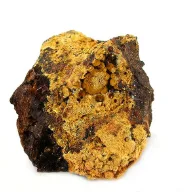 Cacoxenite
Golden needles in iron ore, named the bad guest because they ruined the smelt.
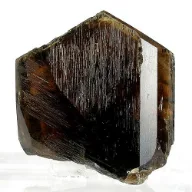 Chrysoberyl
The third hardest gem there is, no relation to beryl, and the only true cat's eye.
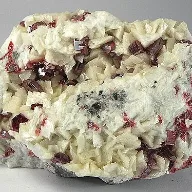 Cinnabar
Mercury ore, the red of every Chinese seal, and the most dangerous mineral in the cabinet.
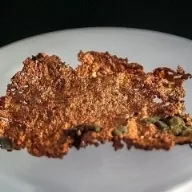 Copper
The first metal anyone ever worked, and one of the few that turns up ready to use.
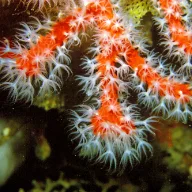 Red coral
The skeleton of a slow-growing animal, worn as a gem for five thousand years.
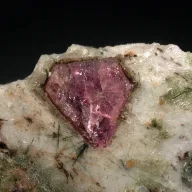 Eudialyte
Raspberry grains in grey Arctic rock, named for dissolving easily.
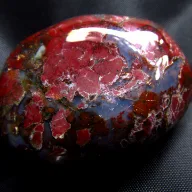 Jasper
Opaque chalcedony, stained by whatever the sediment happened to hold.
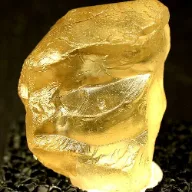 Golden labradorite
Bytownite: a calcium feldspar that cuts into clear champagne gold.
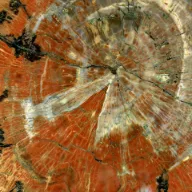 Petrified wood
A tree that became quartz cell by cell, and kept its grain.
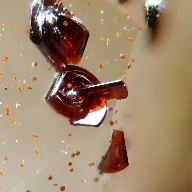 Lepidocrocite
The red half of rust, and the red flecks inside amethyst.
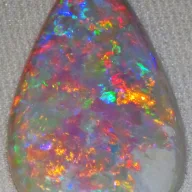 Opal
Water and silica in tiny stacked spheres, splitting light into colour.
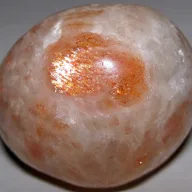 Sunstone
Feldspar full of metal flakes, throwing back the light in orange sparks.
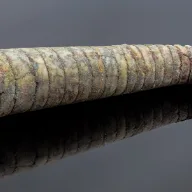 Orthoceras
A straight-shelled squid relative that died four hundred million years ago.
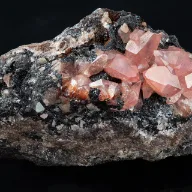 Rhodochrosite
Manganese carbonate in rose red, banded in caves and crystallised in mines.
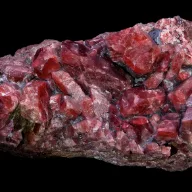 Rhodonite
Pink manganese silicate veined with the black oxide it turns into.
 Ruby
Corundum with chromium in it, and for centuries the most expensive stone on earth.
 Sardonyx
Red-brown and white in straight bands, and the Roman world's seal stone.
 Scheelite
The tungsten ore that glows electric blue under a lamp in the dark.
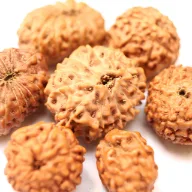 Rudraksha
The stone of a fruit, not of the ground, and the oldest prayer bead in India.
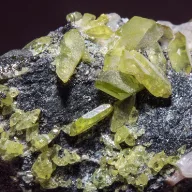 Sphene
Titanite, which throws more fire than a diamond and is far too soft to wear.
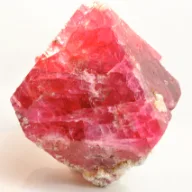 Spinel
Eight hundred years of crown jewels called it a ruby.
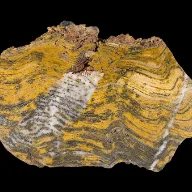 Stromatolite
Three and a half billion years of bacterial mats, turned to stone in layers.
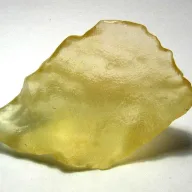 Libyan desert glass
Pale yellow glass lying loose in the Sahara, and a scarab in Tutankhamun's tomb cut from it.
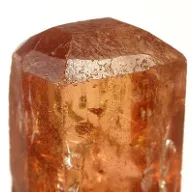 Topaz
Eight on the Mohs scale by definition, and it splits like slate if you hit it right.
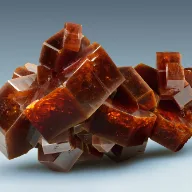 Vanadinite
Hexagonal barrels of orange-red lead vanadate, and the mineral vanadium was found in.
 Zircon
The oldest thing on earth is a grain of it, and no, it is not cubic zirconia.