 Lunarya
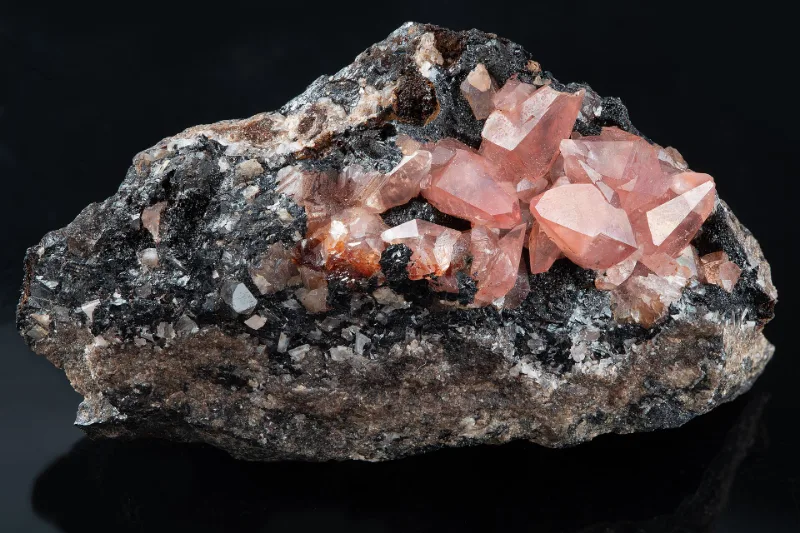
Rhodochrosite
Rhodochrosite is manganese carbonate, MnCO₃, and it comes in two quite different forms. One is banded: pink and white layers, like the rings of a tree, deposited in caves in old silver mines and cut into slabs. The other is crystalline: rhombohedra and scalenohedra of a clear raspberry red that are among the most sought-after mineral specimens in the world. Both are soft, 3.5 to 4, and both fizz in acid.
The colour is the manganese itself, not a trace impurity, which is why it is so saturated. Being a carbonate it shares calcite's problems: perfect cleavage in three directions, a hardness below that of a steel pin, and a violent reaction to anything acidic. Iron substituting for manganese pushes the colour towards brown, and much cheap material is brownish-pink rather than rose. It is the national gemstone of Argentina and the state mineral of Colorado.
In short
- Colour
- Red, orange and gold
- Mineral
- Carbonate
- Formula
- MnCO₃
- Hardness
- 3.5–4 on the Mohs scale
- Crystal system
- Trigonal
- Found in
- Capillitas in Catamarca, Argentina, for the banded stalactitic material; the Sweet Home Mine in Colorado, closed in 2004, for the finest red crystals; N'Chwaning in South Africa, Peru, Romania at Cavnic and Băiuț in Maramureș, China, Mexico and Japan.
- Element
- Fire
- Planet
- Venus
- Chakra
- Heart
- Handling
- Keep out of water and sunlight
How it forms
Rhodochrosite grows in hydrothermal veins, usually in silver, lead and zinc deposits, where manganese-bearing solutions meet carbonate. In the Argentine mines the crystalline material dissolved and was redeposited as stalactites in old workings, and a slice across one of those gives the concentric rings that the trade calls Inca rose. It also forms in manganese ore bodies and in some metamorphic rocks.
In human hands
The Incas are said to have known the Argentine material, and the trade name Rosa del Inca and the story that it is the blood of Inca kings both come from that, though the mines themselves were worked for copper and silver by the Spanish. The great crystals are a modern story: the Sweet Home Mine near Alma, Colorado, was reopened in the 1990s purely to mine specimens rather than ore, and the Alma King, a crystal some sixteen centimetres across found there in 1992, is the most famous rhodochrosite in existence.
Varieties and trade names
- Inca rose
- The banded pink and white stalactitic material from Capillitas in Argentina, cut into slabs and beads.
- Sweet Home crystals
- Transparent raspberry rhombohedra from Colorado; the finest specimens of the species and priced as art.
- N'Chwaning rhodochrosite
- South African crystals, often orange-red and gemmy, from the Kalahari manganese field.
- Gem rhodochrosite
- Faceted stones, soft and cleavable, cut for collectors rather than for rings.
- Manganese ore rhodochrosite
- Massive brown-pink material with no beauty and considerable industrial use.
Telling it from a fake
A drop of vinegar will fizz on it, which rules out rhodonite, thulite and pink chalcedony at once. It is soft — a steel pin marks it — and it cleaves into rhombs, so a chipped edge shows flat angled faces rather than a shell-shaped break. Rhodonite is harder, does not fizz and is veined with black; dyed magnesite and howlite are paler and hold their colour in cracks. The banded material's rings are concentric and irregular, where a dyed imitation is too even.
None of this needs a laboratory, and none of it is proof. A shop that will not say whether a stone is treated has answered the question; ask, and have the answer written on the receipt.
What it is said to do
Read as a heart stone with a particular emphasis: not romance but repair — grief, self-forgiveness, being gentle with oneself about something old. Several books call it the stone of the compassionate heart. It is given to Venus, to Leo and Scorpio, and to the heart. The reading dates from the late twentieth century and the colour does most of the work.
Living with it
Soft, cleavable and chemically vulnerable. Keep it out of water, which dulls the polish over time, and away from anything acidic — vinegar, lemon, wine, descalers, and even prolonged skin contact will etch it. Sunlight fades the pink. No ultrasonic. It is a shelf stone rather than a ring stone, and a banded slab should be dusted rather than washed.
In magic
Rhodochrosite is used in modern practice for repairing the heart: workings for self-forgiveness, for grief that has not found its way out, and for coming back to love after a long absence from it, usually by candlelight on a Friday. It is soft and dissolves in anything acid, so it is an altar stone and never one for a ritual bath, salt, moon water or a vinegar wash.
- Energy
- Projective
- Day
- Friday
- Worked for
- Comfort and recovery · Love and friendship
More of this colour
 Garnet
Not one mineral but a whole family, and half of it ends up as sandpaper.
 Carnelian
Orange chalcedony, and the stone hot wax will not stick to.
 Citrine
Yellow quartz, except that most of it is amethyst that has been in an oven.
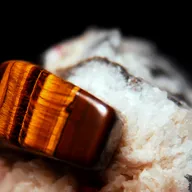 Tiger's eye
A stripe of light that slides across the stone when you tilt it.
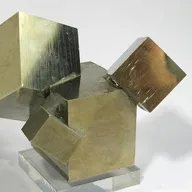 Pyrite
Fool's gold, in cubes so sharp they look machined.
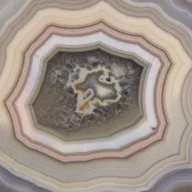 Agate
Chalcedony laid down in bands, one over the next, inside a bubble in old lava.
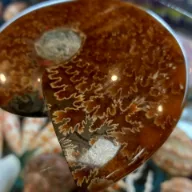 Ammonite
A shell that spiralled through the seas for three hundred million years, turned to stone.
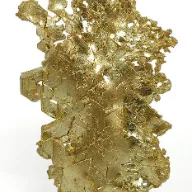 Gold
The one metal that comes out of the ground already finished.
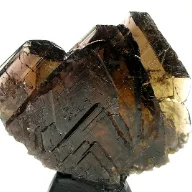 Axinite
Clove-brown wedges of a boron silicate, sharp enough to be named for an axe.
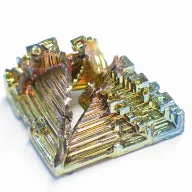 Bismuth
A metal that grows in rainbow staircases — in a saucepan, mostly.
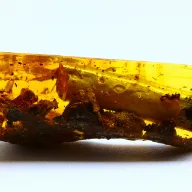 Amber
Not a stone at all: tree resin that leaked out forty million years ago and went hard.
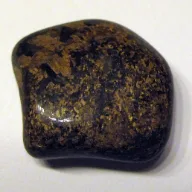 Bronzite
A dark pyroxene with a bronze sheen, from the same family the meteorites are full of.
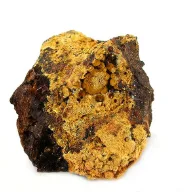 Cacoxenite
Golden needles in iron ore, named the bad guest because they ruined the smelt.
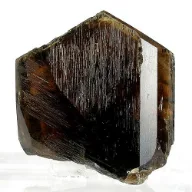 Chrysoberyl
The third hardest gem there is, no relation to beryl, and the only true cat's eye.
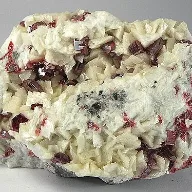 Cinnabar
Mercury ore, the red of every Chinese seal, and the most dangerous mineral in the cabinet.
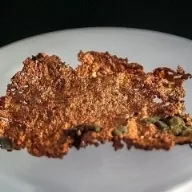 Copper
The first metal anyone ever worked, and one of the few that turns up ready to use.
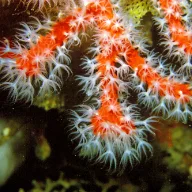 Red coral
The skeleton of a slow-growing animal, worn as a gem for five thousand years.
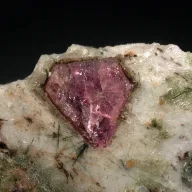 Eudialyte
Raspberry grains in grey Arctic rock, named for dissolving easily.
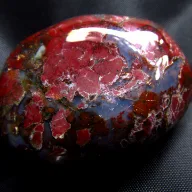 Jasper
Opaque chalcedony, stained by whatever the sediment happened to hold.
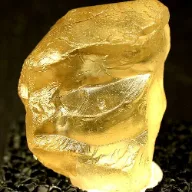 Golden labradorite
Bytownite: a calcium feldspar that cuts into clear champagne gold.
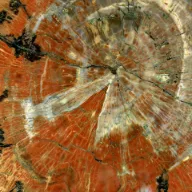 Petrified wood
A tree that became quartz cell by cell, and kept its grain.
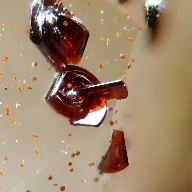 Lepidocrocite
The red half of rust, and the red flecks inside amethyst.
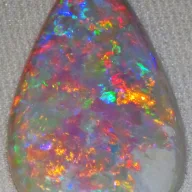 Opal
Water and silica in tiny stacked spheres, splitting light into colour.
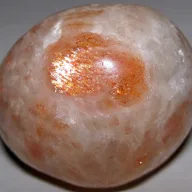 Sunstone
Feldspar full of metal flakes, throwing back the light in orange sparks.
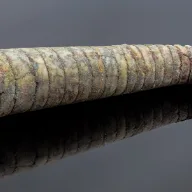 Orthoceras
A straight-shelled squid relative that died four hundred million years ago.
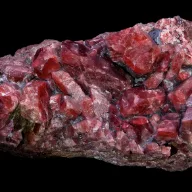 Rhodonite
Pink manganese silicate veined with the black oxide it turns into.
 Ruby
Corundum with chromium in it, and for centuries the most expensive stone on earth.
 Sardonyx
Red-brown and white in straight bands, and the Roman world's seal stone.
 Scheelite
The tungsten ore that glows electric blue under a lamp in the dark.
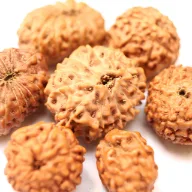 Rudraksha
The stone of a fruit, not of the ground, and the oldest prayer bead in India.
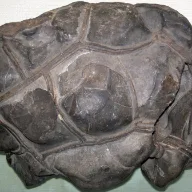 Septarian
A mud nodule that cracked from the inside and filled its own cracks with calcite.
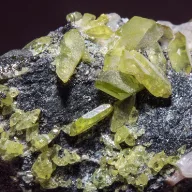 Sphene
Titanite, which throws more fire than a diamond and is far too soft to wear.
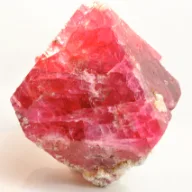 Spinel
Eight hundred years of crown jewels called it a ruby.
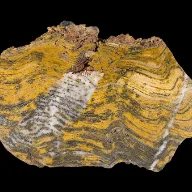 Stromatolite
Three and a half billion years of bacterial mats, turned to stone in layers.
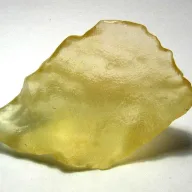 Libyan desert glass
Pale yellow glass lying loose in the Sahara, and a scarab in Tutankhamun's tomb cut from it.
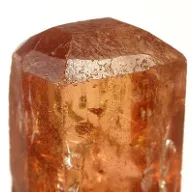 Topaz
Eight on the Mohs scale by definition, and it splits like slate if you hit it right.
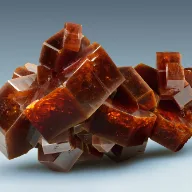 Vanadinite
Hexagonal barrels of orange-red lead vanadate, and the mineral vanadium was found in.
 Zircon
The oldest thing on earth is a grain of it, and no, it is not cubic zirconia.