 Lunarya
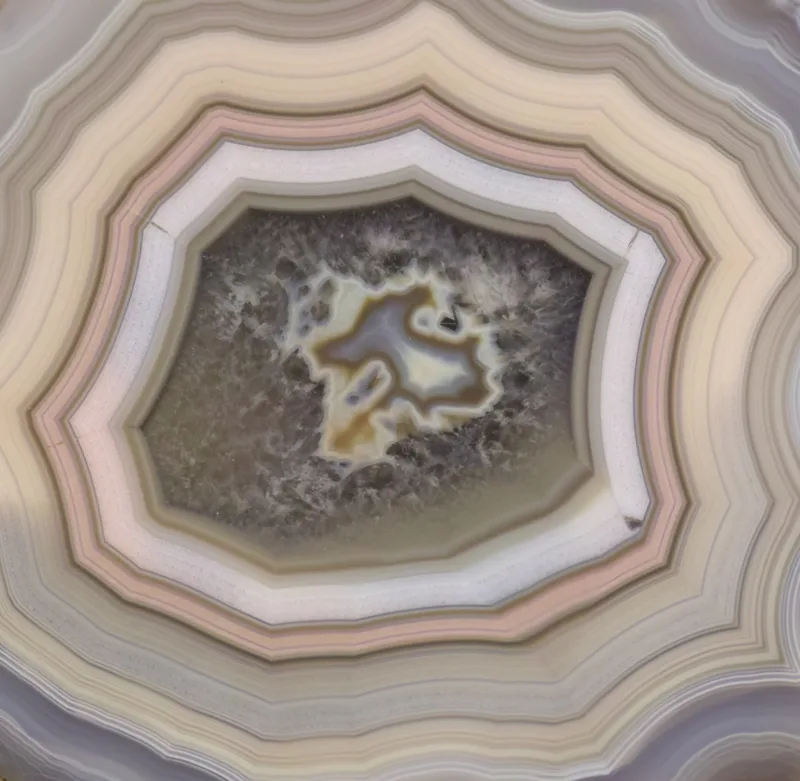
Agate
Agate is chalcedony — quartz in fibres too fine to see — laid down in bands, one after another, on the inside of a cavity in rock. The bands follow the shape of the hole, so a slice shows rings inside rings, in grey, white, brown and red from traces of iron, and sometimes a lining of open crystals where the filling stopped.
It is one of the most worked stones in history: the Stone Age flaked it into blades, the Romans cut their seals in it, and the town of Idar-Oberstein in the Rhineland has been grinding it since the fourteenth century and dyeing it since the nineteenth, which is why most bright agate in a shop is not the colour it was born. Theophrastus wrote it down around 300 BC and named it for the river Achates in Sicily, where it was found; the name has outlasted the river's.
In short
- Colour
- Red, orange and gold
- Mineral
- Chalcedony
- Formula
- SiO₂
- Hardness
- 6.5–7 on the Mohs scale
- Crystal system
- Trigonal
- Found in
- Brazil and Uruguay above all; Mexico, India, Madagascar, Botswana, Germany and the shores of Lake Superior.
- Element
- Earth
- Planet
- Mercury
- Chakra
- Root
- Handling
- Water and light are both fine
How it forms
An agate begins as a gas bubble in cooling lava. Long after the flow has gone cold, water carrying dissolved silica seeps into the hollow, and the silica comes out of it as a layer of chalcedony on the walls, then another over that, and another, each following the shape of the last; where the water changed, the trace of iron in it changed the colour of the band. How the bands become so regular is still argued about — nobody has made an agate in a laboratory — but the result is a nodule that shows rings when it is sliced, or a hollow geode with crystals in the middle where the filling ran out. Blue lace agate grows the same way in a crack rather than a bubble, and moss agate is the plain kind with green chlorite grown through it like weed.
In human hands
It was cut long before it was named: the Stone Age worked it because it flakes to an edge, and by the Bronze Age it was being drilled for beads in the Indus valley and carved into cylinder seals in Mesopotamia. Rome engraved it for signet rings and cameos, Byzantium turned it into cups, and from about 1375 the village of Idar-Oberstein in Germany was grinding the local nodules on sandstone wheels turned by the river. When the Idar seams ran out in the 1800s, its emigrants found the vast pale agates of Brazil and shipped them home, and the town worked out how to dye them — sugar and acid for black, iron salts for red, Prussian blue for blue — which is the industry still.
Varieties and trade names
- Blue lace agate
- Pale blue and white in fine wavy bands, from one district in Namibia; the softest colour in the family and the most copied.
- Moss agate
- Not banded at all: clear chalcedony with green chlorite grown through it in fronds, so a slice looks like a pond.
- Crazy lace agate
- From Chihuahua in Mexico, red, yellow and white bands folded into loops and eyes, cut for the pattern rather than the colour.
- Fire agate
- Chalcedony over layers of iron oxide so thin they split light, so the brown stone flashes green and orange as it turns.
- Tree agate
- White chalcedony with dark green dendrites branching through it like a drawing of a tree; the same thing as moss agate, on white.
- Flower agate
- Pink and cream chalcedony from Madagascar with tiny round chalcedony flowers grown through it, new to the trade since 2018.
Telling it from a fake
Natural agate is quiet: greys, whites, browns and dull reds, with bands that vary in width and sometimes fail. A slice in electric blue, magenta or violet has been dyed, and the dye gathers in the more porous bands, so the colour sits in some rings and not others. Dyed black agate is sold as onyx, and always has been. Real agate is hard enough to scratch glass and cold to the touch; glass imitations show round bubbles and feel warm, and a resin one is scratched by a knife. Under a lens a real band is made of fibres, all pointing the same way across it.
None of this needs a laboratory, and none of it is proof. A shop that will not say whether a stone is treated has answered the question; ask, and have the answer written on the receipt.
What it is said to do
The oldest stone in the cabinet, with the oldest reputation: Pliny already had it as a stone against storms and scorpions, and the medieval lapidaries gave it to farmers for the crops. The modern reading is steadiness — a stone for slow work and long patience, on the sense that something laid down one thin band at a time over ages might know something about not rushing.
Living with it
The easiest stone there is to own. Wash it in anything, wear it anywhere and leave it in the sun; only a dyed one may fade, and it was not the colour you thought it was to begin with.
In magic
Agate has the longest paper trail in the cabinet. Pliny reports that the magi burned it to turn storms aside, the medieval lapidaries gave it to farmers for the harvest, and the etched agate beads of Tibet, the dzi, are still worn as protection. Modern witches use it in garden magic, buried at the edge of a bed, and for steadiness through a long working. Nothing in a ritual can hurt it.
- Energy
- Receptive
- Day
- Wednesday
- Worked for
- Protection · Grounding and endurance
More of this colour
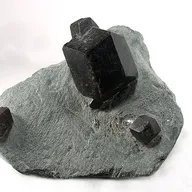 Garnet
Not one mineral but a whole family, and half of it ends up as sandpaper.
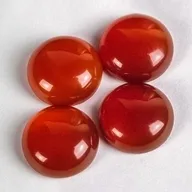 Carnelian
Orange chalcedony, and the stone hot wax will not stick to.
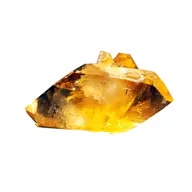 Citrine
Yellow quartz, except that most of it is amethyst that has been in an oven.
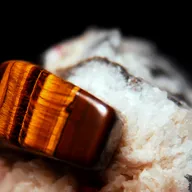 Tiger's eye
A stripe of light that slides across the stone when you tilt it.
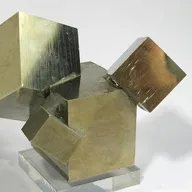 Pyrite
Fool's gold, in cubes so sharp they look machined.
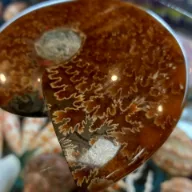 Ammonite
A shell that spiralled through the seas for three hundred million years, turned to stone.
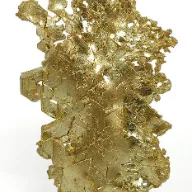 Gold
The one metal that comes out of the ground already finished.
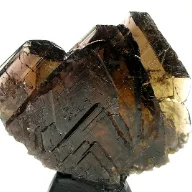 Axinite
Clove-brown wedges of a boron silicate, sharp enough to be named for an axe.
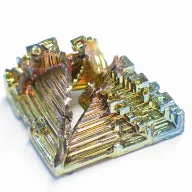 Bismuth
A metal that grows in rainbow staircases — in a saucepan, mostly.
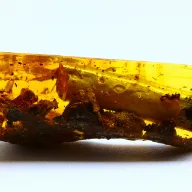 Amber
Not a stone at all: tree resin that leaked out forty million years ago and went hard.
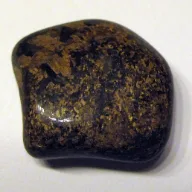 Bronzite
A dark pyroxene with a bronze sheen, from the same family the meteorites are full of.
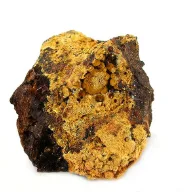 Cacoxenite
Golden needles in iron ore, named the bad guest because they ruined the smelt.
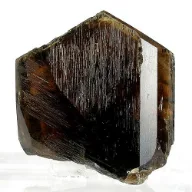 Chrysoberyl
The third hardest gem there is, no relation to beryl, and the only true cat's eye.
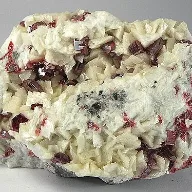 Cinnabar
Mercury ore, the red of every Chinese seal, and the most dangerous mineral in the cabinet.
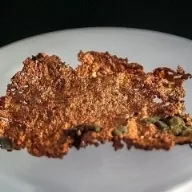 Copper
The first metal anyone ever worked, and one of the few that turns up ready to use.
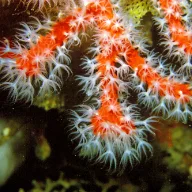 Red coral
The skeleton of a slow-growing animal, worn as a gem for five thousand years.
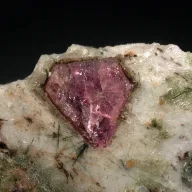 Eudialyte
Raspberry grains in grey Arctic rock, named for dissolving easily.
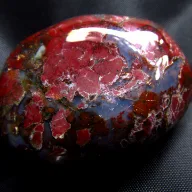 Jasper
Opaque chalcedony, stained by whatever the sediment happened to hold.
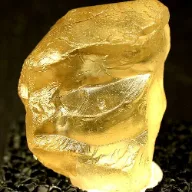 Golden labradorite
Bytownite: a calcium feldspar that cuts into clear champagne gold.
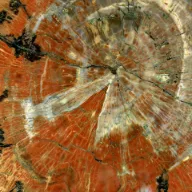 Petrified wood
A tree that became quartz cell by cell, and kept its grain.
 Lepidocrocite
The red half of rust, and the red flecks inside amethyst.
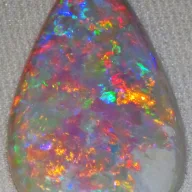 Opal
Water and silica in tiny stacked spheres, splitting light into colour.
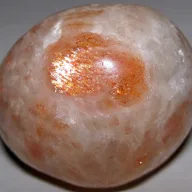 Sunstone
Feldspar full of metal flakes, throwing back the light in orange sparks.
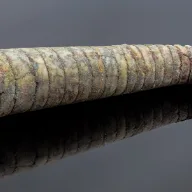 Orthoceras
A straight-shelled squid relative that died four hundred million years ago.
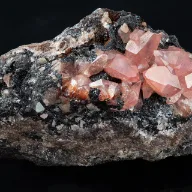 Rhodochrosite
Manganese carbonate in rose red, banded in caves and crystallised in mines.
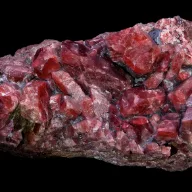 Rhodonite
Pink manganese silicate veined with the black oxide it turns into.
 Ruby
Corundum with chromium in it, and for centuries the most expensive stone on earth.
 Sardonyx
Red-brown and white in straight bands, and the Roman world's seal stone.
 Scheelite
The tungsten ore that glows electric blue under a lamp in the dark.
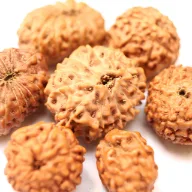 Rudraksha
The stone of a fruit, not of the ground, and the oldest prayer bead in India.
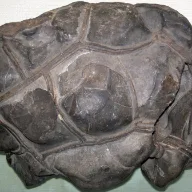 Septarian
A mud nodule that cracked from the inside and filled its own cracks with calcite.
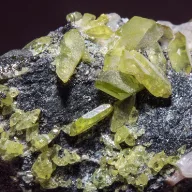 Sphene
Titanite, which throws more fire than a diamond and is far too soft to wear.
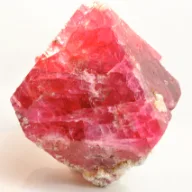 Spinel
Eight hundred years of crown jewels called it a ruby.
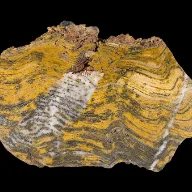 Stromatolite
Three and a half billion years of bacterial mats, turned to stone in layers.
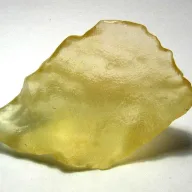 Libyan desert glass
Pale yellow glass lying loose in the Sahara, and a scarab in Tutankhamun's tomb cut from it.
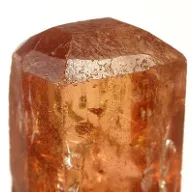 Topaz
Eight on the Mohs scale by definition, and it splits like slate if you hit it right.
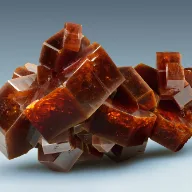 Vanadinite
Hexagonal barrels of orange-red lead vanadate, and the mineral vanadium was found in.
 Zircon
The oldest thing on earth is a grain of it, and no, it is not cubic zirconia.