 Lunarya
Amber
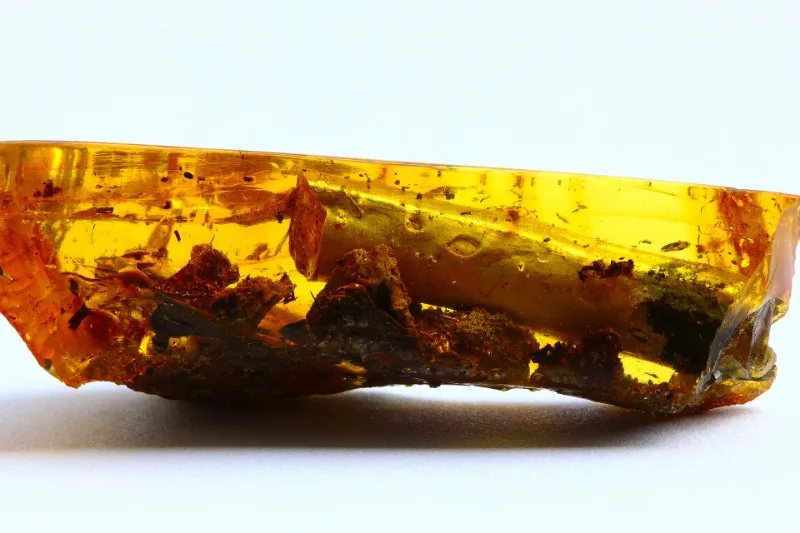
Amber is fossil resin: the sap a conifer bled to seal a wound, buried, oxidised and polymerised until it was hard enough to carve. Baltic amber is about forty-four million years old and about three to eight per cent succinic acid, which is why mineralogists call it succinite. It is soft, warm to the touch, light enough to float in salty water, and it burns — which is the quickest way to know that whatever else it is, it is not a mineral.
Rub a piece on wool and it picks up paper and hair. The Greeks called it elektron and noticed the effect by the sixth century BC; the word for electricity comes from the stone rather than the other way round. Amber also traps whatever was stuck to the resin — midges, ants, spiders, feathers, a lizard's foot, air bubbles from a forest that no longer exists — and those inclusions are the reason palaeontologists care about it at all. The oldest insects in Burmese amber are ninety-nine million years old and still have their hairs.
In short
- Colour
- Red, orange and gold
- Mineral
- Organic, not a mineral
- Formula
- C₁₀H₁₆O
- Hardness
- 2–2.5 on the Mohs scale
- Crystal system
- None — it is organic
- Found in
- The Baltic coast (Kaliningrad, Poland, Lithuania), the Dominican Republic, Myanmar, Mexico (Chiapas), Sicily, Lebanon, and Colți in Buzău county, Romania.
- Element
- Fire
- Planet
- The Sun
- Chakra
- Solar plexus
- Handling
- Keep out of water and sunlight
How it forms
A conifer forest stood on the land now under the Baltic Sea in the Eocene, and for reasons still argued over — heat, disease, insects — it bled resin on a scale nothing does today. The resin hardened, was washed into a river delta and buried in a glauconitic sand the miners call blue earth, where it sat for forty million years while the volatile oils escaped and the rest cross-linked into a solid. Storms still tear lumps out of the seabed and throw them onto the beaches, which is how the Baltic trade began; the mine at Yantarny now digs the blue earth directly and produces most of the world's amber. Dominican amber formed the same way from a legume, not a conifer, and is younger; Burmese amber is older, from the Cretaceous, and comes out of a mine in a conflict zone.
In human hands
Amber travelled the Amber Road from the Baltic to the Adriatic before Rome existed; it is in Mycenaean graves and in a Syrian tomb, and Pliny complained that a figurine of it cost more than a living slave. The Teutonic Knights took the Baltic coast and made gathering amber a monopoly enforced by hanging. Frederick I of Prussia had a room panelled in it, the Amber Room, given to Peter the Great in 1716, looted by the Wehrmacht in 1941 and never seen since. Romania's own amber, romanite, was dug at Colți in Buzău from the nineteenth century: dark red to almost black, harder than Baltic amber, and now mostly in museums.
Varieties and trade names
- Baltic amber (succinite)
- The common one, forty-four million years old, honey to butterscotch; the only amber with much succinic acid in it.
- Dominican blue amber
- Fluoresces blue in daylight over a dark background, from Hispaniola; younger, clearer and full of insects.
- Burmite
- Ninety-nine million years old, red-brown, with the best inclusions in the world and a supply chain worth reading about before buying.
- Romanite
- Romanian amber from Colți, Buzău: dark red-brown to black, harder and more brittle than Baltic, largely worked out.
- Copal
- Resin only thousands of years old, sold as amber to the unwary; it is softer, smells sweeter when heated and dissolves where acetone touches it.
- Pressed amber (ambroid)
- Small scraps heated and squeezed into a block; legal, common, and worth a fraction of solid amber.
Telling it from a fake
Saturated salt water — a couple of spoonfuls in a glass — floats amber and sinks nearly every imitation. A hot pin smells of pine resin in amber, of sweet incense in copal and of burnt plastic in plastic. Rubbed hard on cloth, amber lifts a scrap of paper; glass will not. Under ultraviolet it glows chalky blue-white. Inclusions arranged tidily in the middle of a clear bead, with an insect posed as if for a photograph, are inclusions put there on purpose.
None of this needs a laboratory, and none of it is proof. A shop that will not say whether a stone is treated has answered the question; ask, and have the answer written on the receipt.
What it is said to do
The sun's stone in every tradition that had it: tears of the Heliades in Greece, tears of Freya in the north, congealed sunlight in the Baltic. It is given for warmth, vitality and drawing out what is stuck. Amber teething necklaces are still sold on the claim that succinic acid passes through a baby's skin; there is no evidence that it does, and a cord around an infant's neck is a real strangulation risk, so this is one piece of folklore worth leaving on the shelf.
Living with it
Soft, and dissolved or dulled by nearly everything: no ultrasonic cleaner, no alcohol, no perfume, no acetone. Wipe it with a damp cloth and dry it. It darkens and crazes slowly in air and light, which collectors call patina and sellers call antique.
In magic
Amber is protection in nearly every European tradition that had it: Baltic amulets, Roman charms hung on children, and the necklace of alternating amber and jet beads that a Wiccan high priestess wears, the sun and the night together. Modern practice also uses it to draw out what is stuck — a bad feeling, a bad week — and then cleanses it. Keep it away from salt, alcohol, perfume and strong sun.
- Energy
- Projective
- Day
- Sunday
- Worked for
- Protection · Cleansing
More of this colour
 Garnet
Not one mineral but a whole family, and half of it ends up as sandpaper.
 Carnelian
Orange chalcedony, and the stone hot wax will not stick to.
 Citrine
Yellow quartz, except that most of it is amethyst that has been in an oven.
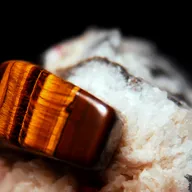 Tiger's eye
A stripe of light that slides across the stone when you tilt it.
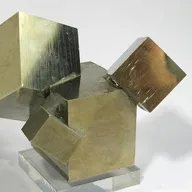 Pyrite
Fool's gold, in cubes so sharp they look machined.
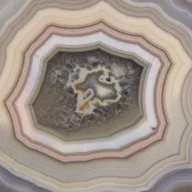 Agate
Chalcedony laid down in bands, one over the next, inside a bubble in old lava.
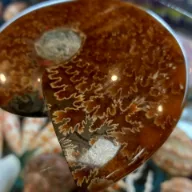 Ammonite
A shell that spiralled through the seas for three hundred million years, turned to stone.
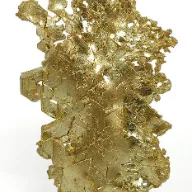 Gold
The one metal that comes out of the ground already finished.
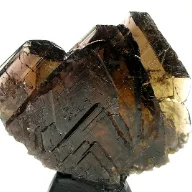 Axinite
Clove-brown wedges of a boron silicate, sharp enough to be named for an axe.
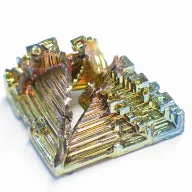 Bismuth
A metal that grows in rainbow staircases — in a saucepan, mostly.
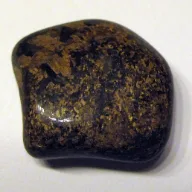 Bronzite
A dark pyroxene with a bronze sheen, from the same family the meteorites are full of.
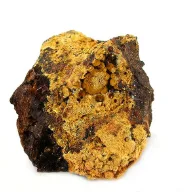 Cacoxenite
Golden needles in iron ore, named the bad guest because they ruined the smelt.
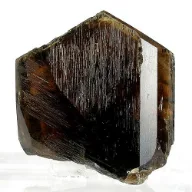 Chrysoberyl
The third hardest gem there is, no relation to beryl, and the only true cat's eye.
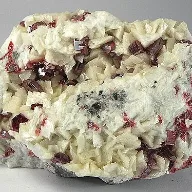 Cinnabar
Mercury ore, the red of every Chinese seal, and the most dangerous mineral in the cabinet.
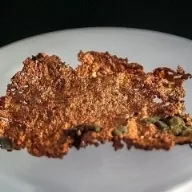 Copper
The first metal anyone ever worked, and one of the few that turns up ready to use.
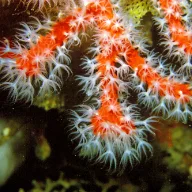 Red coral
The skeleton of a slow-growing animal, worn as a gem for five thousand years.
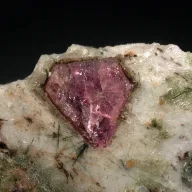 Eudialyte
Raspberry grains in grey Arctic rock, named for dissolving easily.
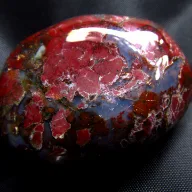 Jasper
Opaque chalcedony, stained by whatever the sediment happened to hold.
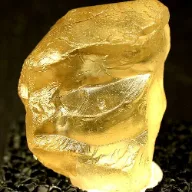 Golden labradorite
Bytownite: a calcium feldspar that cuts into clear champagne gold.
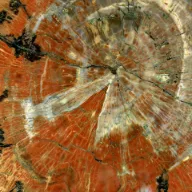 Petrified wood
A tree that became quartz cell by cell, and kept its grain.
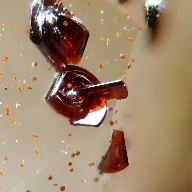 Lepidocrocite
The red half of rust, and the red flecks inside amethyst.
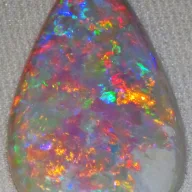 Opal
Water and silica in tiny stacked spheres, splitting light into colour.
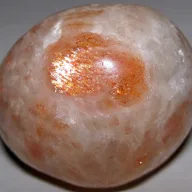 Sunstone
Feldspar full of metal flakes, throwing back the light in orange sparks.
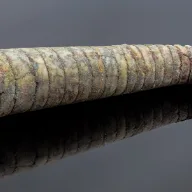 Orthoceras
A straight-shelled squid relative that died four hundred million years ago.
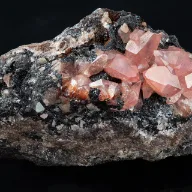 Rhodochrosite
Manganese carbonate in rose red, banded in caves and crystallised in mines.
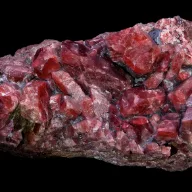 Rhodonite
Pink manganese silicate veined with the black oxide it turns into.
 Ruby
Corundum with chromium in it, and for centuries the most expensive stone on earth.
 Sardonyx
Red-brown and white in straight bands, and the Roman world's seal stone.
 Scheelite
The tungsten ore that glows electric blue under a lamp in the dark.
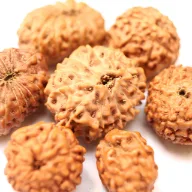 Rudraksha
The stone of a fruit, not of the ground, and the oldest prayer bead in India.
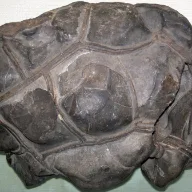 Septarian
A mud nodule that cracked from the inside and filled its own cracks with calcite.
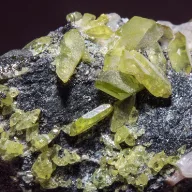 Sphene
Titanite, which throws more fire than a diamond and is far too soft to wear.
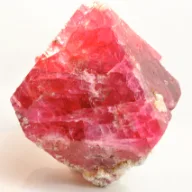 Spinel
Eight hundred years of crown jewels called it a ruby.
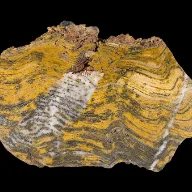 Stromatolite
Three and a half billion years of bacterial mats, turned to stone in layers.
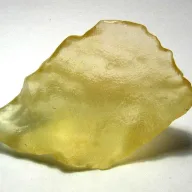 Libyan desert glass
Pale yellow glass lying loose in the Sahara, and a scarab in Tutankhamun's tomb cut from it.
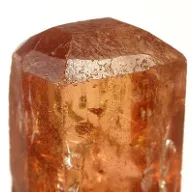 Topaz
Eight on the Mohs scale by definition, and it splits like slate if you hit it right.
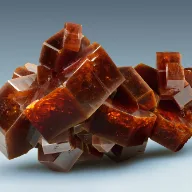 Vanadinite
Hexagonal barrels of orange-red lead vanadate, and the mineral vanadium was found in.
 Zircon
The oldest thing on earth is a grain of it, and no, it is not cubic zirconia.