 Lunarya
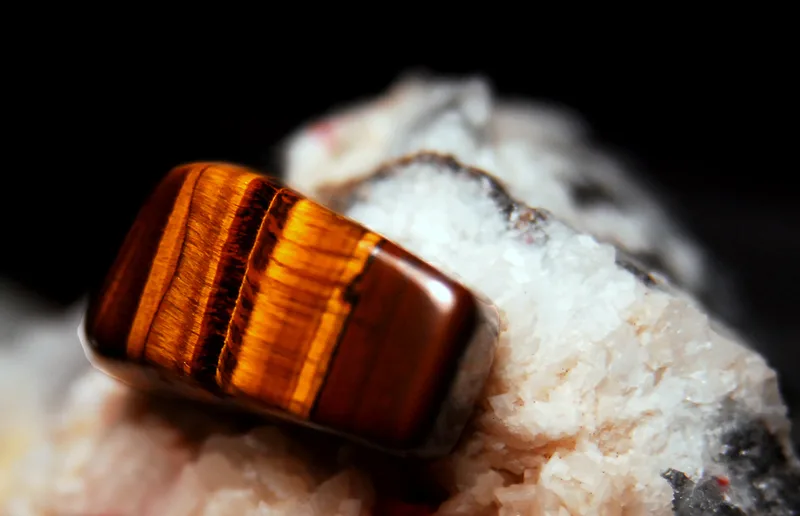
Tiger's eye
Tiger's eye is quartz that has grown through a mass of parallel mineral fibres, and the band of light that slides over its surface — chatoyancy, the cat's-eye effect — is those fibres reflecting together. The gold-brown colour is iron oxide staining; where the iron has not oxidised, the same stone is blue-grey and is sold as hawk's eye.
For a long time it was explained as quartz replacing crocidolite fibre by fibre, a pseudomorph. The better current reading is that quartz and the fibrous amphibole grew at the same time in a crack that was being pulled open, which explains the wavy, column-by-column structure you see in a cut slab. Almost all of it comes from one region: the Northern Cape of South Africa, where it is quarried in beds inside banded ironstone.
In short
- Colour
- Red, orange and gold
- Mineral
- Quartz
- Formula
- SiO₂
- Hardness
- 7 on the Mohs scale
- Crystal system
- Trigonal
- Found in
- South Africa, with smaller amounts from Western Australia and India.
- Element
- Fire
- Planet
- The Sun
- Chakra
- Solar plexus
- Handling
- Water and light are both fine
How it forms
Tiger's eye is quartz that took the place of crocidolite, blue asbestos, keeping the alignment of the fibres, while the iron in the asbestos oxidised to golden goethite; light reflecting off the parallel fibres is the band that moves when you tilt it. Where the process stopped before the blue oxidised, the stone is hawk's eye. The textbook version, quartz replacing asbestos fibre by fibre, was revised in 2003 by geologists who found the two had grown together in cracks that opened and sealed repeatedly. Nearly all of it comes from one belt of ancient ironstone in the Northern Cape of South Africa, laid down two billion years ago.
In human hands
It has no ancient history under its own name, because the deposits were only opened in the second half of the nineteenth century, when it reached Europe from the Cape and sold, at first, at gemstone prices, until the hills turned out to be made of it. The Victorians cut it into cameos and men's rings; the Art Deco jewellers liked its stripes. The mines were asbestos mines, and the asbestos was the point: the tiger's eye was a by-product, and the finished stone, being quartz, is safe, though raw hawk's eye can still carry unreplaced fibre and is not for cutting in a kitchen.
Varieties and trade names
- Golden tiger's eye
- The familiar one: honey and brown in a single bright stripe that slides as the stone turns, from South Africa's Northern Cape.
- Hawk's eye
- The blue-grey stage, where the asbestos fibres are still there and the iron has not yet turned gold.
- Red tiger's eye
- Tiger's eye heated until the goethite becomes hematite; it is real tiger's eye with a changed colour.
- Tiger iron
- Bands of tiger's eye, red jasper and black hematite together, from Western Australia; heavier than it looks.
- Pietersite
- Tiger's eye and hawk's eye broken up and cemented back together in swirls; it has a page of its own here.
Telling it from a fake
It is cheap enough that outright fakes are rare, and the imitation on sale is fibre-optic glass: a very sharp, dead-straight eye, a colour that is even from edge to edge, and, often, a blue, pink or green that no tiger's eye has. Real tiger's eye has bands that waver, a silky sheen that moves as the stone turns, and gold that shades into brown unevenly. Beads in uniform bright colours are dyed or glass; red tiger's eye is real and heated, and there is nothing wrong with it.
None of this needs a laboratory, and none of it is proof. A shop that will not say whether a stone is treated has answered the question; ask, and have the answer written on the receipt.
What it is said to do
A stone of nerve and shrewdness, traditionally worn as protection against being deceived — the eye that watches back. It is given for holding your ground in a negotiation and for staying focused on a thing that has stopped being interesting.
Living with it
Hard, tough, safe in water, and unbothered by light. One of the few on this list that will survive being carried loose in a pocket for years.
In magic
A stone for nerve and for seeing through people. Modern practice puts it in protection charms against deceit, carries it to a negotiation or an interview, and adds it to money bags for a business that needs a hard head. The eye that seems to open and close as it turns is the whole of its magic, and a good one: amulets against the evil eye have always looked back.
- Energy
- Projective
- Day
- Sunday
- Worked for
- Protection · Courage and drive · Money and luck
More of this colour
 Garnet
Not one mineral but a whole family, and half of it ends up as sandpaper.
 Carnelian
Orange chalcedony, and the stone hot wax will not stick to.
 Citrine
Yellow quartz, except that most of it is amethyst that has been in an oven.
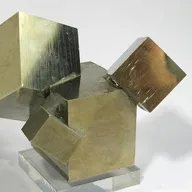 Pyrite
Fool's gold, in cubes so sharp they look machined.
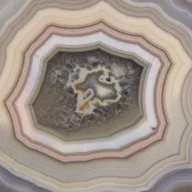 Agate
Chalcedony laid down in bands, one over the next, inside a bubble in old lava.
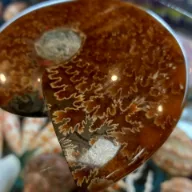 Ammonite
A shell that spiralled through the seas for three hundred million years, turned to stone.
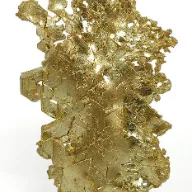 Gold
The one metal that comes out of the ground already finished.
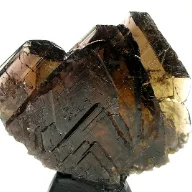 Axinite
Clove-brown wedges of a boron silicate, sharp enough to be named for an axe.
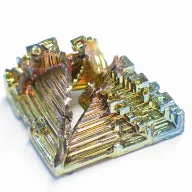 Bismuth
A metal that grows in rainbow staircases — in a saucepan, mostly.
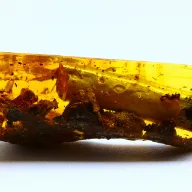 Amber
Not a stone at all: tree resin that leaked out forty million years ago and went hard.
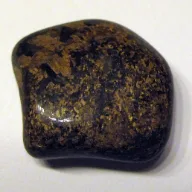 Bronzite
A dark pyroxene with a bronze sheen, from the same family the meteorites are full of.
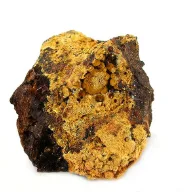 Cacoxenite
Golden needles in iron ore, named the bad guest because they ruined the smelt.
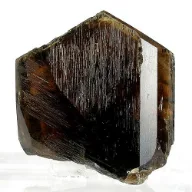 Chrysoberyl
The third hardest gem there is, no relation to beryl, and the only true cat's eye.
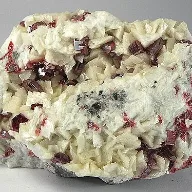 Cinnabar
Mercury ore, the red of every Chinese seal, and the most dangerous mineral in the cabinet.
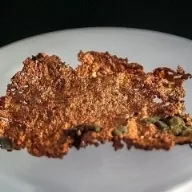 Copper
The first metal anyone ever worked, and one of the few that turns up ready to use.
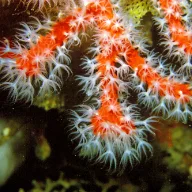 Red coral
The skeleton of a slow-growing animal, worn as a gem for five thousand years.
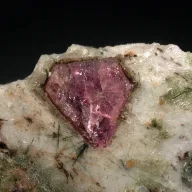 Eudialyte
Raspberry grains in grey Arctic rock, named for dissolving easily.
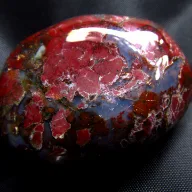 Jasper
Opaque chalcedony, stained by whatever the sediment happened to hold.
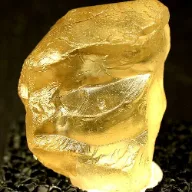 Golden labradorite
Bytownite: a calcium feldspar that cuts into clear champagne gold.
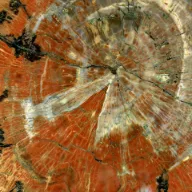 Petrified wood
A tree that became quartz cell by cell, and kept its grain.
 Lepidocrocite
The red half of rust, and the red flecks inside amethyst.
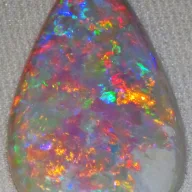 Opal
Water and silica in tiny stacked spheres, splitting light into colour.
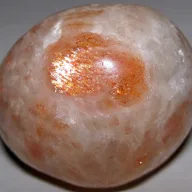 Sunstone
Feldspar full of metal flakes, throwing back the light in orange sparks.
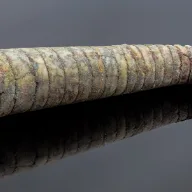 Orthoceras
A straight-shelled squid relative that died four hundred million years ago.
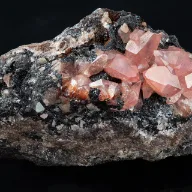 Rhodochrosite
Manganese carbonate in rose red, banded in caves and crystallised in mines.
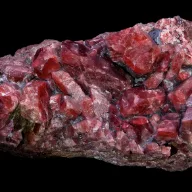 Rhodonite
Pink manganese silicate veined with the black oxide it turns into.
 Ruby
Corundum with chromium in it, and for centuries the most expensive stone on earth.
 Sardonyx
Red-brown and white in straight bands, and the Roman world's seal stone.
 Scheelite
The tungsten ore that glows electric blue under a lamp in the dark.
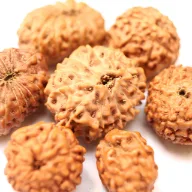 Rudraksha
The stone of a fruit, not of the ground, and the oldest prayer bead in India.
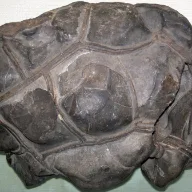 Septarian
A mud nodule that cracked from the inside and filled its own cracks with calcite.
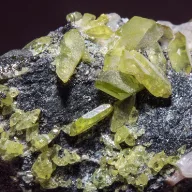 Sphene
Titanite, which throws more fire than a diamond and is far too soft to wear.
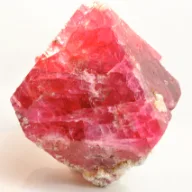 Spinel
Eight hundred years of crown jewels called it a ruby.
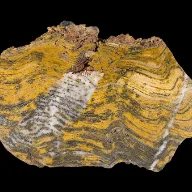 Stromatolite
Three and a half billion years of bacterial mats, turned to stone in layers.
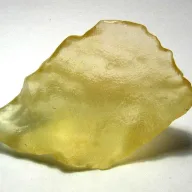 Libyan desert glass
Pale yellow glass lying loose in the Sahara, and a scarab in Tutankhamun's tomb cut from it.
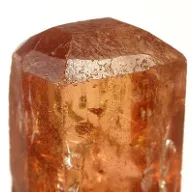 Topaz
Eight on the Mohs scale by definition, and it splits like slate if you hit it right.
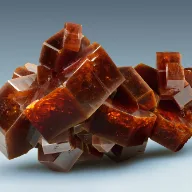 Vanadinite
Hexagonal barrels of orange-red lead vanadate, and the mineral vanadium was found in.
 Zircon
The oldest thing on earth is a grain of it, and no, it is not cubic zirconia.