 Lunarya
Pyrite
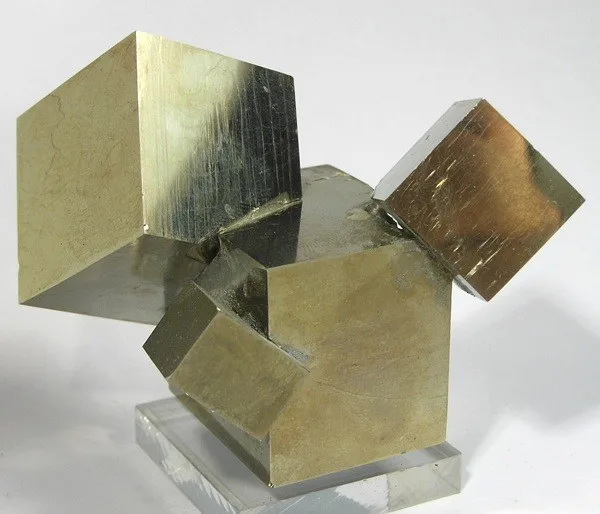
Iron sulfide, brassy yellow with a metallic shine, and famous for growing in cubes with striated faces that look as though somebody cut them. It is harder than gold and much lighter, which is how prospectors told the difference, and it leaves a greenish-black streak where gold leaves gold.
The name is Greek, from pyr, fire: struck against flint it throws sparks, and it was carried in fire-lighting kits and used in the earliest wheel-lock firearms. It is also the main source of the sulfur dioxide problem in coal, and its slow oxidation in damp air — pyrite decay — is a real headache in museums, where specimens crumble to a crust of iron sulfate and sulfuric acid that attacks whatever they are stored with.
In short
- Colour
- Red, orange and gold
- Mineral
- Sulfide
- Formula
- FeS₂
- Hardness
- 6–6.5 on the Mohs scale
- Crystal system
- Cubic
- Found in
- Spain (Navajún, for the perfect cubes), Peru, Italy and everywhere coal is mined.
- Element
- Fire
- Planet
- Mars
- Chakra
- Solar plexus
- Handling
- Keep out of water
How it forms
Iron sulfide forms wherever iron and sulfur meet without oxygen: in black shales and coal, where bacteria make it in raspberry-shaped clusters too small to see; around vents on the sea floor; and in hydrothermal veins, with gold. The perfect cubes of Navajún in northern Spain grew inside a soft marl as the sediment compacted, pushing the clay aside, and the fine lines on their faces come from the crystal alternating between two shapes as it grew. Pyrite also replaces fossils, which is where pyritised ammonites come from, and in damp air it rots into iron sulfate and sulfuric acid, which is why old specimens crumble.
In human hands
The name is from the Greek for fire: struck against flint it sparks, and people lit fires with it from the Stone Age until matches, with the wheellock guns of the sixteenth century in between. The Aztecs and Incas polished it into mirrors. Its other name was earned in 1577, when Martin Frobisher shipped fourteen hundred tons of it home from Baffin Island as gold ore. For a century it was the world's source of sulfuric acid, roasted by the trainload, and the marcasite jewellery of the Georgians and Victorians, in spite of the name, was cut from pyrite.
Varieties and trade names
- Navajún cubes
- The mirror-faced cubes from La Rioja, Spain, that look machined and are not; the classic specimen, sold still in their grey marl.
- Pyrite suns
- Flat radiating discs from the coal shales of Illinois, pressed thin between the layers of rock.
- Marcasite
- A different mineral with the same formula and a worse temper, and the jewellery name for cut pyrite, which is more stable.
- Pyritised fossils
- Ammonites and other shells replaced by pyrite, gold on the outside and, sometimes, gold in the chambers.
Telling it from a fake
Nobody fakes pyrite; the question is whether pyrite is being sold as gold. Gold is soft — a pin dents it — and bends; pyrite is brittle, scratches glass and shatters under the pin. Gold is yellow in shade and in sun; pyrite is brassy and goes darker in shade. Rubbed on unglazed porcelain, gold leaves a gold streak and pyrite a greenish black one, and gold never grows in striated cubes. Chalcopyrite is yellower, softer and tarnishes blue and purple. The gold nuggets in a tourist shop are usually pyrite or brass.
None of this needs a laboratory, and none of it is proof. A shop that will not say whether a stone is treated has answered the question; ask, and have the answer written on the receipt.
What it is said to do
The stone of enterprise and of looking like you belong in the room: it is kept for money and ambition, and read as a shield, on the idea that something this bright and this hard deflects what is aimed at it.
Living with it
Keep it dry — genuinely dry, not just out of the sink. Damp air alone will eventually break a specimen down, so a closed cabinet suits it better than a bathroom shelf, and wash your hands after handling a raw piece.
In magic
Fool's gold is the classic stone of money spells: a cube on the desk, in the till or in a jar with coins and cinnamon, worked on a Sunday or a Thursday as the moon waxes. Its mirror faces give it a second use, as a shield that sends harm back to where it came from, and craftsmen in the ancient Americas made real mirrors from it. It must stay dry: no moon water, no ritual baths, no salt.
- Energy
- Projective
- Day
- Tuesday
- Worked for
- Money and luck · Protection
More of this colour
 Garnet
Not one mineral but a whole family, and half of it ends up as sandpaper.
 Carnelian
Orange chalcedony, and the stone hot wax will not stick to.
 Citrine
Yellow quartz, except that most of it is amethyst that has been in an oven.
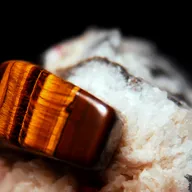 Tiger's eye
A stripe of light that slides across the stone when you tilt it.
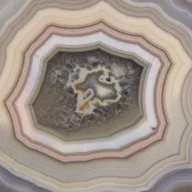 Agate
Chalcedony laid down in bands, one over the next, inside a bubble in old lava.
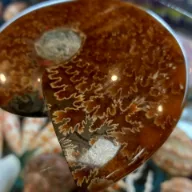 Ammonite
A shell that spiralled through the seas for three hundred million years, turned to stone.
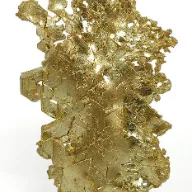 Gold
The one metal that comes out of the ground already finished.
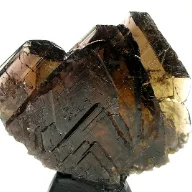 Axinite
Clove-brown wedges of a boron silicate, sharp enough to be named for an axe.
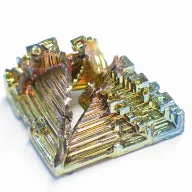 Bismuth
A metal that grows in rainbow staircases — in a saucepan, mostly.
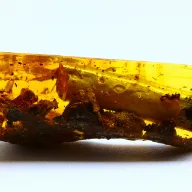 Amber
Not a stone at all: tree resin that leaked out forty million years ago and went hard.
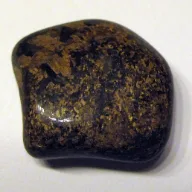 Bronzite
A dark pyroxene with a bronze sheen, from the same family the meteorites are full of.
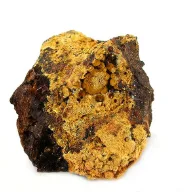 Cacoxenite
Golden needles in iron ore, named the bad guest because they ruined the smelt.
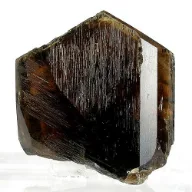 Chrysoberyl
The third hardest gem there is, no relation to beryl, and the only true cat's eye.
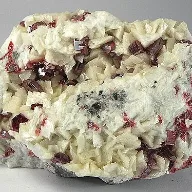 Cinnabar
Mercury ore, the red of every Chinese seal, and the most dangerous mineral in the cabinet.
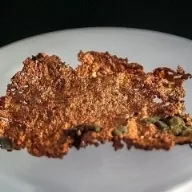 Copper
The first metal anyone ever worked, and one of the few that turns up ready to use.
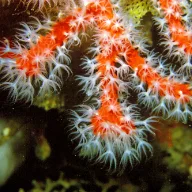 Red coral
The skeleton of a slow-growing animal, worn as a gem for five thousand years.
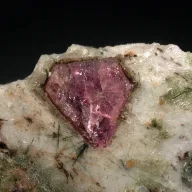 Eudialyte
Raspberry grains in grey Arctic rock, named for dissolving easily.
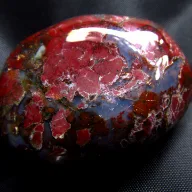 Jasper
Opaque chalcedony, stained by whatever the sediment happened to hold.
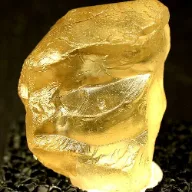 Golden labradorite
Bytownite: a calcium feldspar that cuts into clear champagne gold.
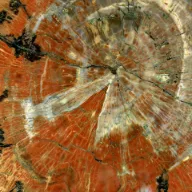 Petrified wood
A tree that became quartz cell by cell, and kept its grain.
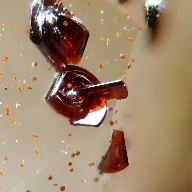 Lepidocrocite
The red half of rust, and the red flecks inside amethyst.
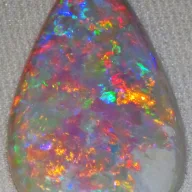 Opal
Water and silica in tiny stacked spheres, splitting light into colour.
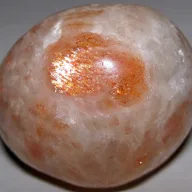 Sunstone
Feldspar full of metal flakes, throwing back the light in orange sparks.
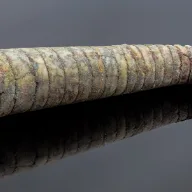 Orthoceras
A straight-shelled squid relative that died four hundred million years ago.
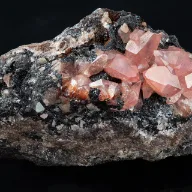 Rhodochrosite
Manganese carbonate in rose red, banded in caves and crystallised in mines.
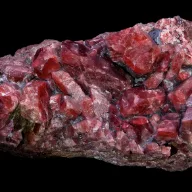 Rhodonite
Pink manganese silicate veined with the black oxide it turns into.
 Ruby
Corundum with chromium in it, and for centuries the most expensive stone on earth.
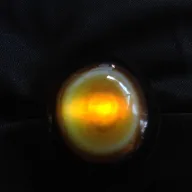 Sardonyx
Red-brown and white in straight bands, and the Roman world's seal stone.
 Scheelite
The tungsten ore that glows electric blue under a lamp in the dark.
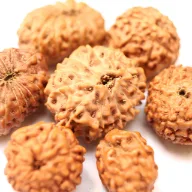 Rudraksha
The stone of a fruit, not of the ground, and the oldest prayer bead in India.
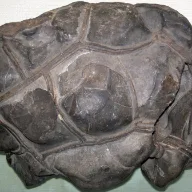 Septarian
A mud nodule that cracked from the inside and filled its own cracks with calcite.
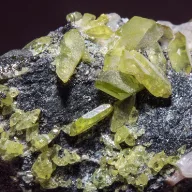 Sphene
Titanite, which throws more fire than a diamond and is far too soft to wear.
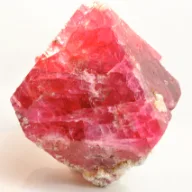 Spinel
Eight hundred years of crown jewels called it a ruby.
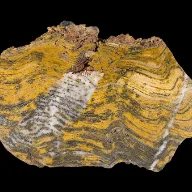 Stromatolite
Three and a half billion years of bacterial mats, turned to stone in layers.
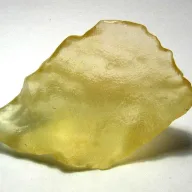 Libyan desert glass
Pale yellow glass lying loose in the Sahara, and a scarab in Tutankhamun's tomb cut from it.
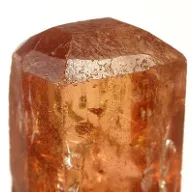 Topaz
Eight on the Mohs scale by definition, and it splits like slate if you hit it right.
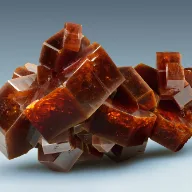 Vanadinite
Hexagonal barrels of orange-red lead vanadate, and the mineral vanadium was found in.
 Zircon
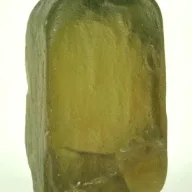
The oldest thing on earth is a grain of it, and no, it is not cubic zirconia.