 Lunarya
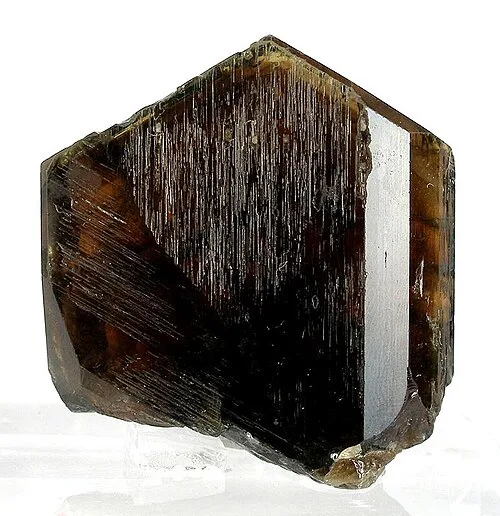
Chrysoberyl
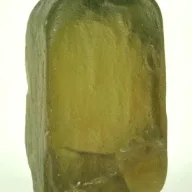
Chrysoberyl is beryllium aluminium oxide, BeAl₂O₄: hard, tough, orthorhombic, and despite the name not a beryl at all. At eight and a half on the Mohs scale it is beaten only by diamond and corundum, and it comes in honey yellow, greenish gold and brown, as well as the two varieties everyone knows it by — alexandrite, which changes colour, and cymophane, the cat's eye.
The eye is the sharpest in gemmology. Fine parallel tubes or needles inside the stone reflect a single line of light, and in a good cabochon that line is knife-thin and opens and closes as the light moves across it — jewellers call the trick milk and honey, since the stone looks half milky and half golden when the eye is centred. Chrysoberyl also twins into pseudo-hexagonal trillings, three crystals grown together at sixty degrees, which look like a single six-sided crystal with a seam.
In short
- Colour
- Red, orange and gold
- Mineral
- Oxide
- Formula
- BeAl₂O₄
- Hardness
- 8.5 on the Mohs scale
- Crystal system
- Orthorhombic
- Found in
- Sri Lanka, Brazil (Minas Gerais and Espírito Santo), Madagascar, Myanmar, Tanzania, Zimbabwe and the Urals.
- Element
- Fire
- Planet
- The Sun
- Chakra
- Solar plexus
- Handling
- Water and light are both fine
How it forms
Beryllium is rare and only concentrates in the last watery melt of a granite, so chrysoberyl grows in pegmatites and in the mica schists that granite fluids have soaked. Unlike beryl, it forms where there is plenty of aluminium and not much silica; where there is silica to spare you get beryl instead. Being hard and heavy, it survives the destruction of its parent rock and collects in river gravels, and the gem gravels of Sri Lanka — the illam, worked for two thousand years — are where most cut chrysoberyl has come from.
In human hands
Sri Lankan cat's eye reached Rome and, by way of the Arab trade, India and China. Werner named the species in 1789. Alexandrite was found in the Urals in the 1830s and named for the tsarevich; cat's eye became a Victorian craze after the Duke of Connaught gave one as an engagement ring in 1878, and prices tripled. In Vedic astrology the cat's eye, lehsunia, is the stone of Ketu, the descending lunar node, and is worn to fend off sudden loss — one of the few stone traditions still followed as strictly as it was two centuries ago.
Varieties and trade names
- Alexandrite
- Chromium-bearing chrysoberyl that reads green by daylight and red by lamplight; it has its own page here.
- Cymophane
- Cat's eye chrysoberyl, honey to greenish, with a single sharp line of light across the dome.
- Alexandrite cat's eye
- Both effects in one stone, from Sri Lanka and Brazil; among the rarest gems there are.
- Trilling
- Three crystals twinned into a pseudo-hexagonal wheel, the classic collector's habit from Brazil.
- Yellow chrysoberyl
- Plain transparent gold to greenish-yellow, faceted and sold simply as chrysoberyl; the old name chrysolite for it caused two centuries of confusion with peridot.
Telling it from a fake
It scratches quartz without effort, which rules out the cat's eye quartzes and tiger's eye sold beside it; those have a broader, softer band of light. Fibre-optic glass cat's eyes are too perfect and show a honeycomb of fibre ends on the base. Cat's eye tourmaline and apatite are softer and their eyes woollier. A greenish-yellow stone that does not change colour under a lamp is chrysoberyl, not alexandrite, whatever the certificate hopes.
None of this needs a laboratory, and none of it is proof. A shop that will not say whether a stone is treated has answered the question; ask, and have the answer written on the receipt.
What it is said to do
Given for discipline, clear-headedness and the kind of protection that is really foresight: the books call it a stone for taking charge of one's own affairs, and cat's eye in particular is an amulet against the evil eye, against sudden loss and — in India and among gamblers everywhere — against the run of bad luck. The Ketu tradition is the oldest living piece of it.
Living with it
Hard, tough and safe in a ring worn daily. Warm soapy water and a brush; an ultrasonic cleaner is fine for clean stones, though cat's eyes full of tubes are better washed by hand. Nothing about it fades.
In magic
Cat's eye chrysoberyl is one of the most serious amulets in the world. In Vedic astrology it is the gem of Ketu, the moon's south node, worn against sudden loss, the evil eye and a gambler's bad run, and it is one of the nine stones of the navaratna. Modern practice keeps it for protection and luck, and uses yellow chrysoberyl in solar spells. It is hard and stable enough for any ritual.
- Energy
- Projective
- Day
- Sunday
- Worked for
- Protection · Money and luck
More of this colour
 Garnet
Not one mineral but a whole family, and half of it ends up as sandpaper.
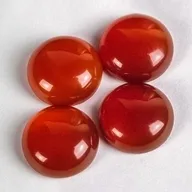 Carnelian
Orange chalcedony, and the stone hot wax will not stick to.
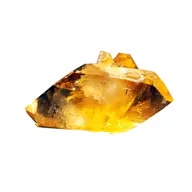 Citrine
Yellow quartz, except that most of it is amethyst that has been in an oven.
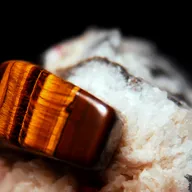 Tiger's eye
A stripe of light that slides across the stone when you tilt it.
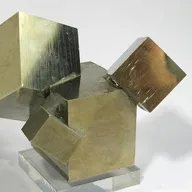 Pyrite
Fool's gold, in cubes so sharp they look machined.
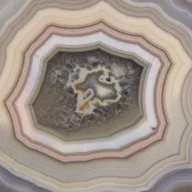 Agate
Chalcedony laid down in bands, one over the next, inside a bubble in old lava.
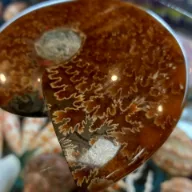 Ammonite
A shell that spiralled through the seas for three hundred million years, turned to stone.
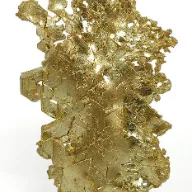 Gold
The one metal that comes out of the ground already finished.
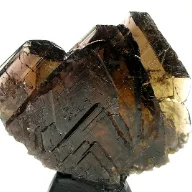 Axinite
Clove-brown wedges of a boron silicate, sharp enough to be named for an axe.
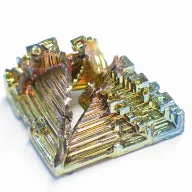 Bismuth
A metal that grows in rainbow staircases — in a saucepan, mostly.
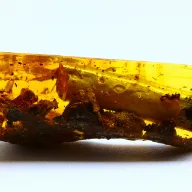 Amber
Not a stone at all: tree resin that leaked out forty million years ago and went hard.
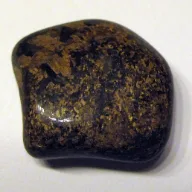 Bronzite
A dark pyroxene with a bronze sheen, from the same family the meteorites are full of.
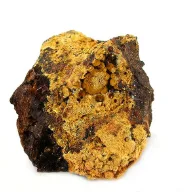 Cacoxenite
Golden needles in iron ore, named the bad guest because they ruined the smelt.
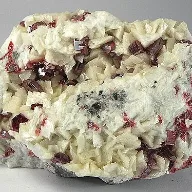 Cinnabar
Mercury ore, the red of every Chinese seal, and the most dangerous mineral in the cabinet.
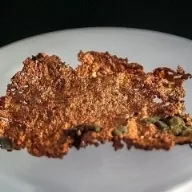 Copper
The first metal anyone ever worked, and one of the few that turns up ready to use.
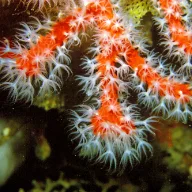 Red coral
The skeleton of a slow-growing animal, worn as a gem for five thousand years.
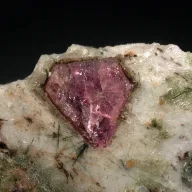 Eudialyte
Raspberry grains in grey Arctic rock, named for dissolving easily.
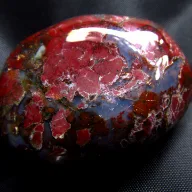 Jasper
Opaque chalcedony, stained by whatever the sediment happened to hold.
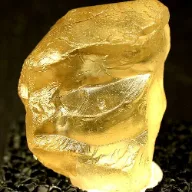 Golden labradorite
Bytownite: a calcium feldspar that cuts into clear champagne gold.
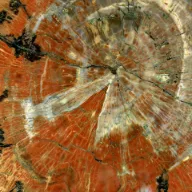 Petrified wood
A tree that became quartz cell by cell, and kept its grain.
 Lepidocrocite
The red half of rust, and the red flecks inside amethyst.
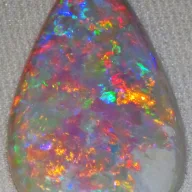 Opal
Water and silica in tiny stacked spheres, splitting light into colour.
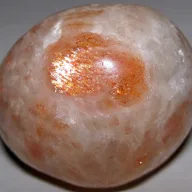 Sunstone
Feldspar full of metal flakes, throwing back the light in orange sparks.
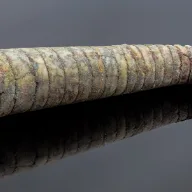 Orthoceras
A straight-shelled squid relative that died four hundred million years ago.
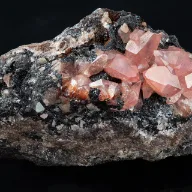 Rhodochrosite
Manganese carbonate in rose red, banded in caves and crystallised in mines.
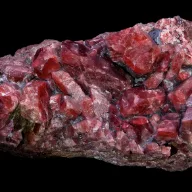 Rhodonite
Pink manganese silicate veined with the black oxide it turns into.
 Ruby
Corundum with chromium in it, and for centuries the most expensive stone on earth.
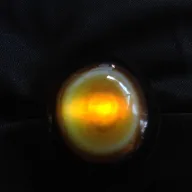 Sardonyx
Red-brown and white in straight bands, and the Roman world's seal stone.
 Scheelite
The tungsten ore that glows electric blue under a lamp in the dark.
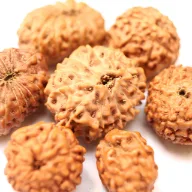 Rudraksha
The stone of a fruit, not of the ground, and the oldest prayer bead in India.
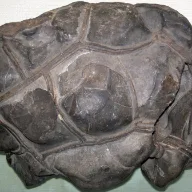 Septarian
A mud nodule that cracked from the inside and filled its own cracks with calcite.
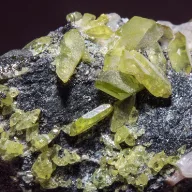 Sphene
Titanite, which throws more fire than a diamond and is far too soft to wear.
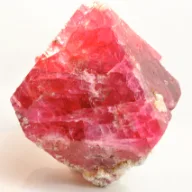 Spinel
Eight hundred years of crown jewels called it a ruby.
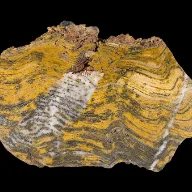 Stromatolite
Three and a half billion years of bacterial mats, turned to stone in layers.
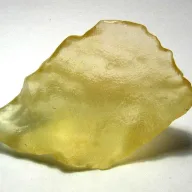 Libyan desert glass
Pale yellow glass lying loose in the Sahara, and a scarab in Tutankhamun's tomb cut from it.
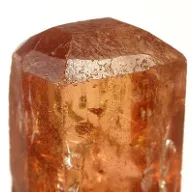 Topaz
Eight on the Mohs scale by definition, and it splits like slate if you hit it right.
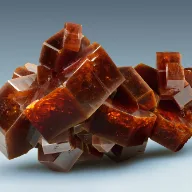 Vanadinite
Hexagonal barrels of orange-red lead vanadate, and the mineral vanadium was found in.
 Zircon
The oldest thing on earth is a grain of it, and no, it is not cubic zirconia.