 Lunarya
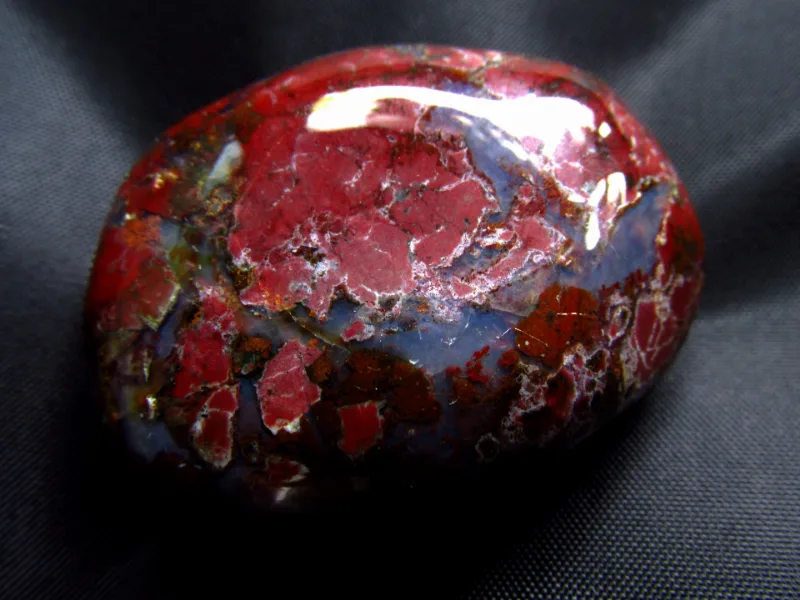
Jasper
Jasper is opaque chalcedony: microcrystalline quartz with enough foreign material in it, often a fifth of the stone by weight, to stop light altogether. Iron oxide gives the reds and yellows, chlorite the greens, manganese and carbon the blacks and greys. There is no single jasper. It is a family name for a rock-like quartz that takes a fine polish and arrives in every pattern a sediment or an ash bed can produce.
Hardness 6.5 to 7, no cleavage, and tough enough that it was the knapping stone of choice wherever flint was scarce. Where agate is banded and translucent, jasper is solid and patterned, and the two grade into one another in a single nodule — agate-jasper is a recognised category. The hundreds of trade names are mostly localities or descriptions rather than distinct materials, and a good number of the most popular are not jaspers at all: several are rhyolite, one is a limestone, and one is a granite.
In short
- Colour
- Red, orange and gold
- Mineral
- Chalcedony
- Formula
- SiO₂
- Hardness
- 6.5–7 on the Mohs scale
- Crystal system
- Trigonal
- Found in
- Everywhere, which is part of the point. India supplies most plain red and green material; the picture jaspers come from Oregon and Idaho, mookaite from Western Australia, ocean jasper from Madagascar, and the celebrated banded jaspers of Orsk from the Urals. Brazil, South Africa, Egypt, Mexico and Russia all produce their own.
- Element
- Earth
- Planet
- Mars
- Chakra
- Root
- Handling
- Water and light are both fine
How it forms
Silica-rich water moves through volcanic ash, tuff or porous sediment and precipitates quartz in the pore spaces, carrying iron, clay and manganese with it. As the rock is cemented grain by grain, the impurities are locked in place, which is why jasper reproduces the structure of what it replaced — bedding, brecciation, the shape of an old gas cavity. Some jasper is a direct chemical sediment instead, laid down on a sea floor with iron, which is the origin of the banded iron formation jaspers.
In human hands
One of the oldest worked stones: Egyptian amulets, Minoan seals, Roman intaglios and Assyrian cylinder seals are all cut in it. The name travels through Greek iaspis and Persian yašp, though the classical iaspis usually meant green chalcedony rather than what we call jasper. It is named among the stones of the high priest breastplate and the foundations of the New Jerusalem. In North America it was knapped for points wherever it outcropped.
Varieties and trade names
- Red jasper
- The plain iron-stained stone, brick to blood red; the oldest and still the commonest.
- Picture jasper
- Oregon and Idaho material whose iron staining reads as desert landscapes; the pattern is sediment, not scenery.
- Mookaite
- Australian, from the Windalia radiolarite: a genuine silicified sediment in cream, mustard and burgundy.
- Ocean jasper
- Orbicular chalcedony and rhyolite from Marovato in Madagascar; the orbs are radiating spherulites.
- Kambaba
- Green and black orbs from Madagascar; a sedimentary rhyolitic rock, often sold as fossil stromatolite, which has a page of its own here and is nothing like it.
- Leopard jasper
- Mexican orbicular rhyolite with ringed spots; a volcanic rock rather than a chalcedony.
- Rainforest jasper
- Queensland rhyolite, green and cream; again a lava rather than a true jasper.
- Laguna
- Laguna material from Chihuahua is properly an agate, banded and translucent, not a jasper.
- Dalmatian stone
- Not a jasper: a pale feldspar rock spotted with black arfvedsonite, which has a page of its own here.
- Calligraphy stone
- Sold as sanskrit jasper; a fossiliferous limestone from India, and the script is crinoid and shell debris.
- Unakite
- Also not a jasper: a granite of pink feldspar and green epidote, from the Unaka range in the Appalachians.
Telling it from a fake
Opaque, waxy to glassy, no cleavage, and hard enough to scratch glass. That combination rules out most imitations at once. The things to be careful of are colour treatments: bright blue, purple and turquoise jaspers are dyed, and so-called sea sediment jasper or impression jasper is usually dyed magnesite or a reconstituted powder-and-resin material, which is lighter, warmer to the touch and smells under a hot pin. Natural jasper colours are earth colours.
None of this needs a laboratory, and none of it is proof. A shop that will not say whether a stone is treated has answered the question; ask, and have the answer written on the receipt.
What it is said to do
The standard modern reading calls it the supreme nurturer and gives it to endurance: the stone for a long job, for physical work, for getting through a stretch rather than making a leap. Each variety then carries its own gloss in the books. It is given to Mars, to Aries and Taurus, and to the root. The old traditions, which are considerable, mostly concern its use for seals and amulets rather than for healing.
Living with it
Easy to live with. Water and sunlight do no harm to natural material, it takes daily wear, and a soft brush and warm water clean it. Dyed pieces are the exception: they bleed, they fade, and they should not go near an ultrasonic tank. Reconstituted material can come apart in hot water.
In magic
Jasper is an old amulet stone: many of the engraved magical gems of the Roman empire are jasper, red and green, carved with gods and charms. Modern practice uses it for endurance in long workings and for protection, and puts a piece of red jasper in the pocket of somebody who has to get through a hard week. It is the easiest stone in the cabinet to keep for ritual.
- Energy
- Receptive
- Day
- Tuesday
- Worked for
- Grounding and endurance · Protection
More of this colour
 Garnet
Not one mineral but a whole family, and half of it ends up as sandpaper.
 Carnelian
Orange chalcedony, and the stone hot wax will not stick to.
 Citrine
Yellow quartz, except that most of it is amethyst that has been in an oven.
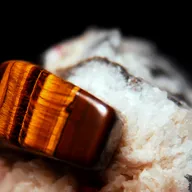 Tiger's eye
A stripe of light that slides across the stone when you tilt it.
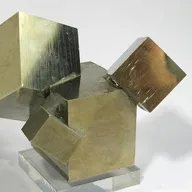 Pyrite
Fool's gold, in cubes so sharp they look machined.
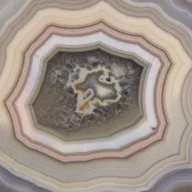 Agate
Chalcedony laid down in bands, one over the next, inside a bubble in old lava.
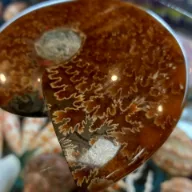 Ammonite
A shell that spiralled through the seas for three hundred million years, turned to stone.
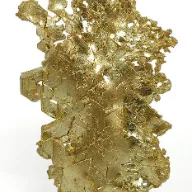 Gold
The one metal that comes out of the ground already finished.
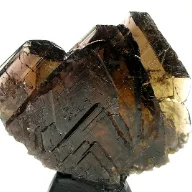 Axinite
Clove-brown wedges of a boron silicate, sharp enough to be named for an axe.
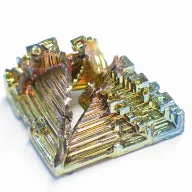 Bismuth
A metal that grows in rainbow staircases — in a saucepan, mostly.
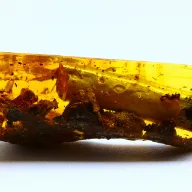 Amber
Not a stone at all: tree resin that leaked out forty million years ago and went hard.
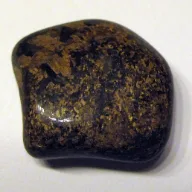 Bronzite
A dark pyroxene with a bronze sheen, from the same family the meteorites are full of.
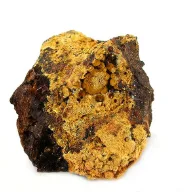 Cacoxenite
Golden needles in iron ore, named the bad guest because they ruined the smelt.
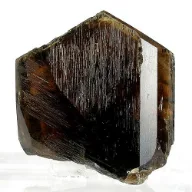 Chrysoberyl
The third hardest gem there is, no relation to beryl, and the only true cat's eye.
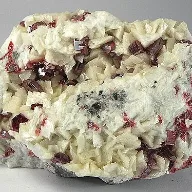 Cinnabar
Mercury ore, the red of every Chinese seal, and the most dangerous mineral in the cabinet.
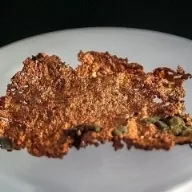 Copper
The first metal anyone ever worked, and one of the few that turns up ready to use.
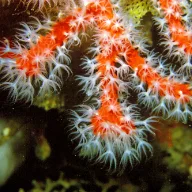 Red coral
The skeleton of a slow-growing animal, worn as a gem for five thousand years.
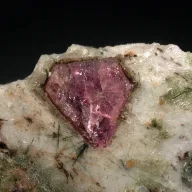 Eudialyte
Raspberry grains in grey Arctic rock, named for dissolving easily.
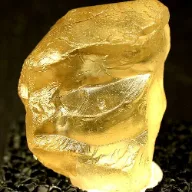 Golden labradorite
Bytownite: a calcium feldspar that cuts into clear champagne gold.
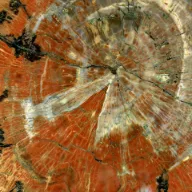 Petrified wood
A tree that became quartz cell by cell, and kept its grain.
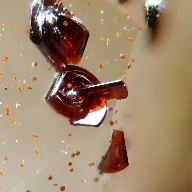 Lepidocrocite
The red half of rust, and the red flecks inside amethyst.
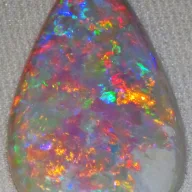 Opal
Water and silica in tiny stacked spheres, splitting light into colour.
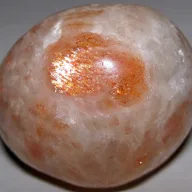 Sunstone
Feldspar full of metal flakes, throwing back the light in orange sparks.
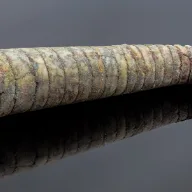 Orthoceras
A straight-shelled squid relative that died four hundred million years ago.
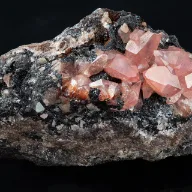 Rhodochrosite
Manganese carbonate in rose red, banded in caves and crystallised in mines.
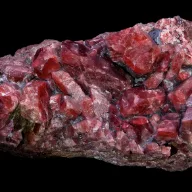 Rhodonite
Pink manganese silicate veined with the black oxide it turns into.
 Ruby
Corundum with chromium in it, and for centuries the most expensive stone on earth.
 Sardonyx
Red-brown and white in straight bands, and the Roman world's seal stone.
 Scheelite
The tungsten ore that glows electric blue under a lamp in the dark.
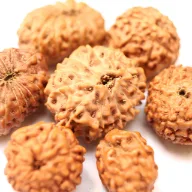 Rudraksha
The stone of a fruit, not of the ground, and the oldest prayer bead in India.
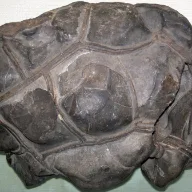 Septarian
A mud nodule that cracked from the inside and filled its own cracks with calcite.
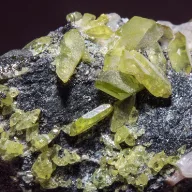 Sphene
Titanite, which throws more fire than a diamond and is far too soft to wear.
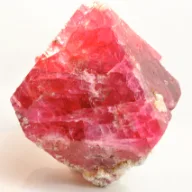 Spinel
Eight hundred years of crown jewels called it a ruby.
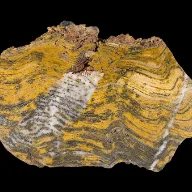 Stromatolite
Three and a half billion years of bacterial mats, turned to stone in layers.
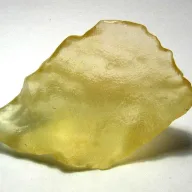 Libyan desert glass
Pale yellow glass lying loose in the Sahara, and a scarab in Tutankhamun's tomb cut from it.
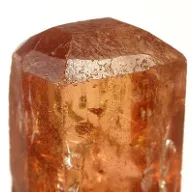 Topaz
Eight on the Mohs scale by definition, and it splits like slate if you hit it right.
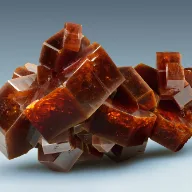 Vanadinite
Hexagonal barrels of orange-red lead vanadate, and the mineral vanadium was found in.
 Zircon
The oldest thing on earth is a grain of it, and no, it is not cubic zirconia.