 Lunarya
Opal
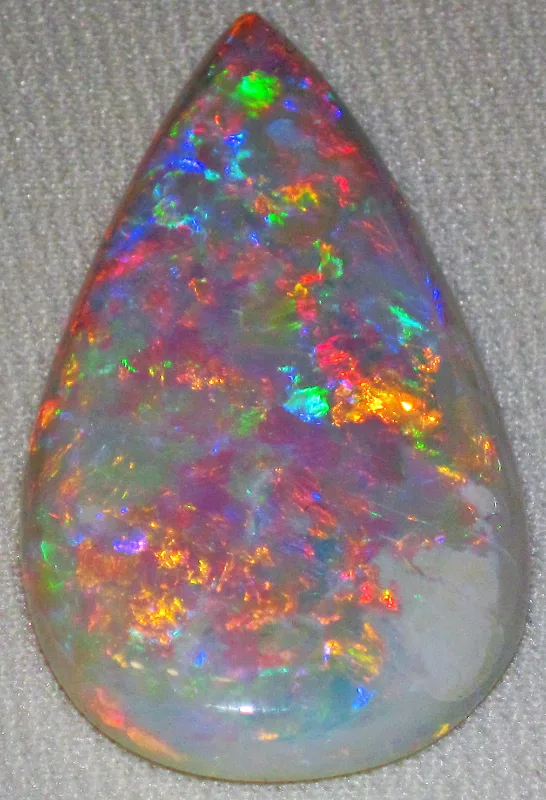
Opal is hydrated silica, SiO₂·nH₂O, and it is not a crystal: it has no lattice, and between three and twenty-one per cent of it is water. What precious opal has instead is order at a larger scale — microscopic silica spheres, all much the same size, stacked in a regular three-dimensional array. Light passing through that array is diffracted, and the colour that comes back depends on the size of the spheres and the angle you look from. That is play of colour, and nothing else does it.
Spheres of about 150 nanometres give blue and violet; larger ones give green, orange and finally red, which is why red-flashing opal is the rarest and dearest. Opal without the ordered stacking is common opal or potch, which can be beautiful but does not flash. Hardness is 5.5 to 6.5 and the stone is brittle. The water matters: opal can lose it to dry air or heat and craze into a web of fine cracks, and there is no repairing that. It is one of October's birthstones.
In short
- Colour
- Red, orange and gold
- Mineral
- Oxide
- Formula
- SiO₂·nH₂O
- Hardness
- 5.5–6.5 on the Mohs scale
- Crystal system
- None — it is amorphous
- Found in
- Australia has produced most of the world's precious opal for a century — Coober Pedy for white, Lightning Ridge for black, Andamooka, Quilpie for boulder. Ethiopia's Wollo province has been a major source since 2008. Mexico gives fire opal, Brazil, Honduras, Peru, Indonesia, Slovakia and the United States the rest.
- Birthstone of
- October
- Element
- Water
- Planet
- Venus
- Chakra
- Heart
- Handling
- Keep out of water and sunlight
How it forms
Silica-rich water percolates into cracks, cavities and fossil spaces in porous rock and evaporates or cools until the silica comes out of solution as a gel, which then dehydrates and hardens. In Australia the rock is Cretaceous sandstone laid down in an inland sea, weathered under a very old, very dry landscape; the same process filled shells, bones and pieces of wood with opal, which is why opalised fossils are an Australian speciality.
In human hands
Pliny described opal in terms nobody has improved on, calling it a stone made of the virtues of all the others. It was among the most valued gems of the Roman world and of medieval Europe. Its reputation for bad luck is traceable to a single novel: Walter Scott's Anne of Geierstein in 1829, in which an enchanted opal loses its fire and its owner dies, after which European opal sales are said to have collapsed for a generation. The Australian fields opened in the 1880s and put that right.
Varieties and trade names
- Black opal
- Precious opal on a dark body colour, from Lightning Ridge; the play of colour is strongest against it and the prices are the highest.
- White and crystal opal
- Pale or transparent body colour, from Coober Pedy and Ethiopia; the commonest precious material.
- Boulder opal
- Thin seams of opal still attached to their ironstone host, from Queensland, and cut with the brown rock as a backing.
- Fire opal
- Transparent orange to red opal from Mexico, often with no play of colour at all; the colour is iron, in the body of the stone.
- Cacholong
- Opaque porcelain-white common opal, chalky and porous, carved in Central Asia and Mongolia for centuries.
- Pink opal
- Common opal coloured by palygorskite, mostly Peruvian; no flash, and often confused with pink chalcedony.
- Doublets and triplets
- A slice of opal glued to a dark backing, sometimes with a quartz cap; legitimate if declared, and much cheaper than solid stone.
Telling it from a fake
Play of colour moves as the stone moves, and it comes from inside, in patches with soft edges. Glass and plastic imitations show a flat pattern that does not shift, and synthetic opal — which is real opal, grown in a laboratory — shows a very regular columnar structure, like a snake's skin, under magnification. On a set stone, check the girdle for the straight glue line of a doublet. Ethiopian hydrophane opal absorbs water and can turn temporarily transparent, which is disconcerting but normal.
None of this needs a laboratory, and none of it is proof. A shop that will not say whether a stone is treated has answered the question; ask, and have the answer written on the receipt.
What it is said to do
The tradition is about imagination and feeling: opal is given to people who dream vividly, and read as amplifying whatever mood it finds, which is the old ambivalence about the stone showing through. It is placed at the heart, under Venus, with Libra, Scorpio and Cancer. The superstition that it is unlucky to wear one unless born in October is Victorian, comes from the novel above, and is worth ignoring.
Living with it
The most delicate gem in common use. Keep it away from dry heat, sunlamps, safe-deposit boxes and airline holds — dry air crazes it. Do not use an ultrasonic or steam cleaner. Wipe it with a damp cloth, never soak a doublet or triplet, and take an opal ring off before washing up, because it cracks on a knock that would not trouble a quartz.
In magic
Opal has a magic of its own in the old books: medieval writers called it patronus furum, the patron of thieves, and said it made its wearer invisible. Modern practice uses it for divination and dreams, and in glamour magic, the spells for being seen as one wishes to be. Keep it out of salt, hot water and long sunbaths: an opal cracks before it fades.
- Energy
- Receptive
- Day
- Friday
- Worked for
- Divination and intuition · Love and friendship
More of this colour
 Garnet
Not one mineral but a whole family, and half of it ends up as sandpaper.
 Carnelian
Orange chalcedony, and the stone hot wax will not stick to.
 Citrine
Yellow quartz, except that most of it is amethyst that has been in an oven.
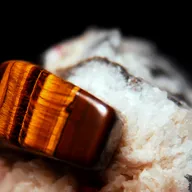 Tiger's eye
A stripe of light that slides across the stone when you tilt it.
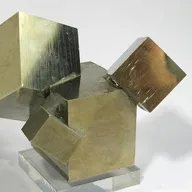 Pyrite
Fool's gold, in cubes so sharp they look machined.
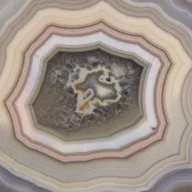 Agate
Chalcedony laid down in bands, one over the next, inside a bubble in old lava.
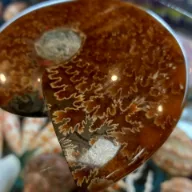 Ammonite
A shell that spiralled through the seas for three hundred million years, turned to stone.
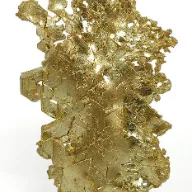 Gold
The one metal that comes out of the ground already finished.
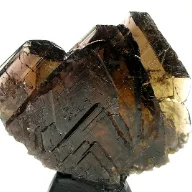 Axinite
Clove-brown wedges of a boron silicate, sharp enough to be named for an axe.
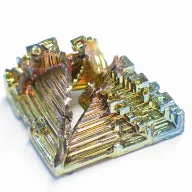 Bismuth
A metal that grows in rainbow staircases — in a saucepan, mostly.
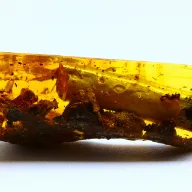 Amber
Not a stone at all: tree resin that leaked out forty million years ago and went hard.
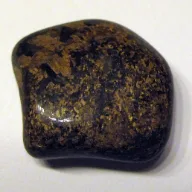 Bronzite
A dark pyroxene with a bronze sheen, from the same family the meteorites are full of.
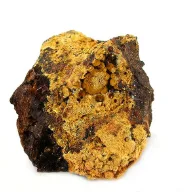 Cacoxenite
Golden needles in iron ore, named the bad guest because they ruined the smelt.
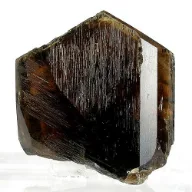 Chrysoberyl
The third hardest gem there is, no relation to beryl, and the only true cat's eye.
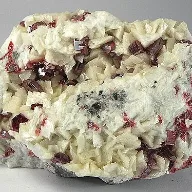 Cinnabar
Mercury ore, the red of every Chinese seal, and the most dangerous mineral in the cabinet.
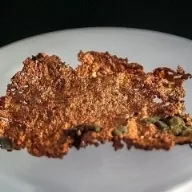 Copper
The first metal anyone ever worked, and one of the few that turns up ready to use.
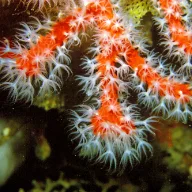 Red coral
The skeleton of a slow-growing animal, worn as a gem for five thousand years.
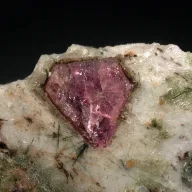 Eudialyte
Raspberry grains in grey Arctic rock, named for dissolving easily.
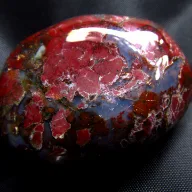 Jasper
Opaque chalcedony, stained by whatever the sediment happened to hold.
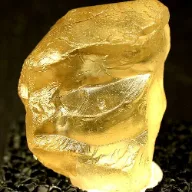 Golden labradorite
Bytownite: a calcium feldspar that cuts into clear champagne gold.
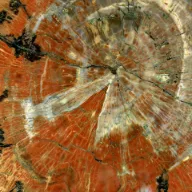 Petrified wood
A tree that became quartz cell by cell, and kept its grain.
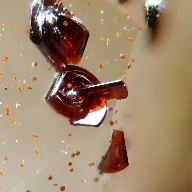 Lepidocrocite
The red half of rust, and the red flecks inside amethyst.
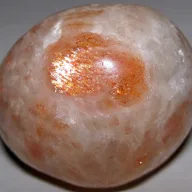 Sunstone
Feldspar full of metal flakes, throwing back the light in orange sparks.
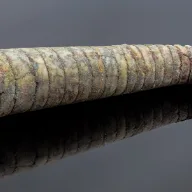 Orthoceras
A straight-shelled squid relative that died four hundred million years ago.
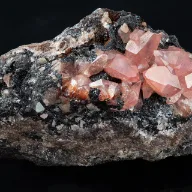 Rhodochrosite
Manganese carbonate in rose red, banded in caves and crystallised in mines.
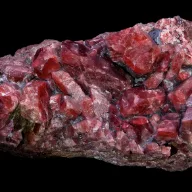 Rhodonite
Pink manganese silicate veined with the black oxide it turns into.
 Ruby
Corundum with chromium in it, and for centuries the most expensive stone on earth.
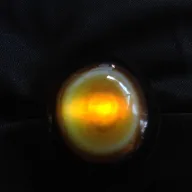 Sardonyx
Red-brown and white in straight bands, and the Roman world's seal stone.
 Scheelite
The tungsten ore that glows electric blue under a lamp in the dark.
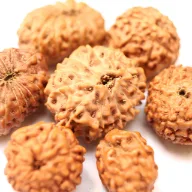 Rudraksha
The stone of a fruit, not of the ground, and the oldest prayer bead in India.
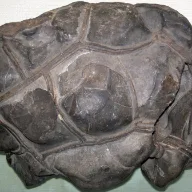 Septarian
A mud nodule that cracked from the inside and filled its own cracks with calcite.
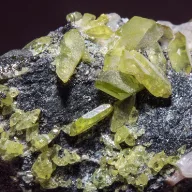 Sphene
Titanite, which throws more fire than a diamond and is far too soft to wear.
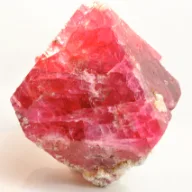 Spinel
Eight hundred years of crown jewels called it a ruby.
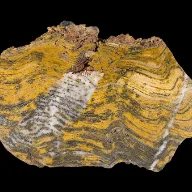 Stromatolite
Three and a half billion years of bacterial mats, turned to stone in layers.
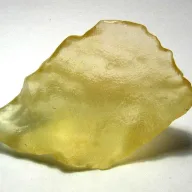 Libyan desert glass
Pale yellow glass lying loose in the Sahara, and a scarab in Tutankhamun's tomb cut from it.
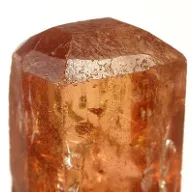 Topaz
Eight on the Mohs scale by definition, and it splits like slate if you hit it right.
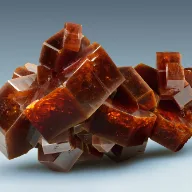 Vanadinite
Hexagonal barrels of orange-red lead vanadate, and the mineral vanadium was found in.
 Zircon
The oldest thing on earth is a grain of it, and no, it is not cubic zirconia.