 Lunarya
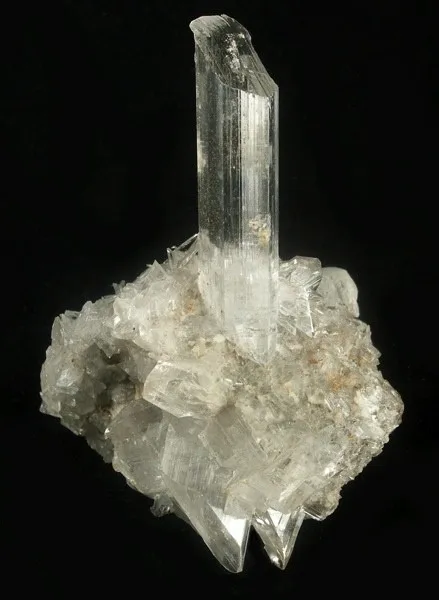
Selenite
Selenite is a clear, foliated variety of gypsum — calcium sulfate with water in the formula — and at 2 on the Mohs scale it is the softest thing most people own. It cleaves into sheets that were once used as window glass, and the fibrous form sold as wands and lamps is properly called satin spar, which glows along its length when a light is put under it.
Its most famous appearance is the Cave of the Crystals at Naica in Mexico, where beams of selenite up to twelve metres long grew in water held for hundreds of thousands of years at just under 60°C — the largest natural crystals ever found, in air too hot to stand in for more than a few minutes. The name is from Selene, the Greek moon, for the pale sheen down a cleaved face.
In short
- Colour
- Clear and white
- Mineral
- Sulfate
- Formula
- CaSO₄·2H₂O
- Hardness
- 2 on the Mohs scale
- Crystal system
- Monoclinic
- Found in
- Mexico, Morocco, Spain and the American Midwest.
- Element
- Water
- Planet
- The Moon
- Chakra
- Crown
- Handling
- Keep out of water
How it forms
Gypsum is what the sea leaves behind. When seawater or a salt lake evaporates to about a third of its volume, calcium sulfate comes out first, before the salt, and builds beds hundreds of metres thick; the Mediterranean nearly dried out six million years ago and left a floor of it. Clear crystals, selenite, grow later, in clay and in caves, from sulfate-rich water. In the Cave of the Crystals at Naica in Mexico, found in 2000, beams of it twelve metres long grew for half a million years in water at 58 °C, the largest crystals on Earth. A fingernail scratches it, it splits into sheets, and it slowly dissolves in water.
In human hands
The name is from selēnē, the moon, for the glow, and the ancients believed the stone waxed and waned with it. The Romans used it as glass before glass: sheets of lapis specularis, quarried in Spain, were set in the windows of villas, bathhouses and greenhouses. Gypsum burned and ground is plaster of Paris, named for the quarries of Montmartre, the material of casts, mouldings and every plasterboard wall. The alabaster of the medieval English carvers was gypsum, cut into altarpieces at Nottingham and shipped across Europe until the Reformation broke most of them.
Varieties and trade names
- Satin spar
- Gypsum in fine parallel fibres, white and silky, which is what nearly every selenite wand, tower and bowl in a shop actually is.
- Desert rose
- Rosettes of gypsum plates with sand grown into them, from the Sahara, Oklahoma and Mexico.
- Orange selenite
- Satin spar and blades stained peach to amber by iron oxide, mostly from Morocco; the colour sits in and between the fibres rather than in the gypsum itself.
- Alabaster
- The fine-grained massive form, soft enough to carve with a knife and translucent enough to make a lamp of.
- Fishtail selenite
- Twinned crystals meeting in a V, like a swallow's tail; the clear blades the name selenite properly belongs to.
Telling it from a fake
Nothing fakes selenite, which costs less than the postage; the confusion runs backwards, because most of what is sold as selenite is satin spar, the same gypsum in fibres, and both are fine as long as neither goes near water. Tell gypsum from quartz or glass with a fingernail, which marks gypsum and nothing else in the shop; tell it from calcite, which also splits into sheets, with vinegar, which fizzes on calcite and does nothing on gypsum. Orange selenite from Morocco is iron-stained and natural; the bright pinks and blues are dyed satin spar.
None of this needs a laboratory, and none of it is proof. A shop that will not say whether a stone is treated has answered the question; ask, and have the answer written on the receipt.
What it is said to do
The clearing stone: it is the one traditionally used to cleanse other stones, and it is kept for quiet, for winding down a room, and for letting something go. Its association with the moon is as old as its name.
Living with it
Never put it in water — gypsum is soluble and a soaked wand comes out chalky and pitted. Dust it dry, keep it off damp surfaces, and expect it to scratch if anything else in the drawer touches it.
In magic
Selenite, named for Selene, the moon, is modern witchcraft's cleanser: a wand laid across other stones to clear them, passed over the body in place of smoke, or set on a windowsill to settle a room. All of it is recent. It is gypsum and dissolves, so it is the one cleansing tool that must never itself be cleansed with water, salt water or moon water.
- Energy
- Receptive
- Day
- Monday
- Worked for
- Cleansing · Calm and peace · Change and letting go
More of this colour
 Clear quartz
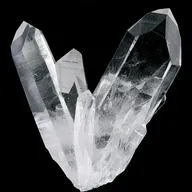
The plain one, and the one the modern world actually runs on.
 Moonstone
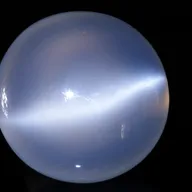
Feldspar with a light inside it that moves when the stone does.
 Amblygonite
A lithium phosphate from the pegmatites, and the palest yellow gem you have never heard of.
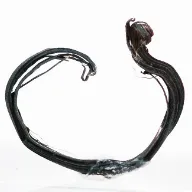 Silver
The metal of the moon, grown in wires and ferns in the veins of the earth.
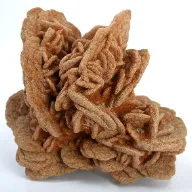 Baryte
The heavy stone: barium sulfate, and the reason a rose can grow in the desert.
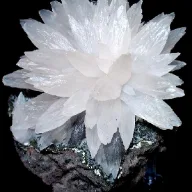 Calcite
The commonest carbonate on Earth, and the crystal that showed physicists light has two paths.
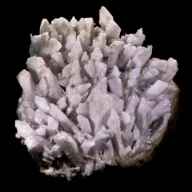 Danburite
A borosilicate that looks exactly like topaz, named after a Connecticut town that paved over the deposit.
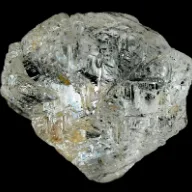 Phenakite
A beryllium silicate so like quartz that it was named the deceiver.
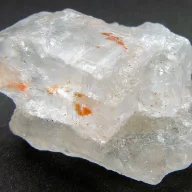 Halite
Rock salt: perfect cubes that will dissolve in a damp room.
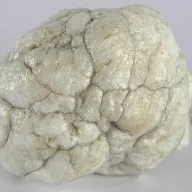 Howlite
White nodules with black veins, and the most dyed mineral in the trade.
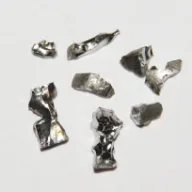 Iridium
The most corrosion-proof metal there is, and the layer that dates the end of the dinosaurs.
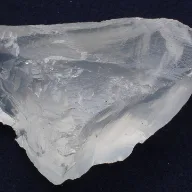 Petalite
The mineral lithium was discovered in, and it looks like nothing at all.
Cradle of Humankind stone
Ordinary grey chalcedony from an extraordinary place outside Johannesburg.
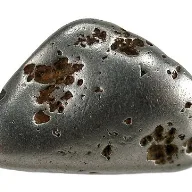 Platinum
Little silver, the Spanish called it, and threw it back in the river.
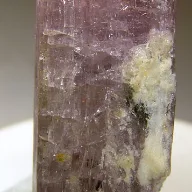 Scapolite
A tetragonal silicate that glows yellow under ultraviolet and fades in the sun.
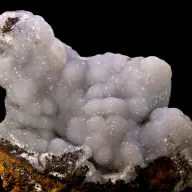 Smithsonite
Zinc carbonate in botryoidal crusts, named after the man who founded the Smithsonian.
Shiva lingam
A Narmada river cobble, ground by hand into an egg and sold as a sacred stone.
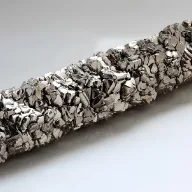 Titanium
The ninth commonest element in the crust, and almost never found as a metal.
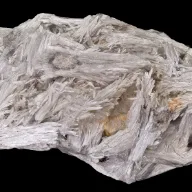 Tremolite
The white amphibole that makes nephrite jade, and, in its fibrous form, asbestos.
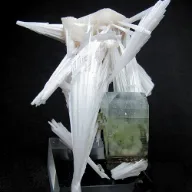 Zeolite
Minerals built like sponges at the atomic scale, which is why industry uses more of them than jewellers do.
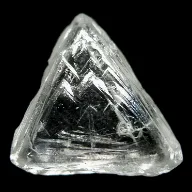 Diamond
Carbon, arranged the hard way, and carried up from two hundred kilometres down.