 Lunarya
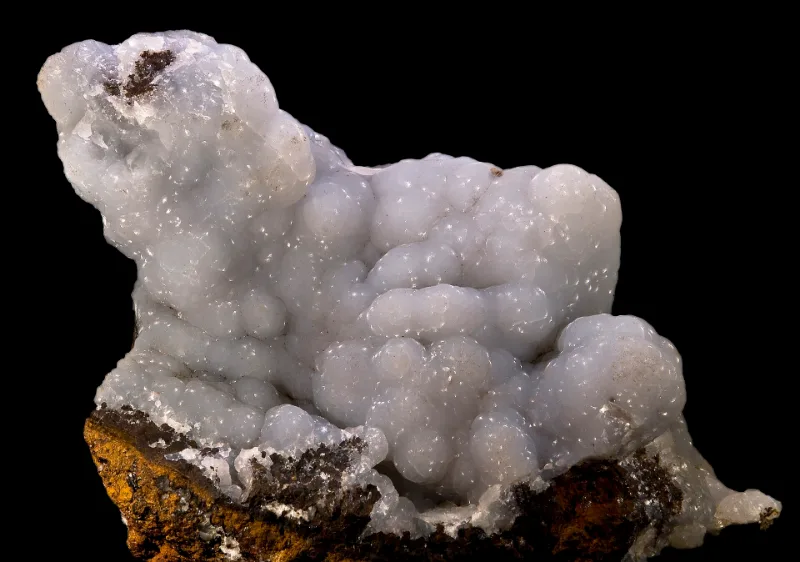
Smithsonite
Smithsonite is zinc carbonate, ZnCO₃, and it rarely bothers with crystals. It grows as rounded botryoidal crusts, kidney shapes and stalactitic masses with a soft, almost waxy satin lustre that no other carbonate quite manages. The colours depend on what else was dissolved in the water: copper gives the famous blue-green, cobalt gives pink and lavender, cadmium gives yellow, iron gives brown. It is heavy for a pale stone, and soft at 4 to 4.5.
It was long confused with hemimorphite, and both went under the old miners' name calamine — which is why calamine lotion is named for a zinc mineral. The two were separated in 1832 and the carbonate was named after James Smithson, the English chemist who had analysed it and who left his fortune to the United States to found an institution he never visited. As a zinc ore it mattered until sulfide ores took over. As a specimen it is prized for the colour and the texture, and it fizzes in acid like any carbonate.
In short
- Colour
- Clear and white
- Mineral
- Carbonate
- Formula
- ZnCO₃
- Hardness
- 4–4.5 on the Mohs scale
- Crystal system
- Trigonal
- Found in
- The Kelly Mine in New Mexico for the blue-green; Tsumeb in Namibia for pink and every other colour; Lavrion in Greece, the Sardinian mines, Mexico, Zambia, Broken Hill in Australia, and Choix in Sinaloa for the finest yellow.
- Element
- Water
- Planet
- Venus
- Chakra
- Heart
- Handling
- Keep out of water
How it forms
A secondary mineral of the oxidised zone. Where a zinc sulfide ore body meets air and water, the sphalerite in it breaks down, the zinc goes into solution, and it reprecipitates as carbonate wherever there is limestone or carbonate-bearing water to meet it. The botryoidal shapes are what happens when a mineral crystallises outward from many points on a cavity wall at once, slowly, from a gel-like film.
In human hands
Smithson's bequest is the good story. He died in Genoa in 1829 having never crossed the Atlantic, and left his estate to the United States to found an establishment for the increase and diffusion of knowledge among men; the money arrived in 1838 as eleven boxes of gold sovereigns. The mineral was named for him in 1832. Mining history is duller but longer: calamine was smelted for brass in the ancient world, and the Romans worked zinc carbonate deposits across Europe.
Varieties and trade names
- Kelly Mine blue-green
- Copper-bearing smithsonite from New Mexico in a distinctive robin's-egg blue; the specimen everybody wants.
- Pink cobaltoan smithsonite
- Coloured by cobalt, from Tsumeb and from Broken Hill; delicate and expensive.
- Turkey fat
- The yellow cadmium-bearing material from Arkansas and Mexico, named for its colour by nineteenth-century miners.
- Dry-bone ore
- The dull, porous, honeycombed ore-grade material, named for looking like weathered bone.
- Hemimorphite
- The zinc silicate that shared the name calamine; similar blue crusts, and the two are still confused.
Telling it from a fake
A drop of vinegar fizzes, which separates it from hemimorphite and chrysocolla at once. It is noticeably heavy — specific gravity around 4.4, well above most pale minerals — and that heft in a light-coloured botryoidal crust is the best field indication. The lustre is silky to slightly pearly rather than glassy. Aragonite and calcite fizz too but are much lighter; prehnite is harder and does not fizz.
None of this needs a laboratory, and none of it is proof. A shop that will not say whether a stone is treated has answered the question; ask, and have the answer written on the receipt.
What it is said to do
Read as one of the gentler stones: kindness, recovery from strain, and the books' favourite phrase for it, a soft landing. Several give it to people going through something they cannot hurry. It is placed at the heart, under Venus, with Pisces and Virgo. The reading came with the pastel colours in the late twentieth century, and there is nothing older.
Living with it
Soft and carbonate, so it wants the same care as rhodochrosite and calcite: no acids, no vinegar or lemon anywhere near it, no ultrasonic, and as little water as possible. Sunlight can fade the blue and pink varieties over years. Dust with a soft brush and keep it where it cannot be knocked, since the botryoidal crusts chip easily.
In magic
Smithsonite is used in modern practice for kindness and recovery: a stone held after a hard stretch, set on an altar for someone going through something that cannot be hurried. The tradition is recent and follows the pastel colours. It is soft and acid-sensitive, so it is kept dry and away from salt and vinegar.
- Energy
- Receptive
- Day
- Friday
- Worked for
- Comfort and recovery · Calm and peace
More of this colour
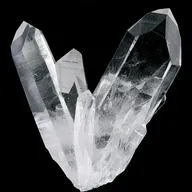 Clear quartz
The plain one, and the one the modern world actually runs on.
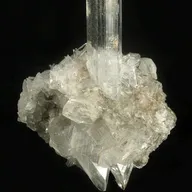 Selenite
Gypsum in satin fibres, soft enough to mark with a fingernail.
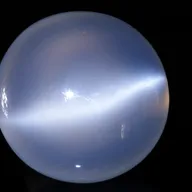 Moonstone
Feldspar with a light inside it that moves when the stone does.
 Amblygonite
A lithium phosphate from the pegmatites, and the palest yellow gem you have never heard of.
 Silver
The metal of the moon, grown in wires and ferns in the veins of the earth.
 Baryte
The heavy stone: barium sulfate, and the reason a rose can grow in the desert.
 Calcite
The commonest carbonate on Earth, and the crystal that showed physicists light has two paths.
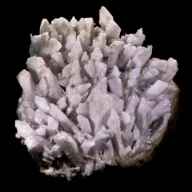 Danburite
A borosilicate that looks exactly like topaz, named after a Connecticut town that paved over the deposit.
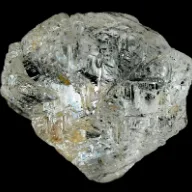 Phenakite
A beryllium silicate so like quartz that it was named the deceiver.
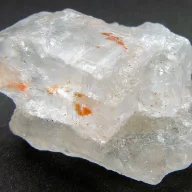 Halite
Rock salt: perfect cubes that will dissolve in a damp room.
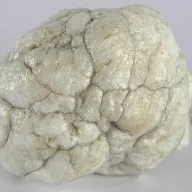 Howlite
White nodules with black veins, and the most dyed mineral in the trade.
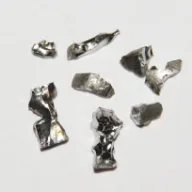 Iridium
The most corrosion-proof metal there is, and the layer that dates the end of the dinosaurs.
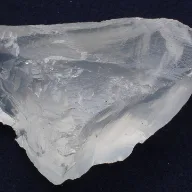 Petalite
The mineral lithium was discovered in, and it looks like nothing at all.
Cradle of Humankind stone
Ordinary grey chalcedony from an extraordinary place outside Johannesburg.
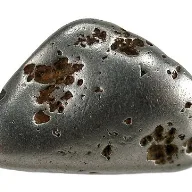 Platinum
Little silver, the Spanish called it, and threw it back in the river.
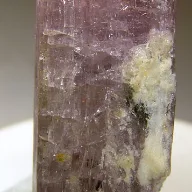 Scapolite
A tetragonal silicate that glows yellow under ultraviolet and fades in the sun.
Shiva lingam
A Narmada river cobble, ground by hand into an egg and sold as a sacred stone.
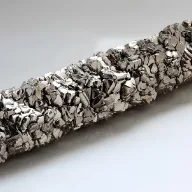 Titanium
The ninth commonest element in the crust, and almost never found as a metal.
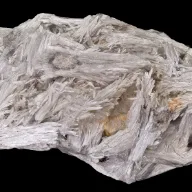 Tremolite
The white amphibole that makes nephrite jade, and, in its fibrous form, asbestos.
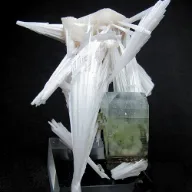 Zeolite
Minerals built like sponges at the atomic scale, which is why industry uses more of them than jewellers do.
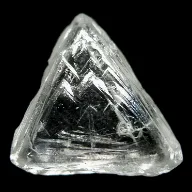 Diamond
Carbon, arranged the hard way, and carried up from two hundred kilometres down.