 Lunarya
Cradle of Humankind stone
This one is sold for where it comes from rather than for what it is. The stone is chalcedony — microcrystalline quartz, the same material as agate and jasper — in grey, cream and white, sometimes faintly banded, hard at 6.5 to 7 and taking a good polish. What it carries is a postcode: the dolomite country northwest of Johannesburg that UNESCO listed in 1999 as the Cradle of Humankind.
It is worth being straightforward. There is nothing unusual about the mineralogy, and a geologist handed a tumbled piece with no label would call it grey chalcedony and move on. The interest is the ground it came out of: a 47,000-hectare landscape of dolomite caves — Sterkfontein, Swartkrans, Kromdraai, Malapa, Rising Star — that has produced some of the richest hominin fossil deposits anywhere. The chalcedony formed in and around those dolomites long before any of that, and it is not itself fossil-bearing.
In short
- Colour
- Clear and white
- Mineral
- Chalcedony
- Formula
- SiO₂
- Hardness
- 6.5–7 on the Mohs scale
- Crystal system
- Trigonal
- Found in
- Gauteng province, South Africa, in the Cradle of Humankind World Heritage Site and the farmland around it. Collecting inside the protected area is regulated; trade material generally comes from surrounding land and from old workings.
- Element
- Earth
- Planet
- Saturn
- Chakra
- Root
- Handling
- Water and light are both fine
How it forms
The dolomite of the Malmani Subgroup was laid down about 2.5 billion years ago in a shallow sea by cyanobacteria building stromatolite reefs. Silica-rich water later moved through that rock, dissolving carbonate and depositing chalcedony in cavities, cracks and replacement patches. Much later still, the dolomite dissolved into a cave system, the caves collapsed and filled with debris, and animals and hominins fell in or were dragged in — which is why the fossils are there at all.
In human hands
The place has the history, not the stone. Raymond Dart described the Taung child in 1925; Robert Broom found the skull called Mrs Ples at Sterkfontein in 1947; the near-complete Little Foot skeleton was excavated over two decades from the same cave; Australopithecus sediba was described from Malapa in 2010 and Homo naledi from Rising Star in 2015. The polished stone is a recent souvenir and crystal-trade item, dating from the 2000s.
Varieties and trade names
- Grey banded chalcedony
- The usual material: soft grey and cream layers, tumbled or cut into palm stones.
- Cradle of Life stone
- The same thing under a second trade name; there is no agreed definition of either.
- Dolomite matrix pieces
- Chalcedony still attached to its host rock, which is the 2.5-billion-year-old stromatolite dolomite.
- Stromatolite
- The banded fossil algal rock of the same formation, sold separately and genuinely a fossil.
- Agate and jasper
- The same mineral in more colourful forms; both have pages here, and the chemistry is identical.
Telling it from a fake
There is no test that distinguishes this from any other grey chalcedony, and that is the honest answer. It is hard enough to scratch glass, waxy to glassy, translucent at a thin edge, and will not fizz in acid, which separates it from the dolomite it grew in. Everything beyond that is the seller's word about locality, so buy it from someone who can say which farm it came off.
None of this needs a laboratory, and none of it is proof. A shop that will not say whether a stone is treated has answered the question; ask, and have the answer written on the receipt.
What it is said to do
The reading is entirely about origins: where one comes from, the length of the human story, and a kind of grounding that is meant to reach past a family into a species. It is given to Saturn, to Capricorn and Aquarius, and to the root. The stone was given these meanings after the World Heritage listing, by people selling it, and the meaning lives in the place rather than in the mineral — which is a fair thing to say out loud and does not make the association worthless.
Living with it
Chalcedony, so nothing troubles it: water, sunlight, heat and daily carrying are all fine, and soapy water cleans it. It will outlast its owner, its label and probably its trade name.
In magic
The stone sold as Cradle of Humankind is used in modern practice for ancestor work on the scale of a species: set on an altar for the dead, held in a meditation on where people come from. The meaning lives in the place, not in the chalcedony, and the craft is honest about that. It is safe in any ritual.
- Energy
- Receptive
- Day
- Saturday
- Worked for
- Grounding and endurance
More of this colour
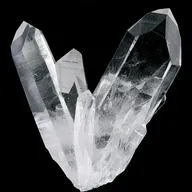 Clear quartz
The plain one, and the one the modern world actually runs on.
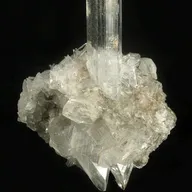 Selenite
Gypsum in satin fibres, soft enough to mark with a fingernail.
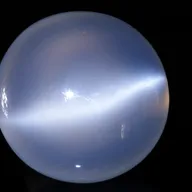 Moonstone
Feldspar with a light inside it that moves when the stone does.
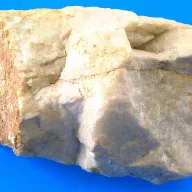 Amblygonite
A lithium phosphate from the pegmatites, and the palest yellow gem you have never heard of.
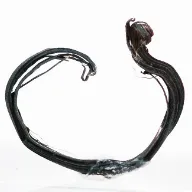 Silver
The metal of the moon, grown in wires and ferns in the veins of the earth.
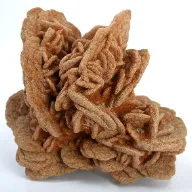 Baryte
The heavy stone: barium sulfate, and the reason a rose can grow in the desert.
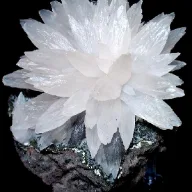 Calcite
The commonest carbonate on Earth, and the crystal that showed physicists light has two paths.
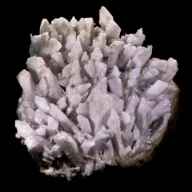 Danburite
A borosilicate that looks exactly like topaz, named after a Connecticut town that paved over the deposit.
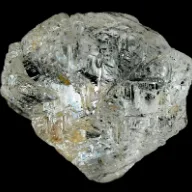 Phenakite
A beryllium silicate so like quartz that it was named the deceiver.
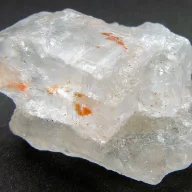 Halite
Rock salt: perfect cubes that will dissolve in a damp room.
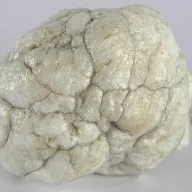 Howlite
White nodules with black veins, and the most dyed mineral in the trade.
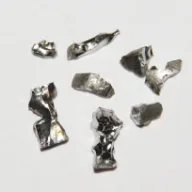 Iridium
The most corrosion-proof metal there is, and the layer that dates the end of the dinosaurs.
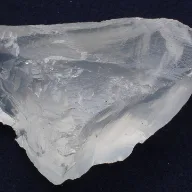 Petalite
The mineral lithium was discovered in, and it looks like nothing at all.
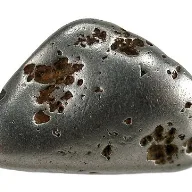 Platinum
Little silver, the Spanish called it, and threw it back in the river.
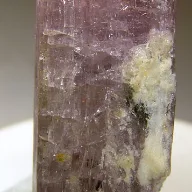 Scapolite
A tetragonal silicate that glows yellow under ultraviolet and fades in the sun.
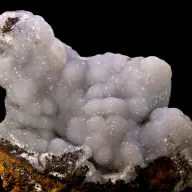 Smithsonite
Zinc carbonate in botryoidal crusts, named after the man who founded the Smithsonian.
Shiva lingam
A Narmada river cobble, ground by hand into an egg and sold as a sacred stone.
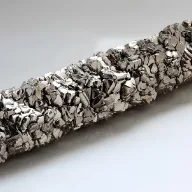 Titanium
The ninth commonest element in the crust, and almost never found as a metal.
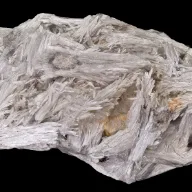 Tremolite
The white amphibole that makes nephrite jade, and, in its fibrous form, asbestos.
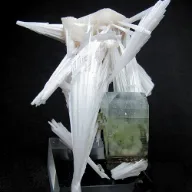 Zeolite
Minerals built like sponges at the atomic scale, which is why industry uses more of them than jewellers do.
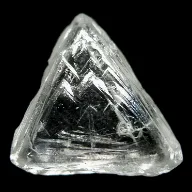 Diamond
Carbon, arranged the hard way, and carried up from two hundred kilometres down.