 Lunarya

Baryte
Baryte is barium sulfate, and the first thing anyone notices is the weight: a crystal of it weighs nearly twice as much as the same quartz, which is what the name means — barys, heavy, in Greek. It grows as clear tabular crystals in white, blue, yellow and brown, as cockscomb sprays, and as the rosettes of sand-filled crystals called desert roses.
Its fame is in three places. A shoemaker and alchemist called Casciarolo picked up a lump near Bologna in 1602, roasted it, and found it glowed in the dark for hours afterwards: the Bologna stone, the first phosphor and a wonder of the seventeenth century. In 1774 Scheele found a new earth in it, which became barium. And most of the world's baryte, some seven million tonnes a year, goes down oil wells as drilling mud, where the weight keeps the pressure in; the rest goes into paint, radiation shielding and the barium meal that shows a stomach on an X-ray.
In short
- Colour
- Clear and white
- Mineral
- Sulfate
- Formula
- BaSO₄
- Hardness
- 3–3.5 on the Mohs scale
- Crystal system
- Orthorhombic
- Found in
- China, India and Morocco for the ore; England (Cumbria), Romania (Baia Sprie), Nevada, Peru, Oklahoma and Sicily for crystals.
- Element
- Earth
- Planet
- Uranus
- Chakra
- Third eye
- Handling
- Water and light are both fine
How it forms
Barium is carried in hot brines and comes out of them as sulfate wherever they meet sulfur-bearing water, so baryte lines the veins of the old lead mines of the Pennines and Transylvania beside galena and fluorite, and it grows in the cracks of limestones and sandstones from the groundwater. In the desert it grows in sand: crystals forming in a damp bed of loose grains trap the grains as they grow, and a cluster of flat crystals meeting at a point comes out as a rose of stone. The Oklahoma roses are baryte and the Saharan ones are mostly gypsum, which is the same trick in a lighter mineral.
In human hands
The Bologna stone made baryte the first mineral known to glow: Galileo wrote about it, and it started the study of phosphorescence that led, three centuries later, to the fluorescent lamp. Scheele's barium and Davy's isolation of the metal in 1808 followed. The golden crystals of Cumberland filled Victorian cabinets, and the mines of Baia Sprie in Maramureș, worked since the fourteenth century, gave the classic blue and honey ones of Romania. The oil industry made it an industrial mineral after 1920, and Oklahoma made the rose rock its state rock in 1968.
Varieties and trade names
- Desert rose
- Rosettes of flat baryte crystals grown in sand and full of it, from Oklahoma; the gypsum roses of the Sahara look the same.
- Blue baryte
- Sky-blue tabular crystals from Cerro Warihuyn in Peru and from Morocco, the colour collectors chase.
- Golden baryte
- The honey-yellow crystals of Meikle in Nevada and of Cumbria, some of the largest and clearest known.
- Bologna stone
- Fibrous nodules of baryte from Monte Paderno, which glow after roasting; a curiosity now, a marvel in 1602.
Telling it from a fake
Pick it up: baryte is far heavier than any glass, calcite or quartz of the same size, and the heft is the surest test there is. It is soft enough to scratch with a copper coin, it does not fizz in vinegar as calcite does, and its crystals are flat tablets with a pearly cleavage. Celestine is the same shape and almost the same weight, and only a flame — green for barium, red for strontium — separates them without a laboratory. Desert roses are sold as one another, but the baryte ones are noticeably heavier than gypsum. Nothing is faked as baryte; there is no reason to.
None of this needs a laboratory, and none of it is proof. A shop that will not say whether a stone is treated has answered the question; ask, and have the answer written on the receipt.
What it is said to do
The heavy stone, and so the tradition makes it a stone of staying put and of memory, the thing that holds. The Bologna stone's glow in the dark gave it an older reading as a stone of dreams and of what is seen with the eyes shut, which the modern lists have kept, filing it under the third eye and under Aquarius.
Living with it
Keep it dry and dust it; water does not dissolve it, but a desert rose is held together by not much, and the sand comes off in a stream. It is soft, so it lives on a shelf.
In magic
Baryte, and the desert rose it often makes, is used in modern practice for staying put and for dreams: a rose on the bedside table for remembering them, a heavy piece on the altar for a working that has to hold. The Bologna stone, baryte that glowed in the dark after it was heated, was a sensation in the seventeenth century and lent it its dreamy reputation. Keep a desert rose dry; it sheds sand.
- Energy
- Receptive
- Day
- Saturday
- Worked for
- Grounding and endurance · Sleep and dreams
More of this colour
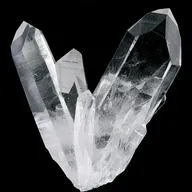 Clear quartz
The plain one, and the one the modern world actually runs on.
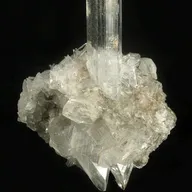 Selenite
Gypsum in satin fibres, soft enough to mark with a fingernail.
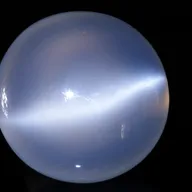 Moonstone
Feldspar with a light inside it that moves when the stone does.
 Amblygonite
A lithium phosphate from the pegmatites, and the palest yellow gem you have never heard of.
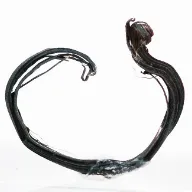 Silver
The metal of the moon, grown in wires and ferns in the veins of the earth.
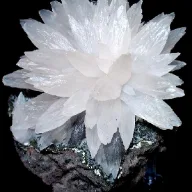 Calcite
The commonest carbonate on Earth, and the crystal that showed physicists light has two paths.
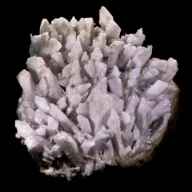 Danburite
A borosilicate that looks exactly like topaz, named after a Connecticut town that paved over the deposit.
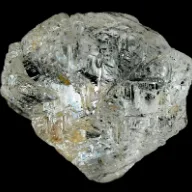 Phenakite
A beryllium silicate so like quartz that it was named the deceiver.
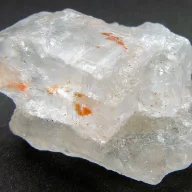 Halite
Rock salt: perfect cubes that will dissolve in a damp room.
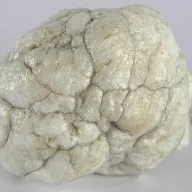 Howlite
White nodules with black veins, and the most dyed mineral in the trade.
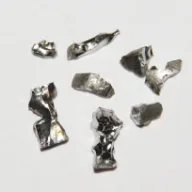 Iridium
The most corrosion-proof metal there is, and the layer that dates the end of the dinosaurs.
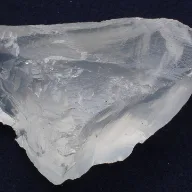 Petalite
The mineral lithium was discovered in, and it looks like nothing at all.
Cradle of Humankind stone
Ordinary grey chalcedony from an extraordinary place outside Johannesburg.
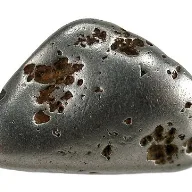 Platinum
Little silver, the Spanish called it, and threw it back in the river.
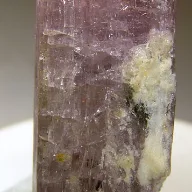 Scapolite
A tetragonal silicate that glows yellow under ultraviolet and fades in the sun.
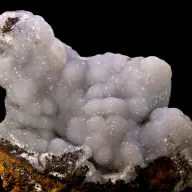 Smithsonite
Zinc carbonate in botryoidal crusts, named after the man who founded the Smithsonian.
Shiva lingam
A Narmada river cobble, ground by hand into an egg and sold as a sacred stone.
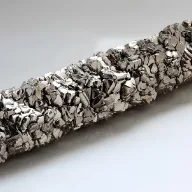 Titanium
The ninth commonest element in the crust, and almost never found as a metal.
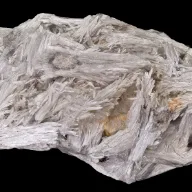 Tremolite
The white amphibole that makes nephrite jade, and, in its fibrous form, asbestos.
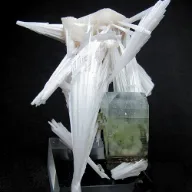 Zeolite
Minerals built like sponges at the atomic scale, which is why industry uses more of them than jewellers do.
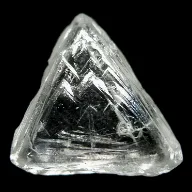 Diamond
Carbon, arranged the hard way, and carried up from two hundred kilometres down.