 Lunarya
Danburite
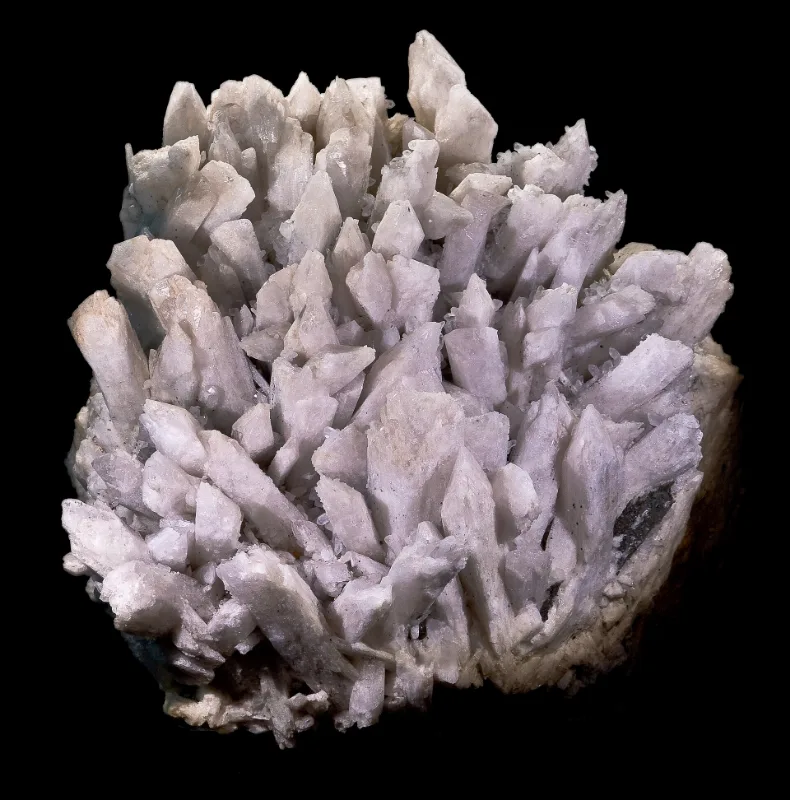
Danburite is a calcium borosilicate, CaB₂Si₂O₈, which grows as clear to white prisms with a wedge-shaped, chisel-like end. At seven to seven and a half on the Mohs scale it is as hard as quartz, it has no real cleavage, and it is transparent enough to facet — a hundred-carat danburite is not a rarity, which is unusual for a mineral most people have never heard of.
It is the classic topaz look-alike. The habit, the lustre and the hardness are all close, and the two were confused for decades until the boron in danburite settled it; the practical difference is that topaz has a perfect cleavage across the crystal and danburite has none, so a knock that splits one merely chips the other. Most danburite fluoresces a strong sky blue under ultraviolet light and some of it goes on glowing for a second after the lamp is switched off, which is a good party trick and a useful test.
In short
- Colour
- Clear and white
- Mineral
- Silicate
- Formula
- CaB₂Si₂O₈
- Hardness
- 7–7.5 on the Mohs scale
- Crystal system
- Orthorhombic
- Found in
- Charcas in San Luis Potosí, Mexico; Dalnegorsk in Russia; Myanmar, Madagascar, Japan and the Swiss Alps.
- Element
- Air
- Planet
- Neptune
- Chakra
- Crown
- Handling
- Water and light are both fine
How it forms
Boron is the key, and boron is a latecomer: it stays in solution while everything else crystallises, and ends up in the last hot fluids leaving an intrusion. Where those fluids meet limestone, the resulting skarn can grow danburite in cavities alongside calcite, apophyllite and datolite, which is the Mexican story at Charcas — clear crystals to fifteen centimetres in a white calcite matrix. The Dalnegorsk deposit in the Russian Far East is the same sort of boron-rich skarn and produces the pink material. Alpine clefts grow small colourless crystals by a cooler route.
In human hands
Charles Upham Shepard described it in 1839 from Danbury, Connecticut, which is one of the few minerals named after a town that has since built over its own type locality — the outcrop is under the city. It was a curiosity until the Mexican finds of the twentieth century made large clear crystals cheap enough to cut, and until the crystal trade picked it up in the 1980s and gave it a reputation it had not previously enjoyed. Industrially, boron comes from borax, not from this, so danburite has never been mined for anything but specimens.
Varieties and trade names
- Mexican danburite
- Water-clear to milky prisms from Charcas, the material most collections have, often on calcite.
- Pink danburite
- Pale rose crystals from Dalnegorsk in Russia; the colour is faint and the crystals are usually etched.
- Yellow danburite
- Golden to champagne stones from Madagascar, sold under trade names invented for the crystal market.
- Datolite
- The other common calcium borosilicate, in the same skarns; greenish, softer, and rounder in habit.
- Faceted danburite
- Cut as a gem for collectors; bright, hard and cheap, and consistently mistaken for topaz or white sapphire.
Telling it from a fake
Look at the termination: danburite ends in a chisel, a wedge with two faces meeting in a blunt edge, and the prism is finely striated along its length. Topaz is heavier, cleaves flat across the crystal and usually has a more complex, pointed end. Quartz prisms are six-sided with striations across rather than along them. The sky-blue ultraviolet glow is a good confirmation, and colourless faceted stones are far more likely to be danburite than the sapphire they are sometimes sold as, since the price is a fraction.
None of this needs a laboratory, and none of it is proof. A shop that will not say whether a stone is treated has answered the question; ask, and have the answer written on the receipt.
What it is said to do
A modern stone with an angelic reputation: the books give it for grief, for letting go and for a quality of lightness, and place it at the crown while insisting it also works on the heart. It arrived in the literature in the 1980s with the Mexican crystals and has nothing older behind it. The reading follows the look of the thing, which is about as clear and undramatic as a mineral gets.
Living with it
Hard, uncleavable and safe in water; wash it in lukewarm soapy water and dry it. It is brittle at the edges, so a faceted stone should be protected in a setting. Light does it no harm, though etched Russian crystals are best kept where they will not be chipped.
In magic
Danburite is used in modern practice as a stone of comfort and release: in workings for grief, for letting go of something that is finished, and on altars where people pray for the dead. It arrived in the literature in the 1980s with the Mexican crystals. It is hard and safe in water and light.
- Energy
- Projective
- Day
- Thursday
- Worked for
- Comfort and recovery · Change and letting go
More of this colour
 Clear quartz
The plain one, and the one the modern world actually runs on.
 Selenite
Gypsum in satin fibres, soft enough to mark with a fingernail.
 Moonstone
Feldspar with a light inside it that moves when the stone does.
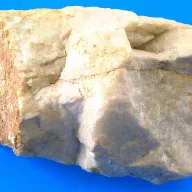 Amblygonite
A lithium phosphate from the pegmatites, and the palest yellow gem you have never heard of.
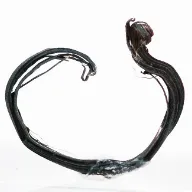 Silver
The metal of the moon, grown in wires and ferns in the veins of the earth.
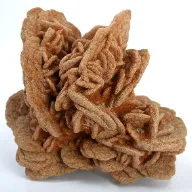 Baryte
The heavy stone: barium sulfate, and the reason a rose can grow in the desert.
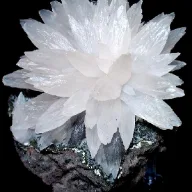 Calcite
The commonest carbonate on Earth, and the crystal that showed physicists light has two paths.
 Phenakite
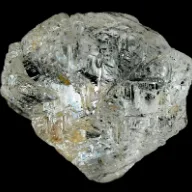
A beryllium silicate so like quartz that it was named the deceiver.
 Halite
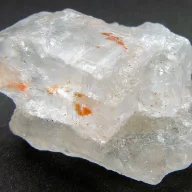
Rock salt: perfect cubes that will dissolve in a damp room.
 Howlite
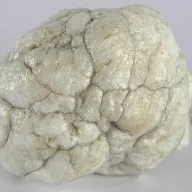
White nodules with black veins, and the most dyed mineral in the trade.
 Iridium
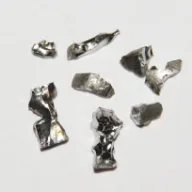
The most corrosion-proof metal there is, and the layer that dates the end of the dinosaurs.
 Petalite
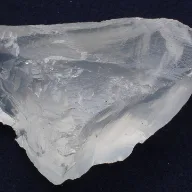
The mineral lithium was discovered in, and it looks like nothing at all.
Cradle of Humankind stone
Ordinary grey chalcedony from an extraordinary place outside Johannesburg.
 Platinum
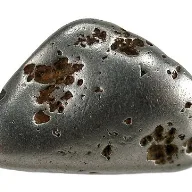
Little silver, the Spanish called it, and threw it back in the river.
 Scapolite
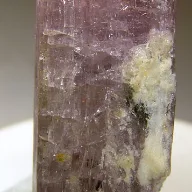
A tetragonal silicate that glows yellow under ultraviolet and fades in the sun.
 Smithsonite
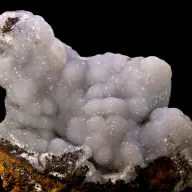
Zinc carbonate in botryoidal crusts, named after the man who founded the Smithsonian.
Shiva lingam
A Narmada river cobble, ground by hand into an egg and sold as a sacred stone.
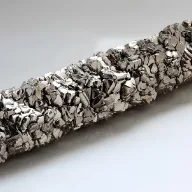 Titanium
The ninth commonest element in the crust, and almost never found as a metal.
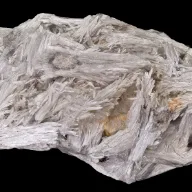 Tremolite
The white amphibole that makes nephrite jade, and, in its fibrous form, asbestos.
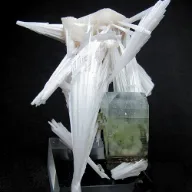 Zeolite
Minerals built like sponges at the atomic scale, which is why industry uses more of them than jewellers do.
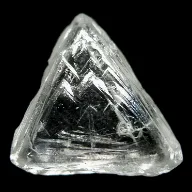 Diamond
Carbon, arranged the hard way, and carried up from two hundred kilometres down.