 Lunarya
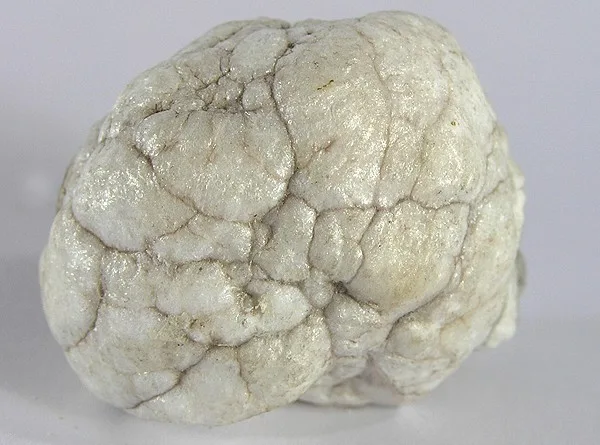
Howlite
Howlite is a calcium borosilicate, Ca₂B₅SiO₉(OH)₅, and it grows as white nodules with a web of grey or black veins running through them. The nodules look like small cauliflowers; cut open they are porcelain-white, faintly porous, and soft — about 3.5, which a steel pin will mark without effort. Henry How, a chemist in Nova Scotia, described it in 1868 after quarrymen complained that it was blunting their tools.
That porosity is why howlite matters commercially far beyond its own merits: it drinks dye. Blue-dyed howlite has been sold as turquoise for a century, under the trade name turquenite among others, and red-dyed howlite stands in for coral, while undyed nodules are passed off as white buffalo stone. A very large share of the cheap turquoise in the world is this mineral with a blue bath behind it. The natural stone, white with its grey web, is a perfectly good material in its own right and rather beautiful.
In short
- Colour
- Clear and white
- Mineral
- Borate
- Formula
- Ca₂B₅SiO₉(OH)₅
- Hardness
- 3.5 on the Mohs scale
- Crystal system
- Monoclinic
- Found in
- Windsor in Nova Scotia is the type locality. The commercial nodules come from the borate deposits of southern California — Tick Canyon, Lang, and the Death Valley district. Others are Turkey, Mexico, Germany, Russia and Serbia.
- Element
- Air
- Planet
- Mercury
- Chakra
- Third eye
- Handling
- Keep out of water
How it forms
Howlite is an evaporite borate. Where boron-rich brines dried in a closed basin, boron minerals crystallised in the gypsum and clay: colemanite, ulexite, and howlite in nodules that grew outward from a centre, which is what gives them their lumpy shape and their internal veining. The black web is the host clay squeezed into shrinkage cracks as the nodule grew.
In human hands
How published it as a new mineral from Nova Scotia and James Dwight Dana named it after him. Californian borate mining from the late nineteenth century made it available in tonnes rather than specimens, and the imitation trade followed almost immediately. The crystal trade sells natural howlite as a calming stone and dyed howlite as everything else, and the two ends of that business have almost nothing to do with each other.
Varieties and trade names
- Natural white howlite
- The plain nodule, white with grey or black veining; tumbled, carved and beaded.
- Turquenite
- Howlite dyed blue and sold as turquoise; the commonest imitation in the jewellery trade.
- Dyed howlite
- Also dyed red for coral, green for jade and purple for nothing in particular; the colour sits in the veins.
- White buffalo
- A Nevada stone that is genuinely its own material; much of what carries the name is howlite or magnesite.
- Magnesite
- The other white blank the trade dyes; a carbonate, so it fizzes in acid where howlite does not.
Telling it from a fake
Hardness first: a pin marks howlite, and turquoise at 5 to 6 resists it. The veining in natural howlite is grey to black and irregular; in dyed material the dye concentrates along those veins and leaves the body paler, so a chipped edge shows white inside a blue skin. A cotton bud with acetone lifts dye. Magnesite fizzes in dilute acid and howlite does not. Reconstituted and resin-bound imitations smell of plastic under a hot pin.
None of this needs a laboratory, and none of it is proof. A shop that will not say whether a stone is treated has answered the question; ask, and have the answer written on the receipt.
What it is said to do
Read as a stone for calming down and for sleeping: the standard advice is a piece under the pillow or on a bedside table, and the keywords in every book are patience, quiet and the slowing of a racing mind. It is placed at the third eye or the crown, under Mercury, with Gemini and Virgo. The tradition is twentieth-century, and the whiteness of the stone is most of the reason for it.
Living with it
Soft and porous, which means no soaking, no oils, no perfume and no ultrasonic. Water leaves marks and anything greasy stains it permanently. Dyed pieces bleed in water and fade in sunlight, so if a blue howlite is being worn, keep it dry. Wipe the natural stone with a barely damp cloth and dry it at once.
In magic
Howlite is used in modern practice for sleep and calm: a piece under the pillow, a palm stone held in a meditation for a racing mind. Its real fame in the craft is as a fake — dyed blue, it is the commonest false turquoise — and practitioners who care check before they buy. Keep it dry; it is porous and stains.
- Energy
- Projective
- Day
- Wednesday
- Worked for
- Sleep and dreams · Calm and peace
More of this colour
 Clear quartz
The plain one, and the one the modern world actually runs on.
 Selenite
Gypsum in satin fibres, soft enough to mark with a fingernail.
 Moonstone
Feldspar with a light inside it that moves when the stone does.
 Amblygonite
A lithium phosphate from the pegmatites, and the palest yellow gem you have never heard of.
 Silver
The metal of the moon, grown in wires and ferns in the veins of the earth.
 Baryte
The heavy stone: barium sulfate, and the reason a rose can grow in the desert.
 Calcite
The commonest carbonate on Earth, and the crystal that showed physicists light has two paths.
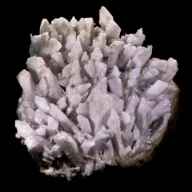 Danburite
A borosilicate that looks exactly like topaz, named after a Connecticut town that paved over the deposit.
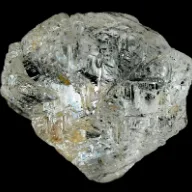 Phenakite
A beryllium silicate so like quartz that it was named the deceiver.
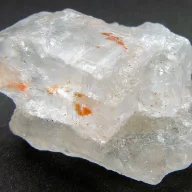 Halite
Rock salt: perfect cubes that will dissolve in a damp room.
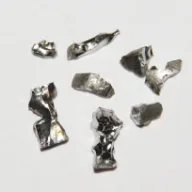 Iridium
The most corrosion-proof metal there is, and the layer that dates the end of the dinosaurs.
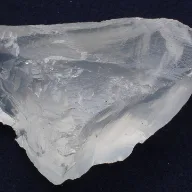 Petalite
The mineral lithium was discovered in, and it looks like nothing at all.
Cradle of Humankind stone
Ordinary grey chalcedony from an extraordinary place outside Johannesburg.
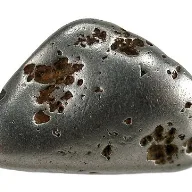 Platinum
Little silver, the Spanish called it, and threw it back in the river.
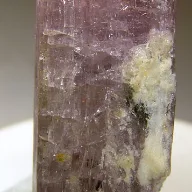 Scapolite
A tetragonal silicate that glows yellow under ultraviolet and fades in the sun.
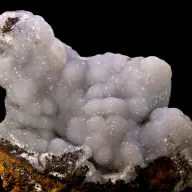 Smithsonite
Zinc carbonate in botryoidal crusts, named after the man who founded the Smithsonian.
Shiva lingam
A Narmada river cobble, ground by hand into an egg and sold as a sacred stone.
 Titanium
The ninth commonest element in the crust, and almost never found as a metal.
 Tremolite
The white amphibole that makes nephrite jade, and, in its fibrous form, asbestos.
 Zeolite
Minerals built like sponges at the atomic scale, which is why industry uses more of them than jewellers do.
 Diamond
Carbon, arranged the hard way, and carried up from two hundred kilometres down.