 Lunarya
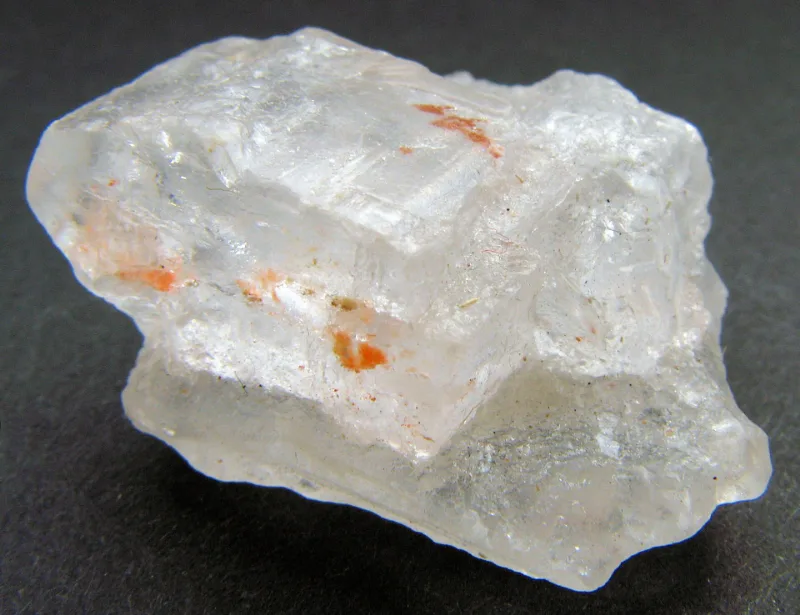
Halite
Halite is sodium chloride, NaCl, which is to say salt. It grows in cubes, cleaves into smaller cubes along three planes at right angles, is soft enough to mark with a fingernail, and is the one mineral in ordinary use that is identified by taste. Pure halite is colourless and looks like glass; the pink, orange and amber pieces owe their colour to iron oxide and to specks of clay caught in the growing crystal.
The blue and violet halite that turns up in old European mines is a different matter. Its colour comes from colour centres — places where a chlorine ion is missing from the lattice and an electron has taken its place — created by radiation from the surrounding rock over geological time. Light destroys them, so a blue crystal on a windowsill will fade to clear. Halite is also mildly deliquescent: in a humid room it pulls water out of the air, wets its own surface, and dries again as a crust.
In short
- Colour
- Clear and white
- Mineral
- Halide
- Formula
- NaCl
- Hardness
- 2–2.5 on the Mohs scale
- Crystal system
- Cubic
- Found in
- Romania is one of the great salt countries — Turda, Praid, Slănic Prahova, Cacica, Ocna Dej and Ocnele Mari, worked since Dacian and Roman times and now as much visited as mined. Others are Wieliczka and Bochnia in Poland, Hallstatt in Austria, Khewra in Pakistan, the Dead Sea, Iran, and the salt domes of Texas and Louisiana.
- Element
- Water
- Planet
- The Moon
- Chakra
- Root
- Handling
- Keep out of water and sunlight
How it forms
Halite is an evaporite. A shallow sea or a closed lake dries out, and the salts come out of solution in order: carbonates first, then gypsum, then halite, then the bitter potassium and magnesium salts at the very end. Repeat that for a few million years and the result is hundreds of metres of rock salt. Buried salt is lighter than the rock above it and flows like a very slow liquid, rising in domes that bend the strata and trap oil against their flanks.
In human hands
Salt made and taxed empires. Roman soldiers were paid partly in it, or paid enough to buy it, which is where salary comes from; the salt roads of central Europe carried the Hallstatt trade; the French gabelle helped bring on a revolution. In Romania the mines at Turda and Praid ran continuously from antiquity, and their worked-out galleries are now used for halotherapy and, at Turda, for an underground funfair. Salt at a threshold, over a shoulder or in a bowl by the door belongs to the same long history.
Varieties and trade names
- Clear halite cubes
- Colourless crystals with three cleavages at right angles; the textbook cubic mineral.
- Blue and violet halite
- Coloured by radiation damage in the lattice, and it fades in daylight; from Germany, Poland and the United States.
- Pink Himalayan salt
- From Khewra in Pakistan, iron-tinted; an ancient deposit, and the health claims made for it are marketing.
- Hopper crystals
- Stepped, skeletal cubes grown fast at a brine surface, hollow-faced and delicate.
- Romanian mine salt
- Grey and banded from Turda, Praid and Slănic, sold as lamps, blocks and carvings.
Telling it from a fake
Touch a clean edge to the tongue: salt tastes of salt, and nothing else in a mineral tray does. It dissolves readily in water and cleaves into cubes when tapped. Sylvite, potassium chloride, looks similar and tastes bitter. Calcite is harder, does not dissolve and cleaves into rhombs rather than cubes. A salt lamp that never sweats in a humid Romanian summer is probably not salt.
None of this needs a laboratory, and none of it is proof. A shop that will not say whether a stone is treated has answered the question; ask, and have the answer written on the receipt.
What it is said to do
Salt is the oldest cleanser in Europe, and the crystal trade inherited the whole tradition intact: circles of salt, salt at doorways, salt in the bath, salt to clear a room or an object. It is given to the Moon, to Cancer and Pisces, and to the root. One piece of received advice is worth contradicting: burying crystals in salt to cleanse them etches, pits or dulls a great many of them, and the care page says which.
Living with it
It dissolves. That is the whole of the handling advice: no water, no damp bathroom, no humid windowsill, and a sealed box or a dry shelf in winter. Coloured varieties fade in daylight as well. Wipe with a dry cloth only, and if a piece has gone sticky in humid weather, dry it gently and accept that it will have lost a little of its surface.
In magic
Salt is the oldest protective substance in European magic: circles of it, lines of it across a threshold, salt in the corners of a new house, bread and salt for a guest. Halite crystals are used to the same ends, and for cleansing a room or an object. Two cautions: salt pits many of the stones it is meant to cleanse, and halite dissolves, so it has no place in a water ritual.
- Energy
- Receptive
- Day
- Monday
- Worked for
- Cleansing · Protection
More of this colour
 Clear quartz
The plain one, and the one the modern world actually runs on.
 Selenite
Gypsum in satin fibres, soft enough to mark with a fingernail.
 Moonstone
Feldspar with a light inside it that moves when the stone does.
 Amblygonite
A lithium phosphate from the pegmatites, and the palest yellow gem you have never heard of.
 Silver
The metal of the moon, grown in wires and ferns in the veins of the earth.
 Baryte
The heavy stone: barium sulfate, and the reason a rose can grow in the desert.
 Calcite
The commonest carbonate on Earth, and the crystal that showed physicists light has two paths.
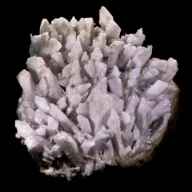 Danburite
A borosilicate that looks exactly like topaz, named after a Connecticut town that paved over the deposit.
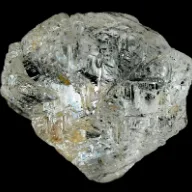 Phenakite
A beryllium silicate so like quartz that it was named the deceiver.
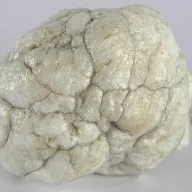 Howlite
White nodules with black veins, and the most dyed mineral in the trade.
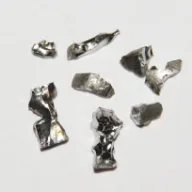 Iridium
The most corrosion-proof metal there is, and the layer that dates the end of the dinosaurs.
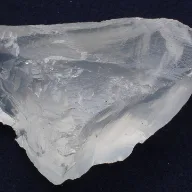 Petalite
The mineral lithium was discovered in, and it looks like nothing at all.
Cradle of Humankind stone
Ordinary grey chalcedony from an extraordinary place outside Johannesburg.
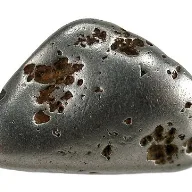 Platinum
Little silver, the Spanish called it, and threw it back in the river.
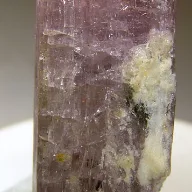 Scapolite
A tetragonal silicate that glows yellow under ultraviolet and fades in the sun.
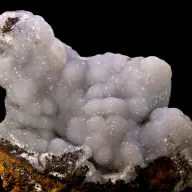 Smithsonite
Zinc carbonate in botryoidal crusts, named after the man who founded the Smithsonian.
Shiva lingam
A Narmada river cobble, ground by hand into an egg and sold as a sacred stone.
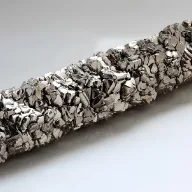 Titanium
The ninth commonest element in the crust, and almost never found as a metal.
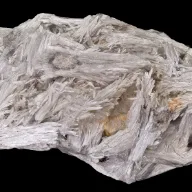 Tremolite
The white amphibole that makes nephrite jade, and, in its fibrous form, asbestos.
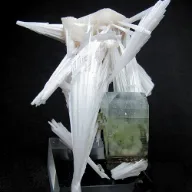 Zeolite
Minerals built like sponges at the atomic scale, which is why industry uses more of them than jewellers do.
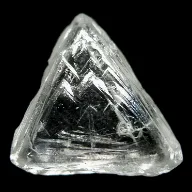 Diamond
Carbon, arranged the hard way, and carried up from two hundred kilometres down.