 Lunarya
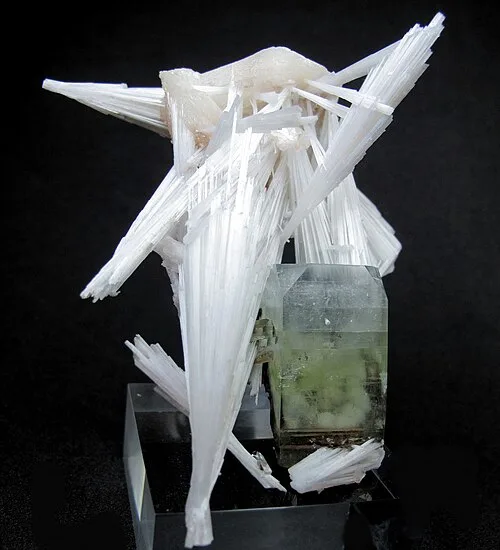
Zeolite
Zeolite is not one mineral but a family of about eighty natural species, all hydrated aluminosilicates of sodium, calcium, potassium and barium, and all built the same way: a rigid framework of silicon, aluminium and oxygen with open cages and channels running through it. Water and loose cations sit in those channels and can come and go without the framework collapsing. The family is soft, 3.5 to 5.5, usually white or pale, and it forms some of the most delicate specimens in mineralogy.
The open structure is what makes zeolites useful. The channels are a fixed size, so a zeolite admits molecules below a certain diameter and refuses larger ones — a molecular sieve, which is how they are sold industrially. The cations in the channels swap freely with cations in a passing solution, which is why zeolite replaced phosphates in laundry detergent and why it was spread on the ground at Chernobyl and pumped into the sea at Fukushima to catch caesium and strontium. Synthetic zeolites crack petroleum into petrol.
In short
- Colour
- Clear and white
- Mineral
- Zeolite
- Formula
- (Na,K,Ca,Ba)–Al–Si–O + H₂O
- Hardness
- 3.5–5.5 on the Mohs scale
- Crystal system
- Several — it is a family
- Found in
- The Deccan basalts of Maharashtra in India — Pune, Nashik and Jalgaon — produce the world's finest specimens by a wide margin. Also Iceland, the Faroes, Nova Scotia, New Jersey, Oregon and Washington, Mont Saint-Hilaire in Quebec, and the tuff beds of Nevada and Turkey for the industrial clinoptilolite.
- Element
- Air
- Planet
- Mercury
- Chakra
- Crown
- Handling
- Keep out of water
How it forms
Zeolites grow where hot, alkaline, silica-rich water meets volcanic rock. The commonest setting is a basalt lava flow: gas bubbles frozen into the rock leave cavities, water percolates through over millions of years, breaks down the volcanic glass and refills the cavities with crystals. A single Deccan cavity may hold stilbite, heulandite, apophyllite, calcite and quartz in a sequence that records the changing fluid. Zeolites also form in thick beds where volcanic ash has settled in a salt lake and altered wholesale, and that is where the industrial tonnage comes from.
In human hands
Axel Fredrik Cronstedt named the group in 1756 after watching stilbite froth and dance in a blowpipe flame as its water boiled off: zeo lithos, the boiling stone. That the water can be driven out and taken back up again without wrecking the crystal is the whole basis of the industry. Synthetic zeolites were developed from the 1940s and had transformed oil refining by the 1960s. Natural zeolite is now mined by the million tonnes for cat litter, water treatment and animal feed.
Varieties and trade names
- Stilbite
- Peach to cream sheaves and bowties, the commonest good specimen from India, and the mineral Cronstedt was heating when he named the group.
- Heulandite
- Flattened coffin-shaped crystals, pearly on the cleavage, in white, peach, green and red; often on the same piece as stilbite.
- Natrolite and scolecite
- Both grow as sprays of fine white needles radiating from a point. Scolecite curls when heated, which is where its name comes from — the Greek for worm.
- Apophyllite
- Sold with the zeolites everywhere and not one: it is a sheet silicate with a different structure. The green Indian crystals are superb and the label is wrong all the same.
- Clinoptilolite
- The industrial zeolite, and the one sold as a powdered supplement. The claims made about swallowing it are not supported, and some products have been found contaminated.
Telling it from a fake
Habit is the first clue: radiating needles, sheaves, bowties and coffin-shaped plates on a dark volcanic matrix are almost always zeolites. They are light in the hand, soft enough to mark with a knife, and usually pearly rather than glassy where they cleave. Calcite grows with them and fizzes in acid, which zeolites do not. Telling the individual species apart by eye is genuinely hard, and dealers routinely label a whole piece stilbite when it holds three or four different minerals.
None of this needs a laboratory, and none of it is proof. A shop that will not say whether a stone is treated has answered the question; ask, and have the answer written on the receipt.
What it is said to do
Zeolites reached the crystal trade late and the writing about them has taken its cue from the industrial use: clearing, filtering, letting go of what has been absorbed. It is a reading built on a real property, although the property belongs to a bed of clinoptilolite in a water treatment plant rather than to a stilbite on a shelf. Here the family goes with air, with Mercury, with Virgo and Aquarius, and with the crown. A zeolite in a glass of water is not filtering anything you would notice.
Living with it
These are fragile minerals. The needles of natrolite and scolecite snap at a touch, and the whole family is soft enough to scratch on almost anything. Keep specimens in a case and move them by the matrix. Do not wash them: the structure is porous and will take up whatever is in the water, and laumontite in particular crumbles to powder as it dries out. Light is harmless. Blow the dust off rather than brushing it.
In magic
Zeolites are used in modern practice for cleansing and release, borrowing the image of the industrial filter: a cluster on the altar to soak up a room's tension, or in workings for letting go. The image is real; the filtering in a living room is not. They are porous and fragile, so they are kept dry and handled by the matrix.
- Energy
- Projective
- Day
- Wednesday
- Worked for
- Cleansing · Change and letting go
More of this colour
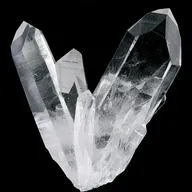 Clear quartz
The plain one, and the one the modern world actually runs on.
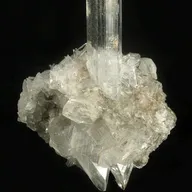 Selenite
Gypsum in satin fibres, soft enough to mark with a fingernail.
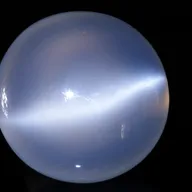 Moonstone
Feldspar with a light inside it that moves when the stone does.
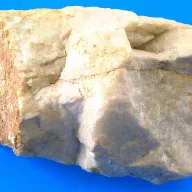 Amblygonite
A lithium phosphate from the pegmatites, and the palest yellow gem you have never heard of.
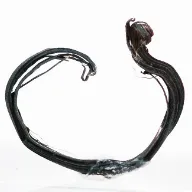 Silver
The metal of the moon, grown in wires and ferns in the veins of the earth.
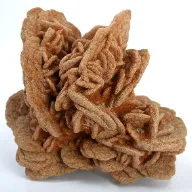 Baryte
The heavy stone: barium sulfate, and the reason a rose can grow in the desert.
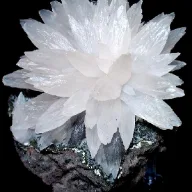 Calcite
The commonest carbonate on Earth, and the crystal that showed physicists light has two paths.
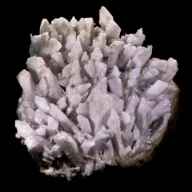 Danburite
A borosilicate that looks exactly like topaz, named after a Connecticut town that paved over the deposit.
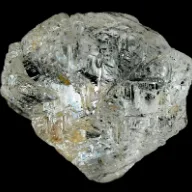 Phenakite
A beryllium silicate so like quartz that it was named the deceiver.
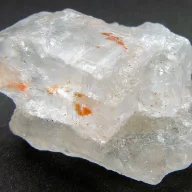 Halite
Rock salt: perfect cubes that will dissolve in a damp room.
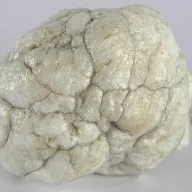 Howlite
White nodules with black veins, and the most dyed mineral in the trade.
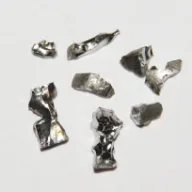 Iridium
The most corrosion-proof metal there is, and the layer that dates the end of the dinosaurs.
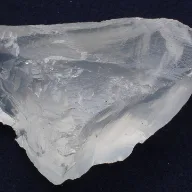 Petalite
The mineral lithium was discovered in, and it looks like nothing at all.
Cradle of Humankind stone
Ordinary grey chalcedony from an extraordinary place outside Johannesburg.
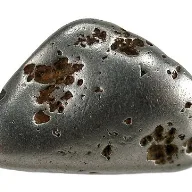 Platinum
Little silver, the Spanish called it, and threw it back in the river.
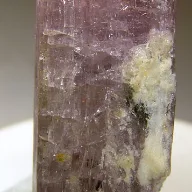 Scapolite
A tetragonal silicate that glows yellow under ultraviolet and fades in the sun.
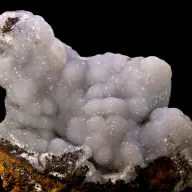 Smithsonite
Zinc carbonate in botryoidal crusts, named after the man who founded the Smithsonian.
Shiva lingam
A Narmada river cobble, ground by hand into an egg and sold as a sacred stone.
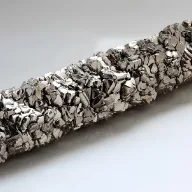 Titanium
The ninth commonest element in the crust, and almost never found as a metal.
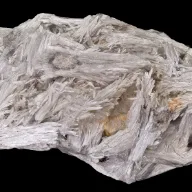 Tremolite
The white amphibole that makes nephrite jade, and, in its fibrous form, asbestos.
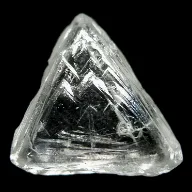 Diamond
Carbon, arranged the hard way, and carried up from two hundred kilometres down.