 Lunarya
Silver
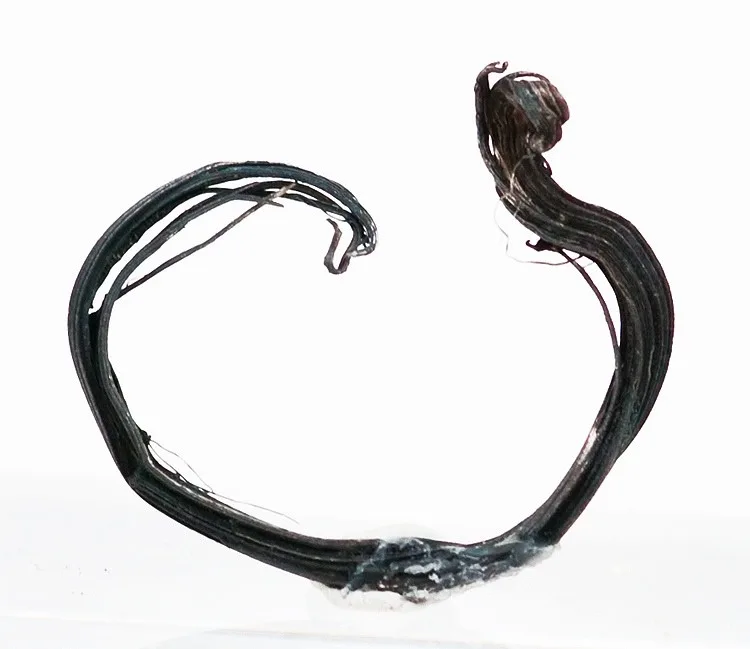
Silver occurs in the ground as itself: the pure metal, grown in veins as curling wires, branching ferns and, rarely, cubes and octahedra, with the same structure and softness as the metal in a spoon. It tarnishes as the spoon does, so most of the native silver in a cabinet is black on the outside and bright only where it has been cut.
Most of the world's silver has always come out of ores rather than the native metal — the argentiferous lead of Laurion that paid for the Athenian fleet, the mountain of Potosí that paid for the Spanish empire — but the wires and plates of native silver are the famous specimens: the metre-long ones of Kongsberg in Norway, mined for the crown from 1623, and the slabs of Cobalt in Ontario that were used as pavement before anyone realised. Silver is the moon's metal in every tradition that assigned metals to planets, for the colour and for the way it dims.
In short
- Colour
- Clear and white
- Mineral
- Native element
- Formula
- Ag
- Hardness
- 2.5–3 on the Mohs scale
- Crystal system
- Cubic
- Found in
- Norway (Kongsberg), Mexico, Ontario (Cobalt), Morocco (Imiter), Saxony (Freiberg), Colorado, Michigan.
- Element
- Water
- Planet
- The Moon
- Chakra
- Crown
- Handling
- Water and light are both fine
How it forms
Silver is carried through rock by hot water as a chloride or a sulfide complex, and drops out of it as metal where the water cools or meets something that takes its sulfur — an iron mineral, a bed of carbon, a change in the rock. In the great veins it grew slowly from a solution just short of saturation, which is what makes wires: the metal adds atom by atom to the tip of a thread and the thread curls as it grows. Nearer the surface, where the sulfide ores of a vein have weathered, silver is set free again in a zone of enriched native metal, which is where most old mines began.
In human hands
It was the money of the ancient world, from the shekel to the denarius, and the metal that measured value in Europe until the nineteenth century; the mines of Laurion, Freiberg, Joachimsthal (which gave the thaler and so the dollar its name) and Potosí each made a state rich in turn. Kongsberg in Norway was found by two goatherds in 1623 and gave the Danish crown two centuries of the finest native silver known. In Cobalt, Ontario, a railway blacksmith is supposed to have thrown a hammer at a fox in 1903 and hit a vein. It has been photography's metal since 1839 and medicine's since long before, for its habit of killing bacteria, which is real.
Varieties and trade names
- Wire silver
- The curls and coils of Kongsberg, Colorado and Morocco; the form collectors pay for, and the hardest to fake convincingly.
- Dendritic silver
- Flat ferns and branches of metal grown in a crack, often from Michigan and Mexico, and often with native copper alongside.
- Silver crystals
- Rare cubes and octahedra, mostly tiny; the metal prefers to grow as wire, and a sharp crystal is a prize.
- Sterling and fine silver
- Not a mineral: the metal refined and, for sterling, alloyed with a little copper, which is what the jewellery is.
Telling it from a fake
Native silver is heavy — half again as heavy as the same lump of galena — and it is the only silver-white metal in a vein that a knife cuts into rather than scratches. Its wires are often black with tarnish and show bright metal only at a fresh nick. Aluminium and tin are lighter, arsenic and antimony are brittle, and 'silver' nuggets sold cheaply are usually one of those or a plated cast. Wire silver has been faked by pulling wire from real metal and gluing it to matrix, which is why a specimen from a reputable dealer costs what it does; the seam of glue is the tell.
None of this needs a laboratory, and none of it is proof. A shop that will not say whether a stone is treated has answered the question; ask, and have the answer written on the receipt.
What it is said to do
The moon's metal, and so the tradition follows the moon: reflection, tides, intuition, the feminine in the old systems and the night in all of them. It is given for clearing the mind and, from its real property of killing germs, for cleanliness in every sense. Silver in the door and on the crib is older than any of the lists.
Living with it
It tarnishes in air and faster near rubber, wool and eggs, all of which give off sulfur. Wipe it with a soft cloth; leave a specimen's black patina alone, since the wires beneath are fragile and worth more untouched.
In magic
Silver is the Moon's metal in alchemy and planetary magic, and the witch's own: ritual jewellery, the crescent on a circlet, the silver coin kept in a purse that should never be empty, the silver bullet of folklore for whatever iron could not stop. Modern practice uses it for protection, intuition and cleansing, and for anything worked on a Monday. Wipe it with a cloth; tarnish is only sulfur.
- Energy
- Receptive
- Day
- Monday
- Worked for
- Protection · Divination and intuition · Cleansing
More of this colour
 Clear quartz
The plain one, and the one the modern world actually runs on.
 Selenite
Gypsum in satin fibres, soft enough to mark with a fingernail.
 Moonstone
Feldspar with a light inside it that moves when the stone does.
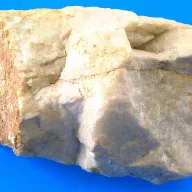 Amblygonite
A lithium phosphate from the pegmatites, and the palest yellow gem you have never heard of.
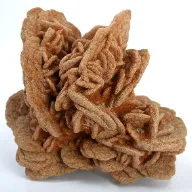 Baryte
The heavy stone: barium sulfate, and the reason a rose can grow in the desert.
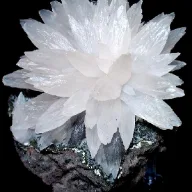 Calcite
The commonest carbonate on Earth, and the crystal that showed physicists light has two paths.
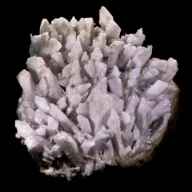 Danburite
A borosilicate that looks exactly like topaz, named after a Connecticut town that paved over the deposit.
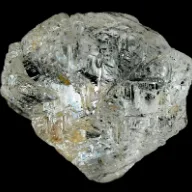 Phenakite
A beryllium silicate so like quartz that it was named the deceiver.
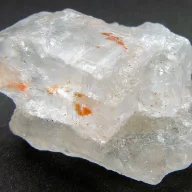 Halite
Rock salt: perfect cubes that will dissolve in a damp room.
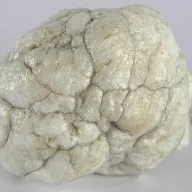 Howlite
White nodules with black veins, and the most dyed mineral in the trade.
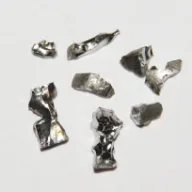 Iridium
The most corrosion-proof metal there is, and the layer that dates the end of the dinosaurs.
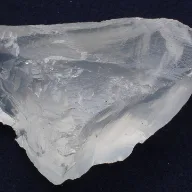 Petalite
The mineral lithium was discovered in, and it looks like nothing at all.
Cradle of Humankind stone
Ordinary grey chalcedony from an extraordinary place outside Johannesburg.
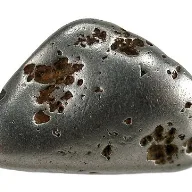 Platinum
Little silver, the Spanish called it, and threw it back in the river.
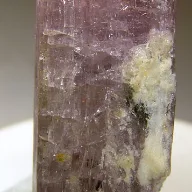 Scapolite
A tetragonal silicate that glows yellow under ultraviolet and fades in the sun.
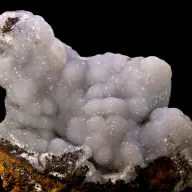 Smithsonite
Zinc carbonate in botryoidal crusts, named after the man who founded the Smithsonian.
Shiva lingam
A Narmada river cobble, ground by hand into an egg and sold as a sacred stone.
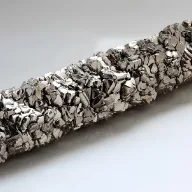 Titanium
The ninth commonest element in the crust, and almost never found as a metal.
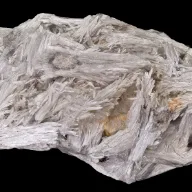 Tremolite
The white amphibole that makes nephrite jade, and, in its fibrous form, asbestos.
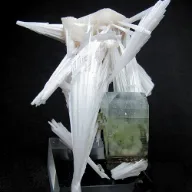 Zeolite
Minerals built like sponges at the atomic scale, which is why industry uses more of them than jewellers do.
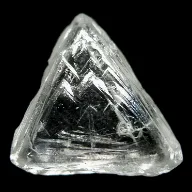 Diamond
Carbon, arranged the hard way, and carried up from two hundred kilometres down.