 Lunarya
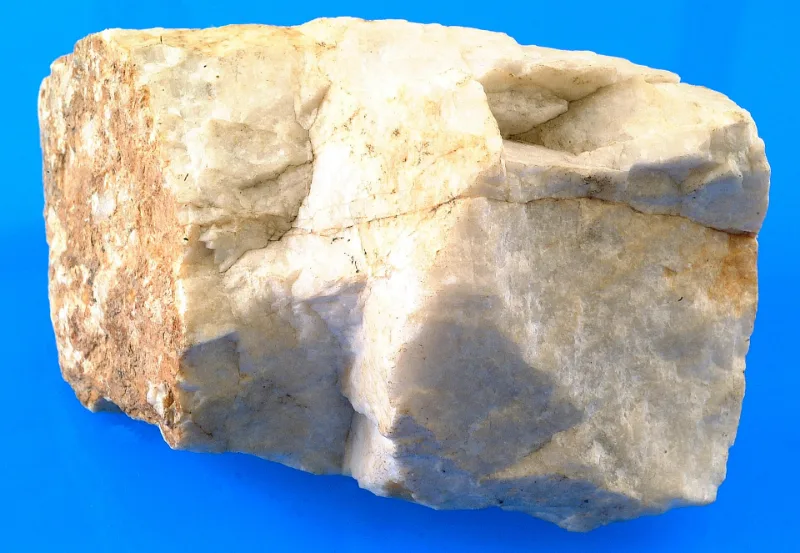
Amblygonite
Amblygonite is a lithium aluminium phosphate with fluorine, one of the minerals that grow where a granite's last melt collects, and as much as a tenth of its weight is lithium oxide. Most of it is white or cream and blocky; the rare transparent pieces, in a pale straw yellow, are cut as gems, which few people have seen and fewer can name.
It was described by August Breithaupt in 1817 from the pegmatites of Saxony and named from the Greek for blunt angle, because its cleavage planes meet obtusely; it is a sober name for a sober mineral. Before spodumene took over, it was mined as an ore of lithium in France, in California and in the Black Hills, where crystals the size of a room were dug out for the metal. Nearly everything sold as amblygonite is actually montebrasite, the same mineral with hydroxyl in place of most of the fluorine, which is commoner; the two are so alike that the trade has stopped trying.
In short
- Colour
- Clear and white
- Mineral
- Phosphate
- Formula
- (Li,Na)AlPO₄(F,OH)
- Hardness
- 5.5–6 on the Mohs scale
- Crystal system
- Triclinic
- Found in
- Brazil (Minas Gerais), Maine, South Dakota, Namibia, Myanmar, France, Spain and Saxony.
- Element
- Air
- Planet
- Mercury
- Chakra
- Solar plexus
- Handling
- Water and light are both fine
How it forms
A granite pegmatite is the last of a granite to set: the residual melt, thick with water and with everything that would not fit into the ordinary minerals — lithium, beryllium, boron, phosphorus — crystallising in coarse veins and pockets. Amblygonite grows there beside spodumene, lepidolite, tourmaline and apatite, as blocks that can weigh tonnes, and it is the phosphorus and the lithium meeting that make it. The clear gem crystals come from a few pockets in Brazil where the mineral grew slowly enough, and cooled gently enough, to stay transparent.
In human hands
The lithium pegmatites of the Black Hills and of Montebras in France were worked in the nineteenth and early twentieth centuries for amblygonite as an ore, when lithium went into glass and greases and, for a while, into a soft drink. The gem story is shorter: cut stones from Brazil and Myanmar began to appear in collectors' cabinets in the 1950s and have stayed there, because at a hardness of six and with perfect cleavage a stone is a risk in a ring. It is still mined as a minor ore where it occurs with spodumene, which is the mineral the world's batteries are now made from.
Varieties and trade names
- Montebrasite
- The hydroxyl-rich end of the series, and the one most 'amblygonite' actually is; named for Montebras in France.
- Gem amblygonite
- Transparent pale yellow crystals from Minas Gerais, faceted for collectors and almost never for jewellery.
- Massive amblygonite
- The white blocks of the lithium mines, worked as ore and sometimes tumbled and sold as a stone.
- Natromontebrasite
- The sodium-rich version, a name now discredited but still on old labels; the same white mineral.
Telling it from a fake
A white blocky stone with a pearly sheen on its cleavage faces and a faint greasy lustre elsewhere, heavier than quartz and scratched, just, by a knife. It is easily confused with albite and with spodumene in the same rocks, and the old field test is the flame: a splinter of amblygonite colours a flame red, from the lithium, and fuses easily, which feldspar does not. Faceted stones are pale yellow to colourless and softer than the citrine or chrysoberyl they might be taken for. Nothing is faked as amblygonite.
None of this needs a laboratory, and none of it is proof. A shop that will not say whether a stone is treated has answered the question; ask, and have the answer written on the receipt.
What it is said to do
A newcomer to the lists, with a tradition assembled in the last few decades: a stone for creative work and for taking things lightly, on the reading that lithium in the ground might do what lithium in a prescription does, which it does not. It is given for unwinding after strain, and for the stretch of a long project when the point of it has gone missing.
Living with it
A shelf stone rather than a pocket one: it cleaves and it is soft. Dust it, keep it dry, and do not tumble it with anything harder.
In magic
Amblygonite has no older magic. The books that use it give it to creative work and to easing strain, as a softer stone for a busy mind at night. It is soft and cleaves, so in practice it is a shelf stone, kept in a dish on the altar rather than carried.
- Energy
- Projective
- Day
- Wednesday
- Worked for
- Calm and peace
More of this colour
 Clear quartz
The plain one, and the one the modern world actually runs on.
 Selenite
Gypsum in satin fibres, soft enough to mark with a fingernail.
 Moonstone
Feldspar with a light inside it that moves when the stone does.
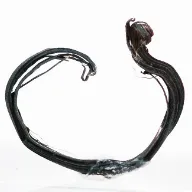 Silver
The metal of the moon, grown in wires and ferns in the veins of the earth.
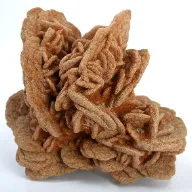 Baryte
The heavy stone: barium sulfate, and the reason a rose can grow in the desert.
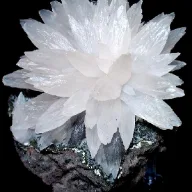 Calcite
The commonest carbonate on Earth, and the crystal that showed physicists light has two paths.
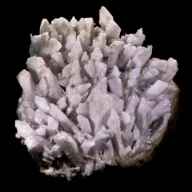 Danburite
A borosilicate that looks exactly like topaz, named after a Connecticut town that paved over the deposit.
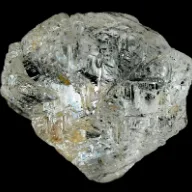 Phenakite
A beryllium silicate so like quartz that it was named the deceiver.
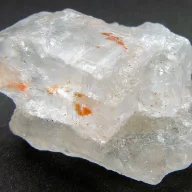 Halite
Rock salt: perfect cubes that will dissolve in a damp room.
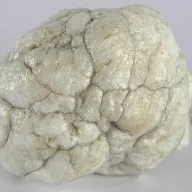 Howlite
White nodules with black veins, and the most dyed mineral in the trade.
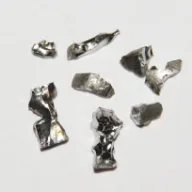 Iridium
The most corrosion-proof metal there is, and the layer that dates the end of the dinosaurs.
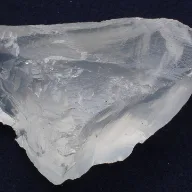 Petalite
The mineral lithium was discovered in, and it looks like nothing at all.
Cradle of Humankind stone
Ordinary grey chalcedony from an extraordinary place outside Johannesburg.
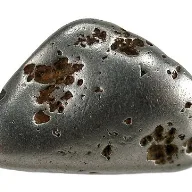 Platinum
Little silver, the Spanish called it, and threw it back in the river.
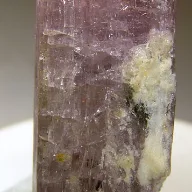 Scapolite
A tetragonal silicate that glows yellow under ultraviolet and fades in the sun.
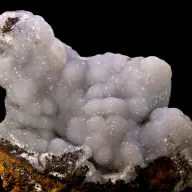 Smithsonite
Zinc carbonate in botryoidal crusts, named after the man who founded the Smithsonian.
Shiva lingam
A Narmada river cobble, ground by hand into an egg and sold as a sacred stone.
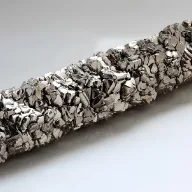 Titanium
The ninth commonest element in the crust, and almost never found as a metal.
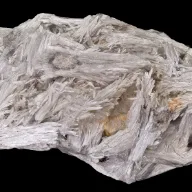 Tremolite
The white amphibole that makes nephrite jade, and, in its fibrous form, asbestos.
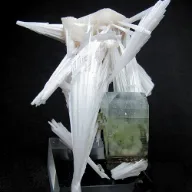 Zeolite
Minerals built like sponges at the atomic scale, which is why industry uses more of them than jewellers do.
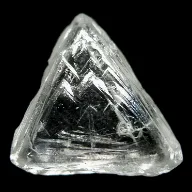 Diamond
Carbon, arranged the hard way, and carried up from two hundred kilometres down.