 Lunarya
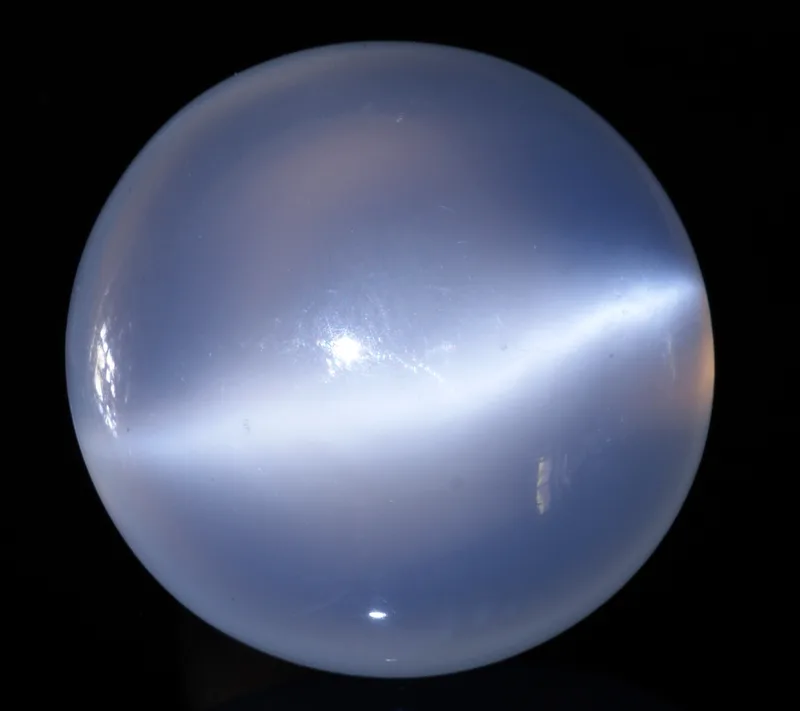
Moonstone
Moonstone is a feldspar that grew as alternating microscopic layers of two slightly different compositions. Light entering the stone is scattered between those layers and comes back as a soft blue-white glow that floats across the surface as the stone is tilted — adularescence, named after the Adula massif in Switzerland where it was first described.
The finest material is nearly colourless with a blue sheen and comes from Sri Lanka, where the best deposits have been worked out; India produces stones with the same effect over grey, peach and green bodies. Moonstone was the signature stone of Art Nouveau — René Lalique used it constantly — and had a second run in the 1960s, which is roughly when it acquired most of its present symbolism.
In short
- Colour
- Clear and white
- Mineral
- Feldspar
- Formula
- KAlSi₃O₈
- Hardness
- 6–6.5 on the Mohs scale
- Crystal system
- Monoclinic
- Found in
- Sri Lanka, India, Madagascar and Myanmar.
- Birthstone of
- June
- Element
- Water
- Planet
- The Moon
- Chakra
- Third eye
- Handling
- Water and light are both fine
How it forms
Moonstone is feldspar, the commonest mineral in the crust, in a form that did something unusual as it cooled: a potassium feldspar separated into microscopically thin alternating layers of two compositions, and light scattering off those layers is the glow that floats beneath the surface and moves as the stone turns. Thin layers give blue, thicker ones white. It grows in pegmatites and metamorphic rock, and the classic source is Sri Lanka, with Myanmar, India, Madagascar and Tanzania after it; the Swiss adularia of the St Gotthard gave the effect its name, adularescence. It has two directions of cleavage and chips if it is dropped.
In human hands
Pliny reported a stone whose image of the moon grew and shrank with it, and in India it was said to be moonlight set hard. It was a modest stone until the Art Nouveau jewellers took it up: Lalique and Louis Comfort Tiffany set it in silver and enamel from the 1890s, and it came back with the Edwardians, with the 1960s, and is back again. Florida made it the state gem in 1970 to mark the Apollo landings, though no moonstone has ever been found in Florida, and a great deal of it has been found in Meetiyagoda, Sri Lanka, where the mines are the village's living.
Varieties and trade names
- Ceylon moonstone
- A colourless, near-transparent body with a blue glow from Sri Lanka; the finest kind, and the one the price list means.
- Rainbow moonstone
- White labradorite from India with a many-coloured flash — a different feldspar, sold at moonstone prices and worth having anyway.
- Peach and grey moonstone
- Indian stones with a white sheen and a body colour, cheaper and easier to find in size.
- Cat's-eye moonstone
- Cut as a dome with a single line of light across it, from needle inclusions lying one way.
- Black moonstone
- Grey to black feldspar from Madagascar with a silver or peach sheen over it; sold since about 2010, and the darkest thing called moonstone.
Telling it from a fake
The imitation is opal glass, which has a milky glow that sits on the surface everywhere at once, does not move when you tilt it and carries bubbles; real adularescence rises from within, is often strongest off-centre and slides across the stone as it turns. Under a loupe, natural moonstone shows stress cracks like centipedes. Rainbow moonstone is labradorite: not a fake, just a different feldspar, and often priced as though it were not. A chipped edge is normal on a stone with two cleavages; a bubble never is.
None of this needs a laboratory, and none of it is proof. A shop that will not say whether a stone is treated has answered the question; ask, and have the answer written on the receipt.
What it is said to do
Read as the moon's own stone and tied to cycles of every kind: it is given for intuition, for patience with a thing that is taking its time, and for dreams. Older Indian tradition treats it as a stone of good fortune and a traveller's protection by night.
Living with it
Safe in soapy water, but it cleaves easily and chips on a hard knock, so a moonstone ring wants more care than a quartz one. Never clean it ultrasonically.
In magic
Moonstone is the moon's own stone in every modern book, used for divination, for dreams and for the cycles of a life: worn at the full moon, put under the pillow, held through a ritual timed to the moon's phase. In India it has long been a stone of good fortune and of love, often given at weddings, and some books add protection for travellers by night. It is safe in water but cleaves at a knock.
- Energy
- Receptive
- Day
- Monday
- Worked for
- Divination and intuition · Sleep and dreams · Protection
More of this colour
 Clear quartz
The plain one, and the one the modern world actually runs on.
 Selenite
Gypsum in satin fibres, soft enough to mark with a fingernail.
 Amblygonite
A lithium phosphate from the pegmatites, and the palest yellow gem you have never heard of.
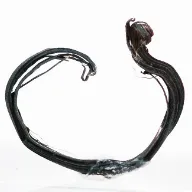 Silver
The metal of the moon, grown in wires and ferns in the veins of the earth.
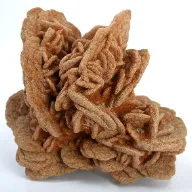 Baryte
The heavy stone: barium sulfate, and the reason a rose can grow in the desert.
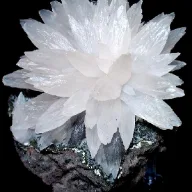 Calcite
The commonest carbonate on Earth, and the crystal that showed physicists light has two paths.
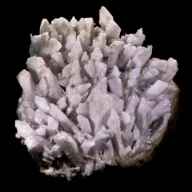 Danburite
A borosilicate that looks exactly like topaz, named after a Connecticut town that paved over the deposit.
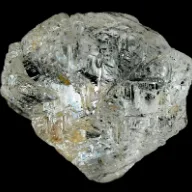 Phenakite
A beryllium silicate so like quartz that it was named the deceiver.
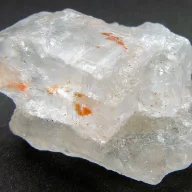 Halite
Rock salt: perfect cubes that will dissolve in a damp room.
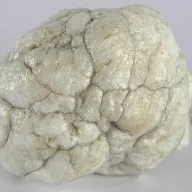 Howlite
White nodules with black veins, and the most dyed mineral in the trade.
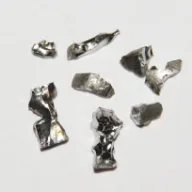 Iridium
The most corrosion-proof metal there is, and the layer that dates the end of the dinosaurs.
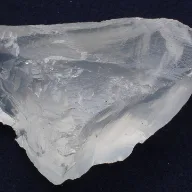 Petalite
The mineral lithium was discovered in, and it looks like nothing at all.
Cradle of Humankind stone
Ordinary grey chalcedony from an extraordinary place outside Johannesburg.
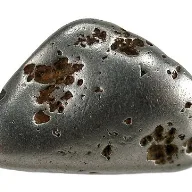 Platinum
Little silver, the Spanish called it, and threw it back in the river.
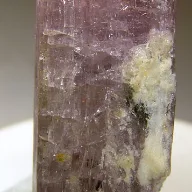 Scapolite
A tetragonal silicate that glows yellow under ultraviolet and fades in the sun.
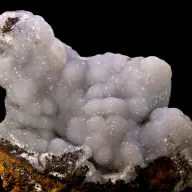 Smithsonite
Zinc carbonate in botryoidal crusts, named after the man who founded the Smithsonian.
Shiva lingam
A Narmada river cobble, ground by hand into an egg and sold as a sacred stone.
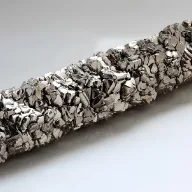 Titanium
The ninth commonest element in the crust, and almost never found as a metal.
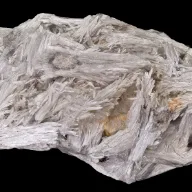 Tremolite
The white amphibole that makes nephrite jade, and, in its fibrous form, asbestos.
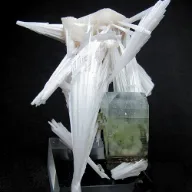 Zeolite
Minerals built like sponges at the atomic scale, which is why industry uses more of them than jewellers do.
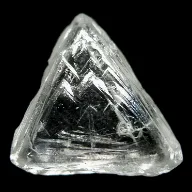 Diamond
Carbon, arranged the hard way, and carried up from two hundred kilometres down.