 Lunarya
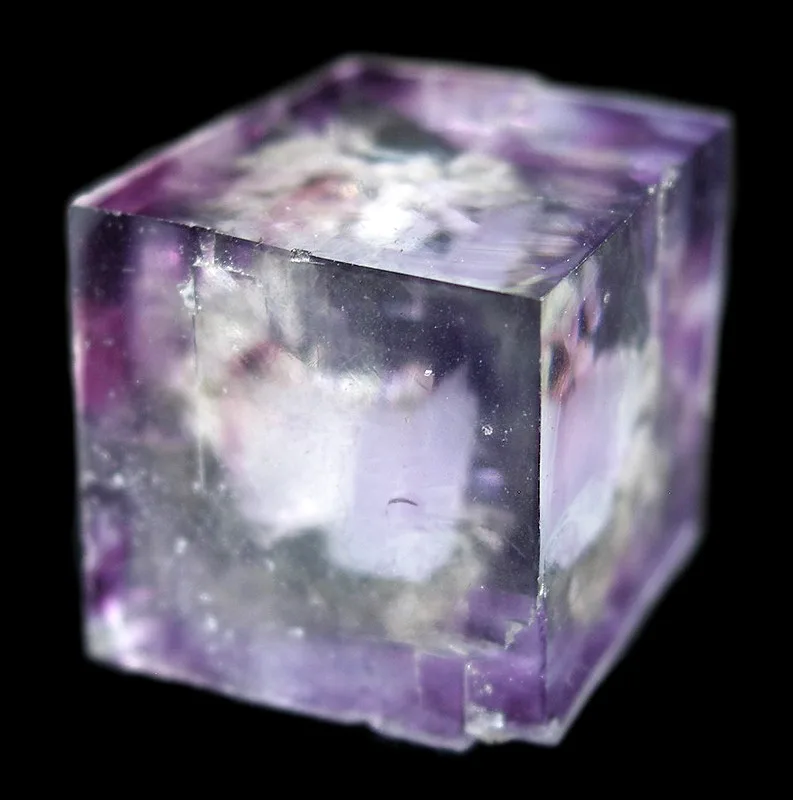
Fluorite
Calcium fluoride: cubic, soft enough to scratch with a coin, and banded in purple, green, blue and colourless layers that show which way the crystal was growing. It cleaves cleanly in four directions, which is why so many pieces in shops are perfect octahedra — those are split, not carved.
Fluorite is the mineral the word fluorescence was made from: George Stokes named the effect in 1852 after the blue glow of fluorspar under ultraviolet light. Its older use is in the name too, from the Latin fluere, to flow — it has been thrown into smelting furnaces for five hundred years to make slag run thin. The banded purple-and-yellow Blue John from Derbyshire has been cut into bowls and urns since the eighteenth century, and the element fluorine was first isolated from this mineral.
In short
- Colour
- Violet and pink
- Mineral
- Halide
- Formula
- CaF₂
- Hardness
- 4 on the Mohs scale
- Crystal system
- Cubic
- Found in
- England (Derbyshire), China, Mexico, Namibia and Illinois.
- Element
- Air
- Planet
- Mercury
- Chakra
- Third eye
- Handling
- Keep out of water and sunlight
How it forms
Fluorite crystallises out of hot, fluorine-rich brines moving through limestone and granite, and fills the veins and cavities they leave, usually beside galena, sphalerite, barite and calcite: it is the waste mineral of the old lead and zinc districts of Illinois, Derbyshire and the northern Pennines. The cube is its natural shape, but it cleaves perfectly in four directions, and the neat octahedra sold in shops are cleaved out of bigger pieces rather than grown. The colours come from lattice defects and traces of rare earths, and change as the brine changes, so a crystal is often banded like a tree.
In human hands
The name is from the Latin fluere, to flow, because a shovelful of it makes the slag in an iron furnace run — Agricola described the use in 1546, and it is still what most of it is mined for. The element fluorine was named after it, and so was fluorescence: George Stokes coined the word in 1852 for the blue glow of a piece from Weardale. The Romans' murrhine cups, worth a fortune to Pliny's contemporaries, were probably fluorite, and the banded purple and yellow Blue John of Castleton in Derbyshire was turned into vases and urns for the drawing rooms of the eighteenth century. Today it goes into hydrofluoric acid, aluminium smelting and the lenses of very good cameras.
Varieties and trade names
- Purple fluorite
- The colour most people picture, from pale lilac to inky violet; it comes from defects in the crystal knocked in by natural radiation, not from an added element.
- Blue fluorite
- Ice blue to deep cornflower, often in the same crystal as the purple, and the colour that fluoresces most reliably under ultraviolet light.
- Green fluorite
- Apple to bottle green, coloured chiefly by traces of rare earth elements; the mainstay of the carved and tumbled fluorite from China.
- Yellow fluorite
- Honey to lemon, from Berbes in Spain, from Illinois and from Morocco; less common than green or purple and often the clearest material of all.
- Pink fluorite
- Rare, and mostly from alpine clefts in Switzerland and Pakistan, where octahedra grew pink on smoky quartz; the colour fades in strong sun.
- Blue John
- The banded blue-purple and yellow fluorite of one hill in Derbyshire, mined for three hundred years and nearly worked out.
- Rainbow fluorite
- Green, purple and blue in bands, mostly from China and Mexico, cut into the towers, spheres and slabs that are most of what shops sell.
- Rogerley green
- From a mine in Weardale, England, and green in a lamp but blue-violet in daylight: fluorescence you can see without a torch.
- Cleavage octahedra
- The tidy little pyramids sold by the handful, split out of larger pieces along the natural cleavage rather than grown that way.
Telling it from a fake
Fluorite is soft enough that a steel blade scratches it, and glass, the only material cheap enough to imitate it, is harder and does not. A real piece shows flat cleavage steps and feathery internal cracks; glass breaks in curved shells. Most fluorite glows blue-violet under an ultraviolet lamp, and glass stays dark. The fraud usually runs the other way, because fluorite is cheap: green and purple fluorite tumbled and sold as emerald, amethyst or green quartz, all of which are harder and none of which a knife will mark.
None of this needs a laboratory, and none of it is proof. A shop that will not say whether a stone is treated has answered the question; ask, and have the answer written on the receipt.
What it is said to do
The tidy-mind stone: it is given for study, for concentration and for untangling something that has got into a mess, on the reading that a mineral which grows in such orderly cubes might lend some of that order out.
Living with it
A desk stone rather than a pocket one — at 4 on the Mohs scale it scratches against keys and chips if dropped. Keep it out of both water and sunlight: it is slightly soluble over time and the purple fades.
In magic
A modern addition to the witch's desk rather than the altar. A fluorite octahedron, split along the crystal's own planes, sits beside books and exam notes, and in spells for study it goes into a charm bag with a sprig of rosemary, the herb of remembrance, on a Wednesday. Anyone who makes moon water should leave it out of the bowl: fluorite is soft, cleaves at a knock and is slowly attacked by water.
- Energy
- Projective
- Day
- Wednesday
- Worked for
- Study and clear thinking · Calm and peace
More of this colour
 Amethyst
Quartz that grew purple in the dark, and the stone everyone starts with.
 Rose quartz
The pink one, given away more often than it is bought.
 Ametrine
Amethyst and citrine in the same crystal, from one mine in the Bolivian jungle.
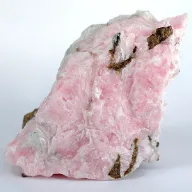 Bustamite
A pale pink manganese silicate from the world's strangest ore bodies, and rhodonite's quieter cousin.
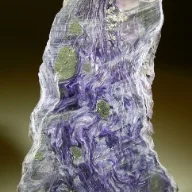 Charoite
A violet rock that exists in one valley in Siberia and nowhere else on Earth.
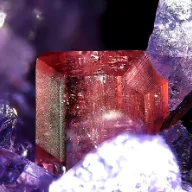 Phosphosiderite
A soft lilac iron phosphate, named after the two things in it.
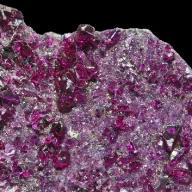 Kämmererite
Chlorite with chromium in it, in a magenta nothing else reaches.
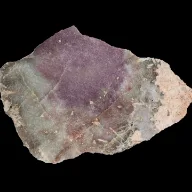 Lepidolite
Lilac mica, and the rock the world's lithium was first found in.
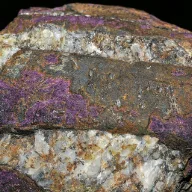 Purpurite
A pegmatite phosphate that rusted purple instead of brown.
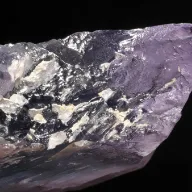 Spodumene
The lithium ore that turns up as pink gem crystals the length of a man.
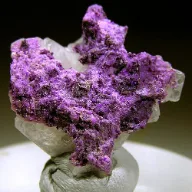 Sugilite
A purple that only exists because one manganese mine in the Kalahari flooded the right way.
 Tanzanite
One hill in Tanzania has all of it, and it was only found in 1967.
 Tourmaline
Thirty-odd minerals sharing one crystal shape, and every colour there is.