 Lunarya
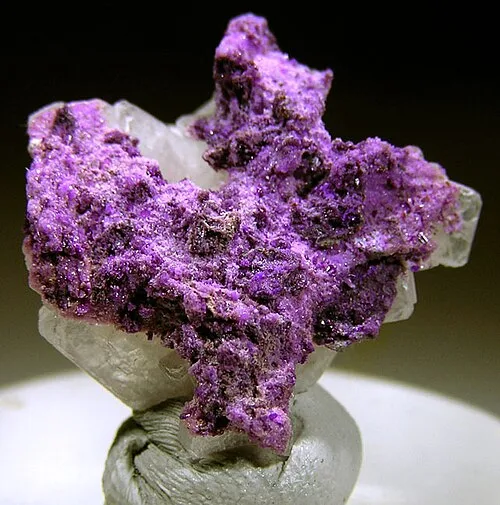
Sugilite
Sugilite is a lithium-bearing cyclosilicate, KNa₂(Fe,Mn,Al)₂Li₃Si₁₂O₃₀, 5.5 to 6.5 on the Mohs scale, and almost always massive rather than crystalline. The colour is the whole point: a saturated reddish violet that has no real competitor among opaque stones, coloured by manganese in an unusual oxidation state. Nearly all of it comes from one small area of one orebody.
It was first found in 1944 on Iwagi Islet in Japan by Ken-ichi Sugi, whose name it carries, but that material was a dull brownish yellow and nobody outside mineralogy cared; the species was not formally described until 1976. The purple appeared in 1975 in the Wessels mine in the Kalahari manganese field of South Africa, and in quantity from 1979. Because the colour depends on trivalent manganese sitting in a particular site in the structure, and that requires a specific set of conditions, no second source of gem purple sugilite has been found in fifty years.
In short
- Colour
- Violet and pink
- Mineral
- Silicate
- Formula
- KNa₂(Fe,Mn,Al)₂Li₃Si₁₂O₃₀
- Hardness
- 5.5–6.5 on the Mohs scale
- Crystal system
- Hexagonal
- Found in
- The Wessels and N'Chwaning mines at Hotazel in the Northern Cape, South Africa, for essentially all of the purple. Iwagi Islet in Japan for the original yellow-brown material, and a few grams from Mont Saint-Hilaire in Quebec, Liguria in Italy and New South Wales.
- Element
- Water
- Planet
- Neptune
- Chakra
- Third eye
- Handling
- Water and light are both fine
How it forms
The Kalahari manganese field is a two-billion-year-old bed of manganese ore that was later cooked and soaked by hot fluids. Sugilite grew in that alteration, in veins and pods through the ore, alongside richterite, aegirine, pectolite and bustamite. The manganese came from the ore itself and the lithium from the fluid, and the mineral formed at a depth and a temperature that the mine happens to have intersected. The gem-grade pockets were worked out quickly, and the price has reflected that ever since.
In human hands
Sugilite has almost no history, which makes it unusual among the stones in this book: it reached the market in about 1980 and everything written about it is younger than that. Dealers tried several names — lavulite, luvulite, royal azel, wesselite — before sugilite stuck, and it is properly said with a hard g, soo-ghee-lite, after the Japanese name. Its rise was fast, its supply is limited, and good solid purple material now costs more per gram than many faceted gems.
Varieties and trade names
- Gel sugilite
- Translucent, even, deep violet with no black in it; the finest grade, rare, and the reason the stone has the reputation it has.
- Sugilite with richterite
- Purple shot through with black veins and patches. The common form, and a good deal cheaper.
- Manganese-poor sugilite
- Pale lilac to greyish pink, from the edges of the same pods; pretty but not what buyers mean by the name.
- Iwagi sugilite
- The original Japanese material, brownish yellow and translucent only in thin grains; of interest to collectors of type localities and to nobody else.
- Dyed imitations
- Dyed magnesite and dyed howlite are sold as sugilite constantly. Both are far softer, and the dye sits in the veins rather than in the body of the stone.
Telling it from a fake
Hardness is the quick test: sugilite is 5.5 to 6.5 and will not be scratched by a steel pin, while the dyed magnesite and howlite sold in its place are 3.5 and will. Dye also concentrates in cracks and comes off on an acetone swab; sugilite's colour is even through the body and does not. Charoite is purple too but shows swirling fibrous bundles rather than flat colour. Purple jade and purple turquoise, as sold, are almost always dyed quartzite.
None of this needs a laboratory, and none of it is proof. A shop that will not say whether a stone is treated has answered the question; ask, and have the answer written on the receipt.
What it is said to do
Sugilite arrived in the middle of the New Age publishing boom and was written about immediately and enthusiastically. It is given to devotion and to shelter — the stone recommended to people going through something long and hard — and to reconciliation with difficult parts of one's own history. It goes with water, with Neptune, with Virgo and Pisces, and with the third eye. The tradition is thirty years old, and the stone's reputation rests on its colour and its scarcity, not on any old lineage.
Living with it
Reasonably hard and stable, with no cleavage: water, soap and daily wear are all fine. Keep it away from sustained heat, which can dull the colour, and off the ultrasonic if the piece has black veining, since the two minerals expand differently. Sunlight in ordinary amounts does no harm. The real risk with sugilite is not damage but the purchase: at these prices, buy from someone who will tell you in writing that the stone is neither dyed nor reconstituted.
In magic
Sugilite came into practice in the 1980s and was adopted at once as a shield for people going through something long: carried through an illness in the family, kept on an altar beside a candle lit each evening, or put into protection bags with black tourmaline. Its purple has made it a favourite on devotional altars. It is tough enough for a ritual bath.
- Energy
- Receptive
- Day
- Thursday
- Worked for
- Protection · Comfort and recovery
More of this colour
 Amethyst
Quartz that grew purple in the dark, and the stone everyone starts with.
 Fluorite
The stone that gave fluorescence its name, in every colour at once.
 Rose quartz
The pink one, given away more often than it is bought.
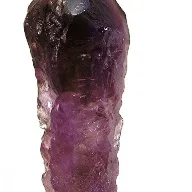 Ametrine
Amethyst and citrine in the same crystal, from one mine in the Bolivian jungle.
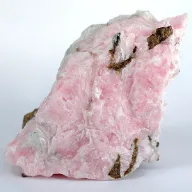 Bustamite
A pale pink manganese silicate from the world's strangest ore bodies, and rhodonite's quieter cousin.
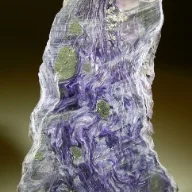 Charoite
A violet rock that exists in one valley in Siberia and nowhere else on Earth.
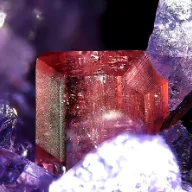 Phosphosiderite
A soft lilac iron phosphate, named after the two things in it.
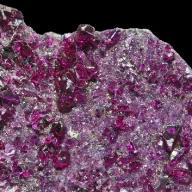 Kämmererite
Chlorite with chromium in it, in a magenta nothing else reaches.
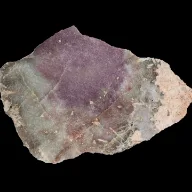 Lepidolite
Lilac mica, and the rock the world's lithium was first found in.
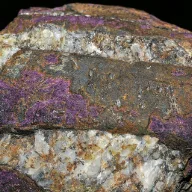 Purpurite
A pegmatite phosphate that rusted purple instead of brown.
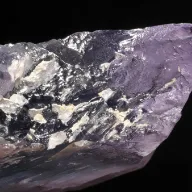 Spodumene
The lithium ore that turns up as pink gem crystals the length of a man.
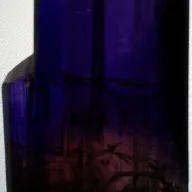 Tanzanite
One hill in Tanzania has all of it, and it was only found in 1967.
 Tourmaline
Thirty-odd minerals sharing one crystal shape, and every colour there is.