 Lunarya
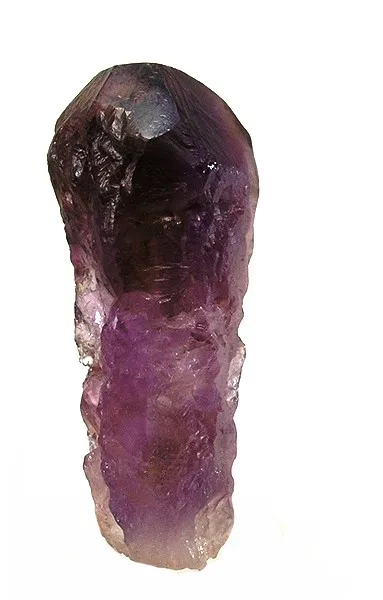
Ametrine
Ametrine is quartz that grew half purple and half yellow: amethyst and citrine in one crystal, with a sharp boundary between them along the crystal's own internal sectors. The iron that colours it is the same in both halves; in the purple it has been irradiated, and in the yellow it has been heated as well, by the rock it grew in.
Nearly all of it comes from a single place, the Anahí mine in the wetlands of eastern Bolivia near the Brazilian border, and the mine has a story to match: a conquistador given the land as a dowry when he married a princess of the Ayoreo people in the 1600s, stones sent home to the Spanish queen, and the mine lost for three centuries. Whatever the truth of that, the deposit was only rediscovered in the 1960s and reached the market in the late 1970s, and it is still the only commercial source.
In short
- Colour
- Violet and pink
- Mineral
- Quartz
- Formula
- SiO₂
- Hardness
- 7 on the Mohs scale
- Crystal system
- Trigonal
- Found in
- Bolivia (the Anahí mine, Santa Cruz); a little from Brazil and India.
- Element
- Air
- Planet
- Mercury
- Chakra
- Crown
- Handling
- Fades in sunlight
How it forms
The purple of amethyst is made when radiation from the surrounding rock knocks an electron off an iron atom in the quartz; heat undoes it, and turns the same iron yellow. At Anahí the quartz grew in veins of dolomite in a hydrothermal field where the temperature varied across a single crystal, so that some sectors of it were hot enough to lose their purple while others kept it. The boundary follows the crystal's growth sectors, which is why a slice shows the colours as neat triangles meeting at the centre rather than as a blur, and why the yellow half is never quite the colour of a citrine grown yellow from the start.
In human hands
The Anahí legend is told on every dealer's website and in no document, and the mine's real history starts in the 1960s, when it was worked briefly and then closed, and in 1977, when it was reopened by a Bolivian company that has run it since; the Bolivian government treated the stone as a national asset and for a while banned the export of rough. It arrived in the shops of Europe and America in the 1980s, under this name and as bolivianite, and became one of the few gemstones of the late twentieth century to acquire a following of its own. Heated amethyst and irradiated synthetic quartz have imitated it since about 1990.
Varieties and trade names
- Anahí ametrine
- The Bolivian stone, the only natural one in quantity, with the boundary between the colours following the crystal's sectors.
- Fantasy cut
- Ametrine faceted to mix the two colours through the stone rather than split them, a style invented for it in the 1980s.
- Treated ametrine
- Amethyst heated on one side only, or irradiated synthetic quartz; the colours meet in a straighter line and a cleaner yellow.
- Bolivianite
- The same stone under the name the mine's owners preferred, still on some labels.
Telling it from a fake
Look at the boundary. In a natural stone the purple and yellow meet in sharp straight lines that radiate from the centre, following the crystal's internal geometry, and the yellow is a brownish honey rather than a lemon. A stone with a soft, blurred change is usually amethyst heated on one side; a stone with a green or blue half is synthetic, since those colours do not occur in nature; and a stone with the yellow too bright and the purple too red has been made in a laboratory and irradiated. Glass imitations are warm to the touch and show bubbles. It is quartz, so a steel blade will not mark it.
None of this needs a laboratory, and none of it is proof. A shop that will not say whether a stone is treated has answered the question; ask, and have the answer written on the receipt.
What it is said to do
The stone of having it both ways: the tradition reads the purple as amethyst's clear head and the yellow as citrine's warmth, and gives the two together for decisions, for people caught between a cautious nature and a wish to act, and for the moment of seeing a thing whole. It is a modern tradition, since the stone is a modern arrival, and honest about it.
Living with it
Wash it like any quartz. Keep it out of the sun, because the purple half fades as amethyst does and the yellow half does not, and the stone slowly stops being what it was.
In magic
With no history behind it, ametrine is used in modern practice as two minds made one: held while deciding, or set between two candles, one purple and one yellow, that stand for the choices, and carried afterwards to keep the decision made. The yellow half gives it a second job beside citrine, in spells for confidence at work. Like amethyst, it belongs to the night and not to the sunny sill.
- Energy
- Projective
- Day
- Wednesday
- Worked for
- Study and clear thinking · Courage and drive
More of this colour
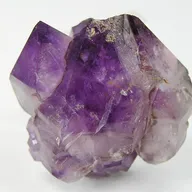 Amethyst
Quartz that grew purple in the dark, and the stone everyone starts with.
 Fluorite
The stone that gave fluorescence its name, in every colour at once.
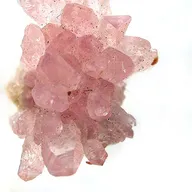 Rose quartz
The pink one, given away more often than it is bought.
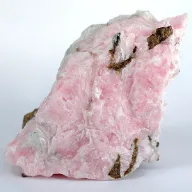 Bustamite
A pale pink manganese silicate from the world's strangest ore bodies, and rhodonite's quieter cousin.
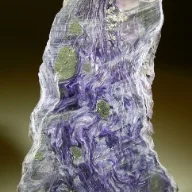 Charoite
A violet rock that exists in one valley in Siberia and nowhere else on Earth.
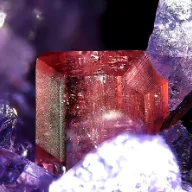 Phosphosiderite
A soft lilac iron phosphate, named after the two things in it.
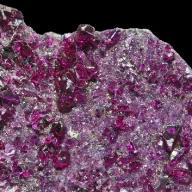 Kämmererite
Chlorite with chromium in it, in a magenta nothing else reaches.
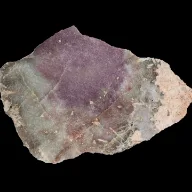 Lepidolite
Lilac mica, and the rock the world's lithium was first found in.
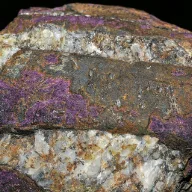 Purpurite
A pegmatite phosphate that rusted purple instead of brown.
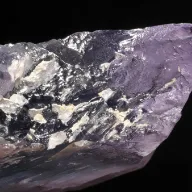 Spodumene
The lithium ore that turns up as pink gem crystals the length of a man.
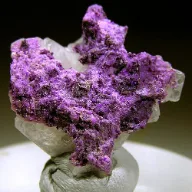 Sugilite
A purple that only exists because one manganese mine in the Kalahari flooded the right way.
 Tanzanite
One hill in Tanzania has all of it, and it was only found in 1967.
 Tourmaline
Thirty-odd minerals sharing one crystal shape, and every colour there is.