 Lunarya
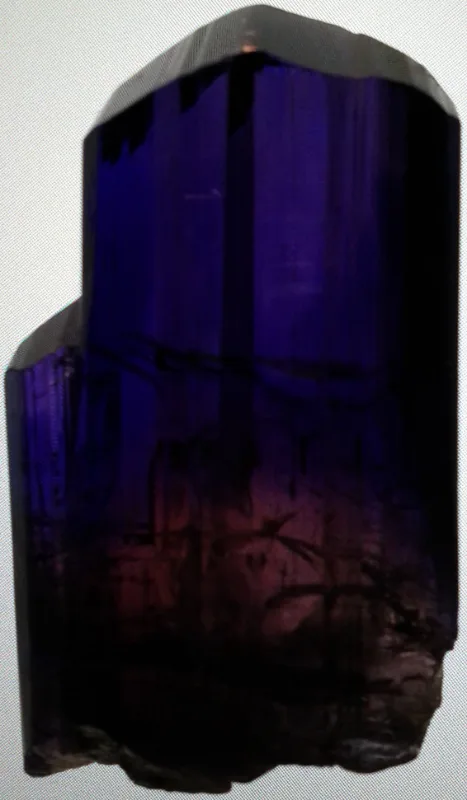
Tanzanite
Tanzanite is the blue-violet gem variety of zoisite, a calcium aluminium silicate coloured by a trace of vanadium. It is 6 to 6.5 on the Mohs scale, orthorhombic, and it comes from one deposit: a strip of ground about seven kilometres long in the Merelani Hills of northern Tanzania, in sight of Kilimanjaro. There is no second source anywhere on earth.
Its defining property is trichroism. Look down the three crystal axes of a rough tanzanite and you see three different colours — violet-blue, a purer blue, and a brownish burgundy. Heating to about 500 degrees drives off the brown and leaves blue and violet, and effectively all tanzanite on the market has been heated; a stone that has not is a collector's item and should be sold as one. Even after heating the stone keeps two colours, so a cut tanzanite shifts between blue and violet as it turns, more strongly under tungsten light than under daylight.
In short
- Colour
- Violet and pink
- Mineral
- Silicate
- Formula
- Ca₂Al₃(SiO₄)₃(OH)
- Hardness
- 6–6.5 on the Mohs scale
- Crystal system
- Orthorhombic
- Found in
- The Merelani Hills, Manyara region, Tanzania. That is the entire list.
- Birthstone of
- December
- Element
- Air
- Planet
- Uranus
- Chakra
- Third eye
- Handling
- Water and light are both fine
How it forms
Merelani sits in a belt of very old metamorphic rock that was folded and cooked around 600 million years ago. Tanzanite grew in lenses of quartz strung out along graphite-bearing gneiss, where the rock was pulled apart into segments and the gaps filled with hot fluid. The vanadium that colours it came from the graphitic rock itself. It is an unusual combination of chemistry, pressure and timing, and the standard estimate is that the odds of it occurring twice are very low — which is the basis for the claim, made in every shop, that tanzanite is a thousand times rarer than diamond.
In human hands
The find is dated to 1967, credited variously to a Maasai herder, Ali Juuyawatu, and to a Goan tailor and prospector, Manuel de Souza, who filed the first claims. Tiffany & Co. took it up within a year, and Henry Platt gave it the name: blue zoisite was accurate and, said out loud, sounded too much like blue suicide to sell. It was made a December birthstone in 2002, the first addition to the list in half a century. The ground has been mined hard since, by a mix of one large operation and thousands of small diggers, and the deposit is expected to be worked out within a few decades.
Varieties and trade names
- Heated tanzanite
- Nearly all of it. Heating to about 500 degrees removes the brown; the treatment is permanent, stable, universally accepted and should still be disclosed.
- Unheated tanzanite
- Naturally blue-violet without treatment, which happens where the rock was hot enough underground. Rare, certificated and priced accordingly.
- Chrome tanzanite
- Coloured by chromium as well as vanadium, with a greener, more intense blue; a genuine rarity from the same deposit.
- Green and yellow zoisite
- The same mineral from the same mine in colours nobody has yet made fashionable; sold as fancy zoisite rather than tanzanite.
- Tanzanite aura quartz
- Quartz with a metal coating fused onto it in a vacuum. It contains no tanzanite, and the name is doing the work of a lie even though every word in it is technically true.
Telling it from a fake
Turn the stone. Real tanzanite changes colour as it rotates, blue one way and violet the other, and the effect is easy to see in a decent-sized stone. Blue-violet synthetic forsterite, sold as tanzanite, does the same trick, and separating them needs a refractometer. Coated quartz gives itself away by the iridescent, oil-slick sheen on the surface and by wear marks where the coating has rubbed through. Cheap imitations in cubic zirconia and synthetic spinel are singly refractive and show no colour change at all.
None of this needs a laboratory, and none of it is proof. A shop that will not say whether a stone is treated has answered the question; ask, and have the answer written on the receipt.
What it is said to do
There was no tradition before 1967, so what exists was written to fit: insight, the ability to say something that has been difficult to say, and adjustment to circumstances that have changed. It is given to air, to Uranus, to Sagittarius and Gemini, and to the third eye and throat together. The two-colour shift is what the writing keeps returning to — a stone that shows you a different face depending on where you stand is an easy image to build on, and at least it is an image taken from the stone itself.
Living with it
Treat it as a stone for earrings and pendants rather than for a ring worn every day. Tanzanite has perfect cleavage in one direction and it is only 6 to 6.5, so a sharp knock on the right plane will split it. Never use an ultrasonic or steam cleaner: sudden temperature change is the classic way tanzanite is destroyed, and jewellers see it regularly. Warm water, mild soap and a soft brush. Water and ordinary sunlight are harmless, but keep it away from heat and from strong acids.
In magic
With no traditional use, tanzanite is used in modern practice for divination and for difficult speech: worn while reading the cards or keeping a dream journal, and held before a conversation that has been rehearsed too often. Its change of colour, blue from one side and violet from another, is taken as a lesson in looking twice. It dislikes heat, so it is kept away from candle flames and hot baths.
- Energy
- Projective
- Day
- Saturday
- Worked for
- Divination and intuition · Speaking and being heard
More of this colour
 Amethyst
Quartz that grew purple in the dark, and the stone everyone starts with.
 Fluorite
The stone that gave fluorescence its name, in every colour at once.
 Rose quartz
The pink one, given away more often than it is bought.
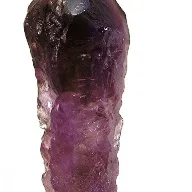 Ametrine
Amethyst and citrine in the same crystal, from one mine in the Bolivian jungle.
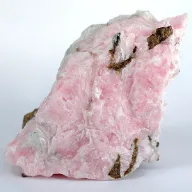 Bustamite
A pale pink manganese silicate from the world's strangest ore bodies, and rhodonite's quieter cousin.
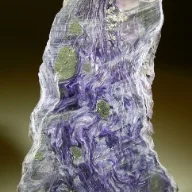 Charoite
A violet rock that exists in one valley in Siberia and nowhere else on Earth.
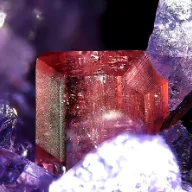 Phosphosiderite
A soft lilac iron phosphate, named after the two things in it.
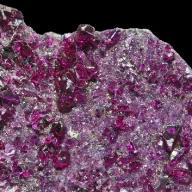 Kämmererite
Chlorite with chromium in it, in a magenta nothing else reaches.
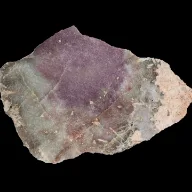 Lepidolite
Lilac mica, and the rock the world's lithium was first found in.
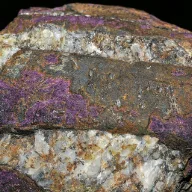 Purpurite
A pegmatite phosphate that rusted purple instead of brown.
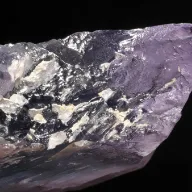 Spodumene
The lithium ore that turns up as pink gem crystals the length of a man.
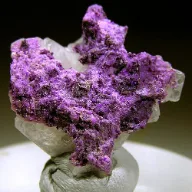 Sugilite
A purple that only exists because one manganese mine in the Kalahari flooded the right way.
 Tourmaline
Thirty-odd minerals sharing one crystal shape, and every colour there is.