 Lunarya
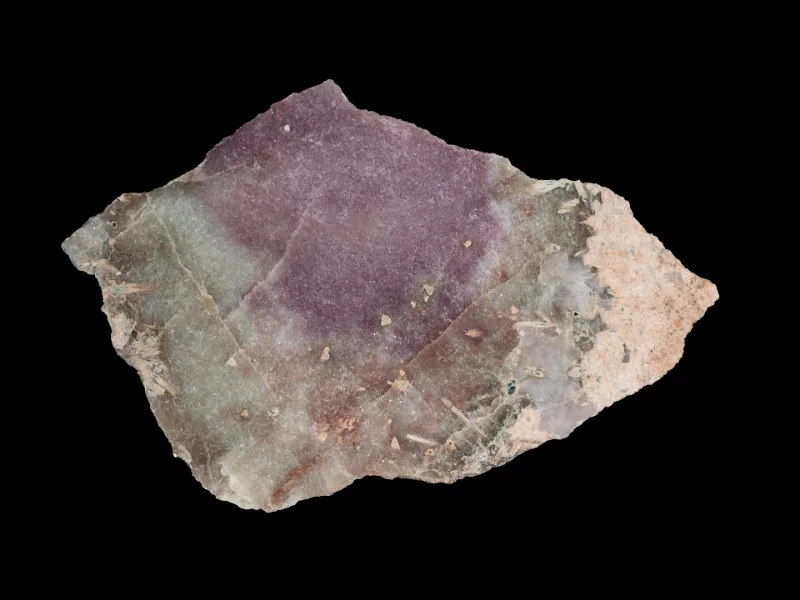
Lepidolite
Lepidolite is the lithium mica, K(Li,Al)₃(Si,Al)₄O₁₀(F,OH)₂, and it is the only common mica that is lilac. Manganese does the colouring; the lithium is invisible but it is the reason the mineral exists. Like every mica it splits along one perfect cleavage into elastic sheets, and a mass of the little scales gives a soft glitter that no other violet stone has. It is soft, 2.5 to 3, and a fingernail will mark it.
Strictly the name now covers a series rather than a species — trilithionite and polylithionite, with the intermediates that most specimens actually are — but lepidolite is what everyone says and what every label reads. It was the main ore of lithium for a century and a half, and it is also a leading source of rubidium and caesium, which have nowhere else to concentrate. A note worth making plainly: the lithium in a lepidolite tumble is locked into a silicate and does nothing whatever to a person holding it. Several books imply otherwise.
In short
- Colour
- Violet and pink
- Mineral
- Mica
- Formula
- K(Li,Al)₃(Si,Al)₄O₁₀(F,OH)₂
- Hardness
- 2.5–3 on the Mohs scale
- Crystal system
- Monoclinic
- Found in
- Rožná in the Czech Republic, Minas Gerais in Brazil, the Bikita pegmatite in Zimbabwe, Madagascar, Afghanistan, the Himalaya Mine in San Diego County, Sweden, and the Urals.
- Element
- Water
- Planet
- The Moon
- Chakra
- Third eye
- Handling
- Keep out of water
How it forms
Granite pegmatites, and specifically the lithium-rich ones. As a granite magma crystallises, lithium is one of the elements that stays behind in the shrinking pocket of melt, and at the very end that melt makes the minerals nothing else can: lepidolite, petalite, spodumene, elbaite tourmaline, amblygonite. Lepidolite commonly forms the pink-purple mass those pegmatite pockets are lined with, and the tourmaline crystals sit in it.
In human hands
Klaproth named it in 1792 from the Greek for scale. In 1817, Johan August Arfwedson, working in Berzelius's laboratory on petalite from Utö, found an unknown alkali metal and called it lithium; lepidolite from the same pegmatite family soon became its ore. Lithium mining moved to spodumene and then to brine, but lepidolite has come back into the conversation in the last few years as battery demand has grown. The crystal trade sells it as a calming stone.
Varieties and trade names
- Lilac mica books
- Stacked hexagonal plates that split into sheets; the collector's form and the prettiest.
- Lepidolite with tourmaline
- Pink or green elbaite crystals sitting in lilac mica, from Brazil and Afghanistan.
- Massive lepidolite
- Fine-grained purple rock, stabilised with resin for tumbling because the loose scales will not hold together.
- Rubellite in lepidolite
- The Brazilian combination of red tourmaline in mica; a display stone rather than a wearable one.
- Zinnwaldite
- The iron-lithium mica, brown to grey, from the Erzgebirge; the same family without the colour.
Telling it from a fake
It flakes and it sparkles. A needle lifts a sheet from the edge, and the sheet bends and springs back — mica is elastic, chlorite is not. Charoite is fibrous, swirled and much harder. Purple fluorite is glassy, cubic and cleaves into octahedra. Amethyst is far harder and transparent. Any lilac stone soft enough to mark with a fingernail and made of visible scales is this.
None of this needs a laboratory, and none of it is proof. A shop that will not say whether a stone is treated has answered the question; ask, and have the answer written on the receipt.
What it is said to do
The standard reading is calm and transition: the stone given for a period of change, for a mind that will not settle at night, and for letting go of something one has been gripping. It goes to the third eye, to the Moon, and to Libra and Pisces. The lithium connection is why it was picked for this role, and it is worth repeating that the connection is a matter of chemistry on paper rather than anything the stone does.
Living with it
Soft and flaky. Keep it out of water, which lifts the sheets apart, and wipe rather than wash. Light does no harm. Do not carry it loose, do not tumble it with anything, and expect an untreated specimen to shed a little glitter wherever it is kept. Resin-stabilised tumbles are much tougher but should still stay out of hot water.
In magic
Lepidolite is the modern witch's stone for worry: a flake in a sleep sachet with chamomile and lavender, a palm stone held through a calming meditation, a piece set out as the moon wanes in workings for letting go of something that has been gripped too long. The lithium in it is why it was chosen and does nothing in a sachet. Keep it out of ritual water, which lifts the sheets apart.
- Energy
- Receptive
- Day
- Monday
- Worked for
- Calm and peace · Sleep and dreams · Change and letting go
More of this colour
 Amethyst
Quartz that grew purple in the dark, and the stone everyone starts with.
 Fluorite
The stone that gave fluorescence its name, in every colour at once.
 Rose quartz
The pink one, given away more often than it is bought.
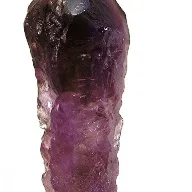 Ametrine
Amethyst and citrine in the same crystal, from one mine in the Bolivian jungle.
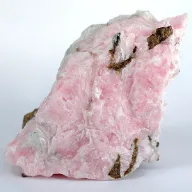 Bustamite
A pale pink manganese silicate from the world's strangest ore bodies, and rhodonite's quieter cousin.
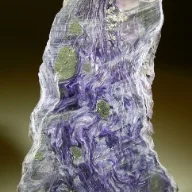 Charoite
A violet rock that exists in one valley in Siberia and nowhere else on Earth.
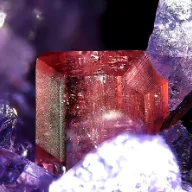 Phosphosiderite
A soft lilac iron phosphate, named after the two things in it.
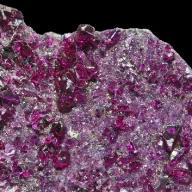 Kämmererite
Chlorite with chromium in it, in a magenta nothing else reaches.
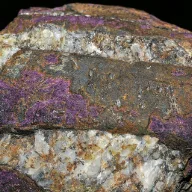 Purpurite
A pegmatite phosphate that rusted purple instead of brown.
 Spodumene
The lithium ore that turns up as pink gem crystals the length of a man.
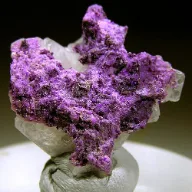 Sugilite
A purple that only exists because one manganese mine in the Kalahari flooded the right way.
 Tanzanite
One hill in Tanzania has all of it, and it was only found in 1967.
 Tourmaline
Thirty-odd minerals sharing one crystal shape, and every colour there is.