 Lunarya
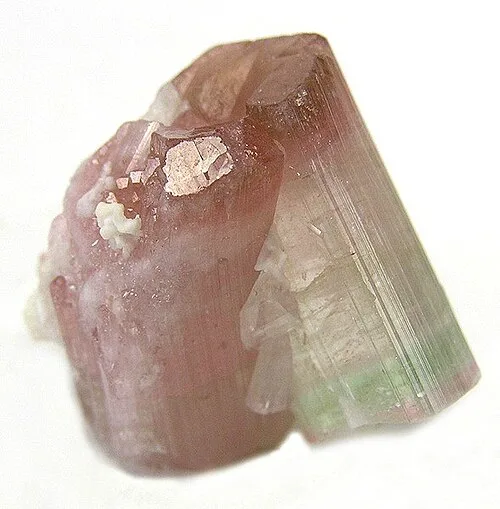
Tourmaline
Tourmaline is not one mineral. It is a family of more than thirty boron silicates with the same crystal structure and wildly different chemistry, which is why it comes in more colours than any other gem — colourless, pink, red, orange, yellow, green, blue, violet, brown, black, and often several at once in the same crystal. The crystals are long prisms with a rounded triangular cross-section and deep grooves down the length, and the whole family sits between 7 and 7.5 on the Mohs scale.
Tourmaline is both piezoelectric and pyroelectric. Squeeze a crystal or warm it and the two ends take opposite electrical charges, strongly enough to pull dust and ash across a table — the Dutch importers of the 1700s used tourmaline to clean out their pipes and called it aschentrekker, the ash-puller. The Curie brothers measured the effect properly in 1880, alongside quartz, and tourmaline pressure gauges were still being used to measure explosions sixty years later. The crystals are also hemimorphic: the two ends are shaped differently, because the structure has no centre of symmetry.
In short
- Colour
- Violet and pink
- Mineral
- Silicate
- Formula
- (Na,Ca)(Fe,Mg,Li,Al)₃Al₆(BO₃)₃Si₆O₁₈(OH,F)₄
- Hardness
- 7–7.5 on the Mohs scale
- Crystal system
- Trigonal
- Found in
- Minas Gerais and Paraíba in Brazil; the pegmatites of Maine and southern California; Pala and Mount Mica; Afghanistan, Pakistan, Nigeria, Mozambique, Madagascar, Namibia and Sri Lanka. Black schorl is common almost everywhere granite is.
- Birthstone of
- October
- Element
- Earth
- Planet
- Venus
- Chakra
- Heart
- Handling
- Water and light are both fine
How it forms
Tourmaline needs boron, and boron is the last thing left in a cooling granite. It grows in pegmatites, in the pockets where the final fluid had room and time, and in the rock around them where that fluid soaked in. Elbaite, the gem species, forms where lithium is also present, which is why the finest tourmaline comes from the same pegmatites as kunzite and lepidolite. A crystal grows lengthwise in stages as the fluid changes, so a single prism can record several different chemistries stacked end to end — which is exactly what a bicoloured or watermelon tourmaline is.
In human hands
The name is Sinhalese, turamali, roughly mixed-colour stones, and came to Europe with Dutch parcels from Ceylon in 1703; before that, coloured tourmaline had simply been sold as ruby or emerald. A large red tourmaline given to Catherine the Great spent two centuries in the Russian crown jewels labelled as a ruby. Chinese demand for pink tourmaline in the late nineteenth century effectively kept the San Diego mines open, and they closed when the Empress Dowager Cixi died in 1908. Paraíba tourmaline, found in 1987 and on the market from 1989, is coloured by copper and is one of the most expensive gems by weight in the world.
Varieties and trade names
- Indicolite
- Blue elbaite, from a greenish teal to a deep ink. Genuine saturated blue is rare, and much of what is sold is heated to improve it.
- Rubellite
- Pink to red. A stone earns the name only if it keeps its red under artificial light; pinks that go brown under a lamp are just pink tourmaline.
- Black tourmaline
- Schorl, nineteen parts in twenty of all tourmaline and the commonest of the family. It has a page of its own here.
- Watermelon tourmaline
- Pink core, green rind, usually sold as slices cut across the crystal. The zoning is a record of the fluid changing while the crystal grew.
- Verdelite and Paraíba
- Green elbaite is the commonest gem colour and the cheapest good one; Paraíba is the neon blue-green coloured by copper, first found in Brazil in 1987 and since in Nigeria and Mozambique.
Telling it from a fake
The cross-section settles it: a rounded triangle with grooved faces is tourmaline and almost nothing else. It is strongly dichroic, darkest looking down the length of the crystal, which is why cutters orient long stones across the axis. Green tourmaline is separated from emerald by being singly coloured rather than patchy and by having no cleavage — tourmaline has none at all, which also means it takes knocks well. Warm a rough crystal and hold it near cigarette ash; if the ash jumps, it is tourmaline.
None of this needs a laboratory, and none of it is proof. A shop that will not say whether a stone is treated has answered the question; ask, and have the answer written on the receipt.
What it is said to do
Because the family spans every colour, the tradition has given tourmaline almost every attribute, sorted by shade: pink to the heart, green to growth, blue to speech, black to protection. What runs through all of it is balance, and the pyroelectric trick sits behind more of that writing than the writers usually admit. Here it goes with the mixed elements the colours suggest, with Venus, with Libra and Scorpio, and with the heart. October's birthstone is the coloured gem rather than the black.
Living with it
Hard, without cleavage, and one of the more robust gems to wear. Water and soap are fine. Heat is not: tourmaline can crack from a sudden temperature change, and the pyroelectric charge means a warm stone attracts dust and will look grubby quickly. Skip ultrasonic and steam cleaning, especially for included stones like rubellite and Paraíba, which are often heavily fractured and sometimes filled. Strong light is harmless to most tourmaline, though some irradiated pinks fade.
In magic
Coloured tourmaline is worked by colour in modern practice: pink for love, green for money and growing things, blue for peace and speech, watermelon for the heart. The pink goes into Friday love bags with rose quartz; the green is buried in a pot with a seed, or kept in the wallet of a business that is starting out. Warmed, tourmaline holds a static charge and pulls ash towards it, which makes it one of the few charms with a measurable effect behind the metaphor.
- Energy
- Receptive
- Day
- Friday
- Worked for
- Love and friendship · Money and luck
More of this colour
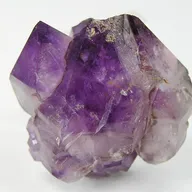 Amethyst
Quartz that grew purple in the dark, and the stone everyone starts with.
 Fluorite
The stone that gave fluorescence its name, in every colour at once.
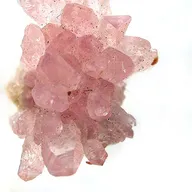 Rose quartz
The pink one, given away more often than it is bought.
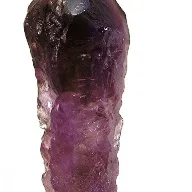 Ametrine
Amethyst and citrine in the same crystal, from one mine in the Bolivian jungle.
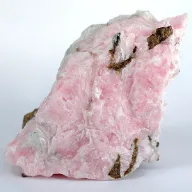 Bustamite
A pale pink manganese silicate from the world's strangest ore bodies, and rhodonite's quieter cousin.
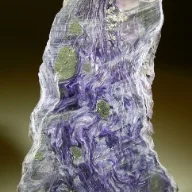 Charoite
A violet rock that exists in one valley in Siberia and nowhere else on Earth.
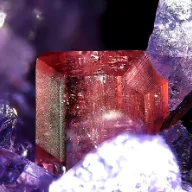 Phosphosiderite
A soft lilac iron phosphate, named after the two things in it.
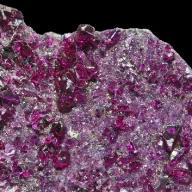 Kämmererite
Chlorite with chromium in it, in a magenta nothing else reaches.
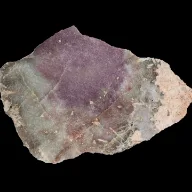 Lepidolite
Lilac mica, and the rock the world's lithium was first found in.
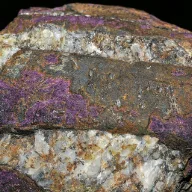 Purpurite
A pegmatite phosphate that rusted purple instead of brown.
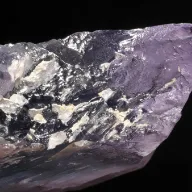 Spodumene
The lithium ore that turns up as pink gem crystals the length of a man.
 Sugilite
A purple that only exists because one manganese mine in the Kalahari flooded the right way.
 Tanzanite
One hill in Tanzania has all of it, and it was only found in 1967.