 Lunarya

Diamond
Diamond is carbon — the same element as graphite and as soot — with every atom bonded to four others in a rigid three-dimensional net. That arrangement makes it the hardest natural substance, 10 on the Mohs scale and the top of it by definition, and gives it the highest thermal conductivity of anything on earth. A diamond feels cold because it pulls heat out of your skin faster than any metal.
Hardness is not toughness. Diamond has perfect cleavage in four directions parallel to the faces of an octahedron, and a well-aimed tap will split one cleanly; that is how the 3,106-carat Cullinan was divided in 1908. Diamond also burns: heated to around 800 degrees in air it oxidises to carbon dioxide and disappears, which Lavoisier demonstrated in the 1770s with a burning glass, to the horror of the jewellers who had supplied the stone.
In short
- Colour
- Clear and white
- Mineral
- Native element
- Formula
- C
- Hardness
- 10 on the Mohs scale
- Crystal system
- Cubic
- Found in
- Botswana, Russia, Canada, the Democratic Republic of the Congo, Australia and South Africa produce most of it. The historic sources were the alluvial gravels of Golconda in India, which supplied every famous diamond before 1725, and then Brazil, and then the Kimberley pipes from 1871.
- Birthstone of
- April
- Element
- Fire
- Planet
- Venus
- Chakra
- Crown
- Handling
- Water and light are both fine
How it forms
Diamonds grow 150 to 200 kilometres down, in the cold, thick mantle roots beneath the oldest continents, where the pressure is high enough for carbon to take this form rather than graphite. Most are one to three and a half billion years old — far older than the rock that carries them. They reach the surface in kimberlite, a magma that rises fast enough to arrive in hours; slower, and they would revert to graphite on the way. A few come from much deeper, and their inclusions are the only direct samples anyone has of the earth's transition zone.
In human hands
India had the only diamonds in the world for two thousand years, and the Sanskrit texts call them vajra, thunderbolt. The modern diamond began in 1871 at Kimberley, and by 1888 Cecil Rhodes had consolidated the mines into De Beers, which controlled supply for the next century. The engagement ring as a near-universal custom is younger: the 1947 advertising line "A Diamond Is Forever", written by Frances Gerety, is generally credited with creating it. Since 2018 laboratory-grown diamonds have taken a large share of the market and their price has collapsed.
Varieties and trade names
- Colourless diamond
- Graded D to Z for the absence of colour. The fainter yellows are the ordinary run of gem diamond.
- Fancy colours
- Yellow and brown from nitrogen, blue from boron, green from natural irradiation, pink and red from a bent lattice. Red is the rarest gem colour there is.
- Macles and industrial stone
- Flat triangular twins, and the included and black material that is most of what is mined. Four-fifths of mined diamond by weight is industrial.
- Laboratory-grown diamond
- Grown by high pressure or from carbon gas. It is the same mineral, not an imitation, and is identified by its growth patterns rather than by any difference in substance.
- Simulants
- Cubic zirconia and moissanite are not diamond and not carbon. Moissanite is silicon carbide, and gives itself away by the doubled facet edges a loupe shows.
Telling it from a fake
Thermal conductivity is the practical test and the reason jewellers' diamond testers work: a diamond drains heat from the probe faster than anything else, though moissanite can fool the older single-probe testers. A clean diamond sheds water rather than letting it spread, and the facet edges under a loupe are razor-sharp where a simulant's are rounded. Distinguishing natural from laboratory-grown needs a laboratory, and honest sellers say which they are selling.
None of this needs a laboratory, and none of it is proof. A shop that will not say whether a stone is treated has answered the question; ask, and have the answer written on the receipt.
What it is said to do
Diamond has carried the same reading for two thousand years, because the property is so obvious: it is the stone of what cannot be broken or altered — constancy, resolve, clear intention. The lapidaries gave it courage in battle and the power to betray poison. In Vedic astrology it belongs to Venus, and it is given to Aries and Taurus, to fire, and to the crown. It is also the stone with the most difficult history behind it, and no account of it is honest without that.
Living with it
Nothing scratches it but another diamond — which is why diamonds should be stored separately, since one loose stone in a box will mark everything else in there. Water, soap, sunlight and ultrasonic cleaners are all fine for a clean stone, though not for one with reaching fractures. The cleavage is real: a hard knock on the girdle can chip or split a set stone. Do not have one repaired by a jeweller who will torch the setting with the stone still in it.
In magic
Diamond means constancy in every tradition: the lapidaries gave it courage and victory and said it betrayed poison, and in Vedic astrology it is Venus's gem, worn for love and for luxury. Modern practice uses it in workings for commitment — an engagement ring is a vow worn on the hand — and for protection and resolve. Nothing in a ritual can damage it, though a hard knock can.
- Energy
- Projective
- Day
- Friday
- Worked for
- Love and friendship · Courage and drive · Protection
More of this colour
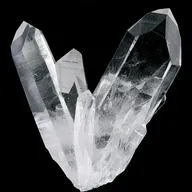 Clear quartz
The plain one, and the one the modern world actually runs on.
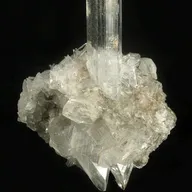 Selenite
Gypsum in satin fibres, soft enough to mark with a fingernail.
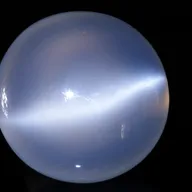 Moonstone
Feldspar with a light inside it that moves when the stone does.
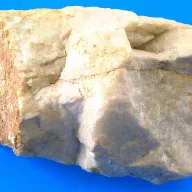 Amblygonite
A lithium phosphate from the pegmatites, and the palest yellow gem you have never heard of.
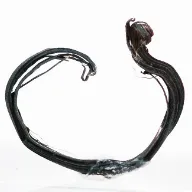 Silver
The metal of the moon, grown in wires and ferns in the veins of the earth.
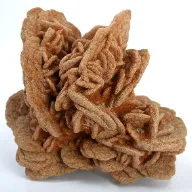 Baryte
The heavy stone: barium sulfate, and the reason a rose can grow in the desert.
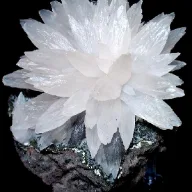 Calcite
The commonest carbonate on Earth, and the crystal that showed physicists light has two paths.
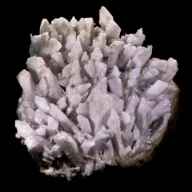 Danburite
A borosilicate that looks exactly like topaz, named after a Connecticut town that paved over the deposit.
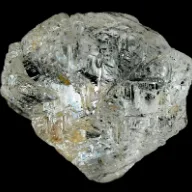 Phenakite
A beryllium silicate so like quartz that it was named the deceiver.
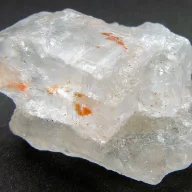 Halite
Rock salt: perfect cubes that will dissolve in a damp room.
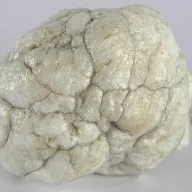 Howlite
White nodules with black veins, and the most dyed mineral in the trade.
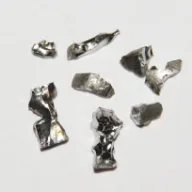 Iridium
The most corrosion-proof metal there is, and the layer that dates the end of the dinosaurs.
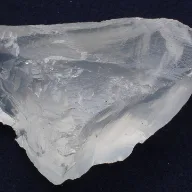 Petalite
The mineral lithium was discovered in, and it looks like nothing at all.
Cradle of Humankind stone
Ordinary grey chalcedony from an extraordinary place outside Johannesburg.
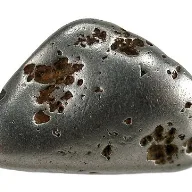 Platinum
Little silver, the Spanish called it, and threw it back in the river.
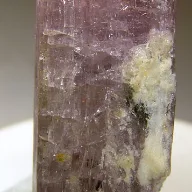 Scapolite
A tetragonal silicate that glows yellow under ultraviolet and fades in the sun.
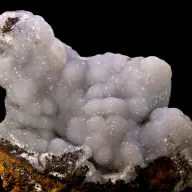 Smithsonite
Zinc carbonate in botryoidal crusts, named after the man who founded the Smithsonian.
Shiva lingam
A Narmada river cobble, ground by hand into an egg and sold as a sacred stone.
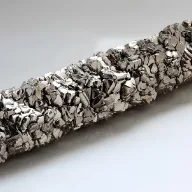 Titanium
The ninth commonest element in the crust, and almost never found as a metal.
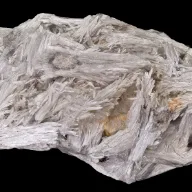 Tremolite
The white amphibole that makes nephrite jade, and, in its fibrous form, asbestos.
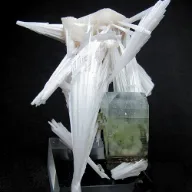 Zeolite
Minerals built like sponges at the atomic scale, which is why industry uses more of them than jewellers do.