 Lunarya
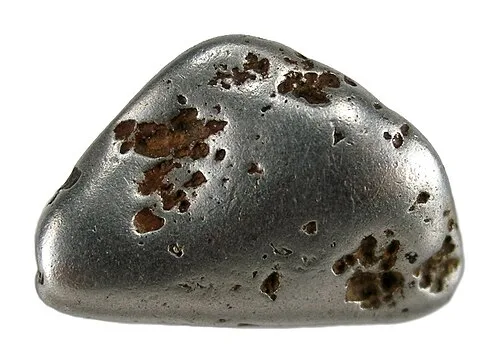
Platinum
Platinum is element 78, a dense grey-white metal that does not tarnish, does not dissolve in ordinary acids and melts only at 1,768 degrees. It occurs native — as grains, flakes and the occasional nugget in river gravels — usually alloyed with iron and with the other platinum-group metals. Hardness is 4 to 4.5, softer than most people expect, and it is very heavy: a cubic centimetre weighs 21.45 grams.
Its refusal to react is why it matters. Chemists use it for crucibles and electrodes, and about a third of all production goes into catalytic converters, where a thin coating turns exhaust gases into less harmful ones. Jewellers use it because it holds a diamond without discolouring and because it does not wear away when scratched — the metal moves rather than being lost. Medicine uses it too: cisplatin and its relatives are among the most effective chemotherapy drugs there are.
In short
- Colour
- Clear and white
- Mineral
- Native element
- Formula
- Pt
- Hardness
- 4–4.5 on the Mohs scale
- Crystal system
- Cubic
- Found in
- The Bushveld Complex in South Africa holds most of the world's reserves and produces the majority of the metal. Norilsk in Russia is the other great source, as a by-product of nickel. Native nuggets come from placers in the Urals, in Colombia and Ecuador, in British Columbia and Alaska, and in Zimbabwe.
- Element
- Earth
- Planet
- Saturn
- Chakra
- Crown
- Handling
- Water and light are both fine
How it forms
Platinum concentrates where a slow-cooling body of mafic magma separates sulfide droplets, which scavenge the platinum-group metals out of the melt; the Bushveld reefs are layers a metre or two thick containing a few grams of metal per tonne. Weathering frees the grains, and rivers sort them into placers, which is where every pre-industrial civilisation that used platinum got it.
In human hands
Pre-Columbian metalworkers in Ecuador and Colombia sintered platinum with gold into jewellery more than two thousand years ago, without ever reaching its melting point. Spanish miners on the Río Pinto in the eighteenth century found grey grains they could not melt or separate from gold and named them platina, little silver, as an insult; some was reportedly thrown back into the river. Antonio de Ulloa described it in 1748, Europe learned to work it by the end of that century, and it went from nuisance to the most expensive of the common precious metals.
Varieties and trade names
- Native platinum
- Water-worn grains and nuggets from river gravels, usually alloyed with iron, iridium and palladium.
- Sperrylite
- Platinum arsenide, the commonest platinum mineral, in small brilliant silver cubes; a collector's prize.
- Refined platinum
- Sponge, ingot and wire, which is what a shop sells as a specimen; industrial metal of stated purity.
- Platinum-iridium
- The alloy of standards: the old prototype kilogram and metre were made of it, and so are the best crucibles.
- White gold
- Not platinum: gold alloyed pale and usually rhodium-plated; it costs less and the plating wears off.
Telling it from a fake
Weight settles most of it. Platinum is twice as dense as silver, and a piece that looks like a silver nugget but feels like lead is the right sort of surprise. It does not tarnish, so a grey metal with no trace of black sulfide film is a good sign, and it is unaffected by nitric acid, which dissolves silver instantly. Jewellery is hallmarked; anything sold as a natural platinum crystal deserves a hard look, since good crystals are museum objects.
None of this needs a laboratory, and none of it is proof. A shop that will not say whether a stone is treated has answered the question; ask, and have the answer written on the receipt.
What it is said to do
There is little of it, and what there is was reasoned from the metal: endurance, worth that does not announce itself, and the refining of something over a long time. It is filed with Saturn, with Capricorn and Aquarius, and at the crown. The metal was unknown in the Old World before the sixteenth century and unworkable until the eighteenth, so no older tradition exists here, whatever a shelf label says.
Living with it
Nothing harms it. Water, air, sunlight, salt and acid leave it exactly as it was, which is the whole point of the metal. It is soft enough to scratch, but the scratch displaces metal rather than removing it, so a worn platinum ring keeps its weight and can be polished back. Store nuggets so they do not rub, and clean with soapy water.
In magic
Platinum has no older magic, since the Old World did not know it before the sixteenth century. Modern practitioners reason from the metal — endurance and quiet worth — and use it in workings for things meant to last, a marriage among them, and now and then in spells for prosperity. Water, salt and fire cannot harm it.
- Energy
- Receptive
- Day
- Saturday
- Worked for
- Grounding and endurance · Money and luck
More of this colour
 Clear quartz
The plain one, and the one the modern world actually runs on.
 Selenite
Gypsum in satin fibres, soft enough to mark with a fingernail.
 Moonstone
Feldspar with a light inside it that moves when the stone does.
 Amblygonite
A lithium phosphate from the pegmatites, and the palest yellow gem you have never heard of.
 Silver
The metal of the moon, grown in wires and ferns in the veins of the earth.
 Baryte
The heavy stone: barium sulfate, and the reason a rose can grow in the desert.
 Calcite
The commonest carbonate on Earth, and the crystal that showed physicists light has two paths.
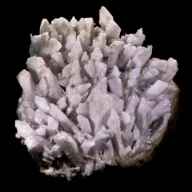 Danburite
A borosilicate that looks exactly like topaz, named after a Connecticut town that paved over the deposit.
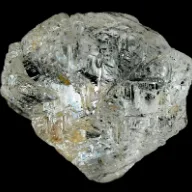 Phenakite
A beryllium silicate so like quartz that it was named the deceiver.
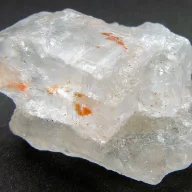 Halite
Rock salt: perfect cubes that will dissolve in a damp room.
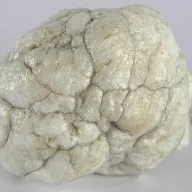 Howlite
White nodules with black veins, and the most dyed mineral in the trade.
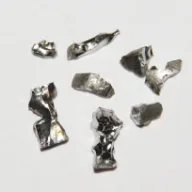 Iridium
The most corrosion-proof metal there is, and the layer that dates the end of the dinosaurs.
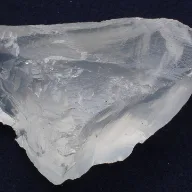 Petalite
The mineral lithium was discovered in, and it looks like nothing at all.
Cradle of Humankind stone
Ordinary grey chalcedony from an extraordinary place outside Johannesburg.
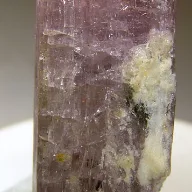 Scapolite
A tetragonal silicate that glows yellow under ultraviolet and fades in the sun.
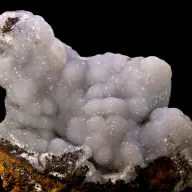 Smithsonite
Zinc carbonate in botryoidal crusts, named after the man who founded the Smithsonian.
Shiva lingam
A Narmada river cobble, ground by hand into an egg and sold as a sacred stone.
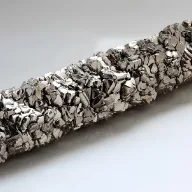 Titanium
The ninth commonest element in the crust, and almost never found as a metal.
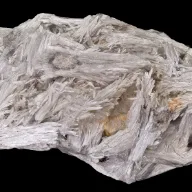 Tremolite
The white amphibole that makes nephrite jade, and, in its fibrous form, asbestos.
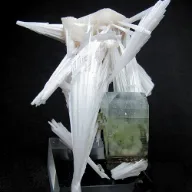 Zeolite
Minerals built like sponges at the atomic scale, which is why industry uses more of them than jewellers do.
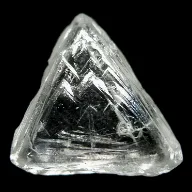 Diamond
Carbon, arranged the hard way, and carried up from two hundred kilometres down.