 Lunarya
Saturn
Saturn is the principle of less, and it has the worst reputation in the zodiac for reasons that are only half fair. It rules time, limits, duty and consequence: the areas where things take longer, cost more and only work if you actually do them properly.
Its return to the place it occupied at your birth, at about twenty-nine, is the best known event in astrology, and it is usually described as the year the borrowed life ends and the chosen one starts. Saturn gives nothing away and keeps everything it gives.
What it rules
In a chart
Read Saturn for where someone has to work hardest, and where that work eventually holds.
What it rules
Saturn in stone
The stones the lists give to Saturn. This is tradition rather than mineralogy, and each stone's own page keeps the two apart.
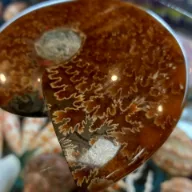 Ammonite
A shell that spiralled through the seas for three hundred million years, turned to stone.
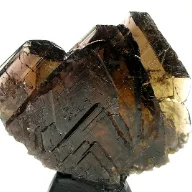 Axinite
Clove-brown wedges of a boron silicate, sharp enough to be named for an axe.
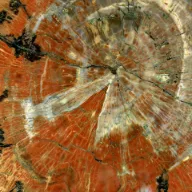 Petrified wood
A tree that became quartz cell by cell, and kept its grain.
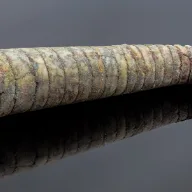 Orthoceras
A straight-shelled squid relative that died four hundred million years ago.
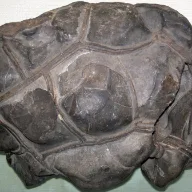 Septarian
A mud nodule that cracked from the inside and filled its own cracks with calcite.
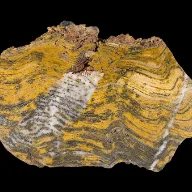 Stromatolite
Three and a half billion years of bacterial mats, turned to stone in layers.
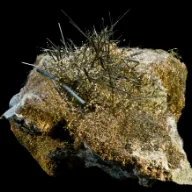 Actinolite
Green needles of amphibole, and the mineral half of all jade is made of.
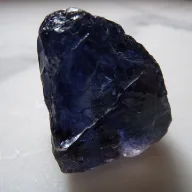 Iolite
Cordierite: violet-blue from one side, straw yellow from another.
Cradle of Humankind stone
Ordinary grey chalcedony from an extraordinary place outside Johannesburg.
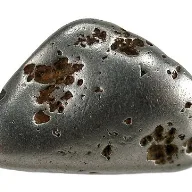 Platinum
Little silver, the Spanish called it, and threw it back in the river.
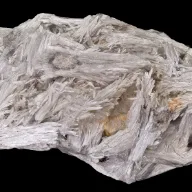 Tremolite
The white amphibole that makes nephrite jade, and, in its fibrous form, asbestos.
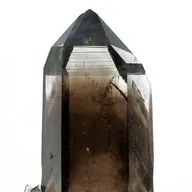 Smoky quartz
Quartz turned brown by the radioactivity of its own bedrock.
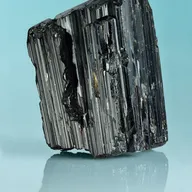 Black tourmaline
The stone that pulls ash out of a pipe when you warm it.
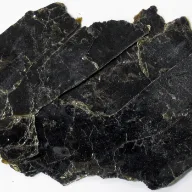 Biotite
Black mica: the flakes in every granite, and sheets big enough to roof a shed.
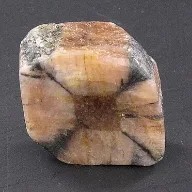 Chiastolite
An andalusite that grows a dark cross inside itself, and was sold for centuries as a Christian charm.
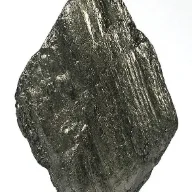 Graphite
Carbon in its soft form: the same element as diamond, stacked in sheets that slide.
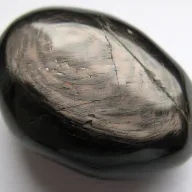 Hypersthene
A bronze-sheened pyroxene whose name the mineralogists retired.
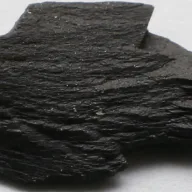 Jet
Fossil driftwood, black and warm in the hand, and Victorian mourning.
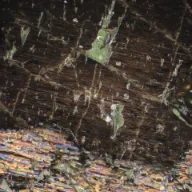 Nuummite
Three-billion-year-old Greenlandic rock that flashes gold and copper.
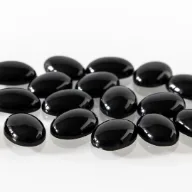 Onyx
Straight-banded chalcedony, and the black stone that is nearly always dyed.
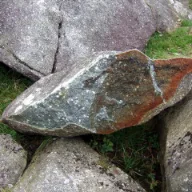 Preseli bluestone
The spotted dolerite of Stonehenge, from a Welsh hillside 250 kilometres away.
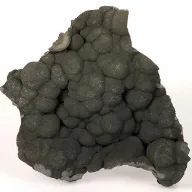 Psilomelane
A field name for the hard black manganese ores, kept alive by lapidaries.
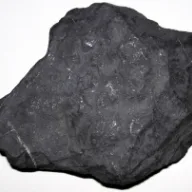 Shungite
Two-billion-year-old carbon rock from Karelia, and a great deal of nonsense.
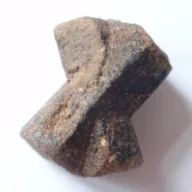 Staurolite
Two crystals grown through each other at sixty degrees, which comes out as a cross.