 Lunarya
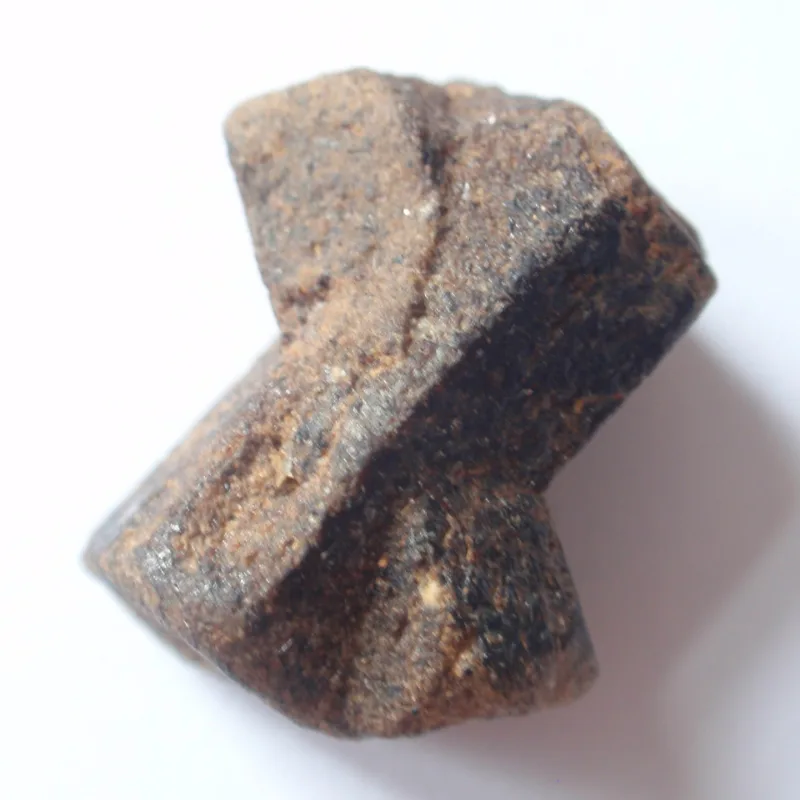
Staurolite
Staurolite is an iron aluminium silicate, dark reddish brown to nearly black, 7 to 7.5 on the Mohs scale and rarely transparent. It is famous for one thing: it twins, two crystals interpenetrating at sixty degrees to make a leaning cross, or more rarely at ninety degrees to make an upright one. The name is Greek, stauros, cross.
The cross is not a carving or a coincidence. Twinning is a regular fault in the way a crystal stacks, and in staurolite two of the possible faults are cheap enough energetically that the mineral takes them often. The sixty-degree twin, the leaning St Andrew's cross, is the common one; the ninety-degree Greek cross is perhaps one in ten and worth much more. Single untwinned prisms are commoner than either, and most of a staurolite schist is made of them.
In short
- Colour
- Dark
- Mineral
- Silicate
- Formula
- (Fe,Mg)₂Al₉Si₄O₂₂(OH)₂
- Hardness
- 7–7.5 on the Mohs scale
- Crystal system
- Monoclinic
- Found in
- Fairy Stone State Park in Virginia and the Blue Ridge of Georgia, where staurolite is the state mineral; Coray and Baud in Brittany, where the crosses have been picked up for centuries; Taos in New Mexico; the Swiss and Austrian Alps; Scotland; Brazil; and the schists of the Carpathians.
- Element
- Earth
- Planet
- Saturn
- Chakra
- Root
- Handling
- Water and light are both fine
How it forms
Staurolite is an index mineral. It appears in pelitic schists — old muds, buried and cooked — in a narrow band of conditions around 550 to 650 degrees and a good depth of pressure, which is why a geologist who finds it can put a number on what happened to the rock. Below that band the same chemistry makes chlorite and garnet, above it sillimanite. It weathers out whole when the schist breaks down, which is how loose crosses end up in a stream bed.
In human hands
The Brittany crosses were sold to pilgrims as pierres de croix before the mineral had a name. In the Virginia Blue Ridge the story is that the fairies of the forest were told of the crucifixion and wept, and their tears fell as stone crosses; the state park built around the deposit has repeated it since 1936, and the same literature will tell you that Theodore Roosevelt and Thomas Edison carried one. The mineral was described in 1792. Its industrial use is unglamorous: crushed staurolite sand goes into sandblasting and foundry moulds.
Varieties and trade names
- St Andrew's cross
- The sixty-degree twin, leaning like an X. The common form, and the one nearly all fairy crosses are.
- Greek cross
- The ninety-degree twin, upright and symmetrical. Much rarer, and priced accordingly.
- Single crystals
- Stubby six-sided prisms, untwinned, often full of quartz grains they grew around; the ordinary form in a schist.
- Lusakite
- A cobalt-bearing blue staurolite from Zambia, a genuine rarity and nothing like the usual brown.
- Carved and cast crosses
- A real problem in the trade. A surprising number of tourist fairy crosses are cut from soft rock or moulded from resin; a real one is hard enough to scratch glass and has a gritty, granular surface, never a smooth machined one.
Telling it from a fake
Hardness settles most of it: staurolite will scratch glass and a carved or cast imitation will not. Real crystals are dull and granular, usually with quartz sand grains embedded in the surface, and the two arms are rarely the same length or perfectly square. The colour is a dark reddish brown that shows red at a thin edge. Chiastolite makes a cross too, but it is a cross in section, dark andalusite carbon in a paler prism, and it has to be sliced to show at all.
None of this needs a laboratory, and none of it is proof. A shop that will not say whether a stone is treated has answered the question; ask, and have the answer written on the receipt.
What it is said to do
The cross does all the work here. Staurolite is given to protection, to grounding, and to the meeting of two things — earth and sky, the ordinary and whatever is above it — and it is the standard stone for anyone who wants an amulet that looks like an amulet without being made into one. It goes with earth, with Saturn, with Pisces and Capricorn, and with the root centre. Both traditions treat it as something found rather than bought.
Living with it
Hard and durable; water and sunlight do it no harm and it needs no particular care. The crystals are brittle at the arms of a twin, so a dropped cross tends to break where the two prisms meet. Cleaning is a brush and water — the surface is granular and holds dirt, and soaking does no damage. If you are buying one, scratch a piece of glass with it before you pay.
In magic
Staurolite is the fairy cross, and one of the best-documented charms in American folk magic: the Virginia legend says the crosses are the tears the fairies shed at the news of the Crucifixion, and they have been carried for luck and protection for two centuries. Modern practice keeps them for both. Make sure a cross scratches glass before buying it; carved fakes are common.
- Energy
- Receptive
- Day
- Saturday
- Worked for
- Protection · Money and luck
More of this colour
 Smoky quartz
Quartz turned brown by the radioactivity of its own bedrock.
 Labradorite
A dull grey stone until you turn it, and then it is peacock blue.
 Obsidian
Volcanic glass with an edge finer than a surgical steel blade.
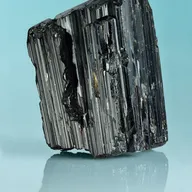 Black tourmaline
The stone that pulls ash out of a pipe when you warm it.
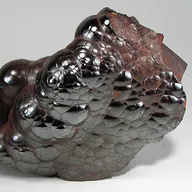 Hematite
Black as a mirror, and it leaves a blood-red line on anything you scratch it against.
Agni manitite
A black glass from Java, sold as a tektite; volcanic, as it turns out.
 Arfvedsonite
A black amphibole with a blue flash, named for the man who found lithium.
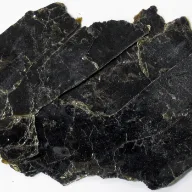 Biotite
Black mica: the flakes in every granite, and sheets big enough to roof a shed.
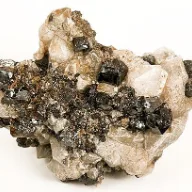 Brookite
Titanium dioxide in its rarest shape: thin red-brown blades grown in Alpine cracks.
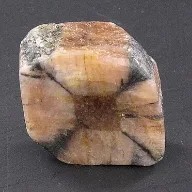 Chiastolite
An andalusite that grows a dark cross inside itself, and was sold for centuries as a Christian charm.
Columbianite
Colombian volcanic glass, sold as a tektite it is not.
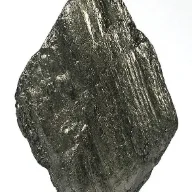 Graphite
Carbon in its soft form: the same element as diamond, stacked in sheets that slide.
 Aegirine
Black pyroxene needles from the strangest rocks on the planet.
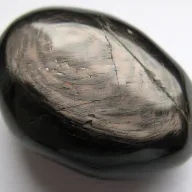 Hypersthene
A bronze-sheened pyroxene whose name the mineralogists retired.
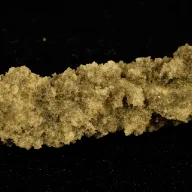 Fulgurite
Sand struck by lightning and fused, in a second, into hollow glass.
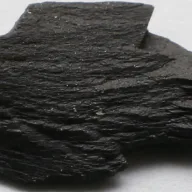 Jet
Fossil driftwood, black and warm in the hand, and Victorian mourning.
Indigo gabbro
A Madagascan rock sold under a wizard name it was given in 2010.
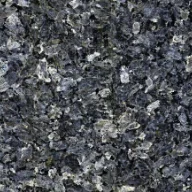 Larvikite
Norway's national rock, and the blue flash on half the shop fronts in Europe.
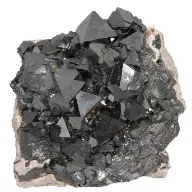 Magnetite
The most magnetic mineral there is, and the first compass.
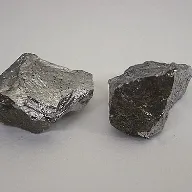 Manganese
The metal that makes steel tough, and that never occurs native.
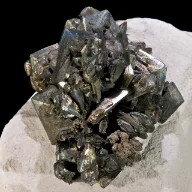 Marcasite
Pyrite's unstable twin, which eats itself in a damp drawer.
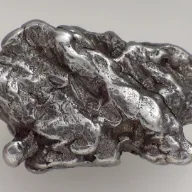 Campo del Cielo
An iron meteorite that fell on the Argentine Chaco four thousand years ago.
 Nuummite
Three-billion-year-old Greenlandic rock that flashes gold and copper.
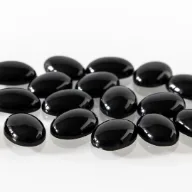 Onyx
Straight-banded chalcedony, and the black stone that is nearly always dyed.
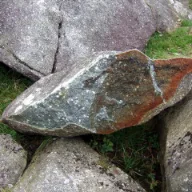 Preseli bluestone
The spotted dolerite of Stonehenge, from a Welsh hillside 250 kilometres away.
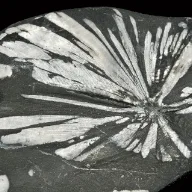 Chrysanthemum stone
Black rock with white mineral flowers that are not fossils.
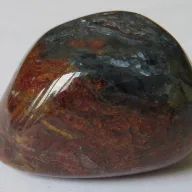 Pietersite
Tiger's eye smashed and cemented back together, so the light swirls.
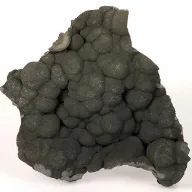 Psilomelane
A field name for the hard black manganese ores, kept alive by lapidaries.
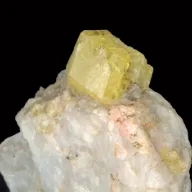 Rhodizite
A caesium borate as hard as topaz, and about as rare as minerals get.
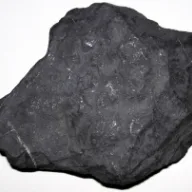 Shungite
Two-billion-year-old carbon rock from Karelia, and a great deal of nonsense.
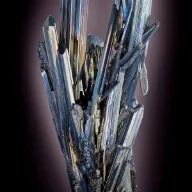 Stibnite
Steel-grey swords in a spray, soft enough to mark with a fingernail, and poisonous.
 Terahertz stone
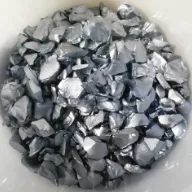
Furnace silicon, cut into beads and sold on a claim about radiation it does not emit.