 Lunarya
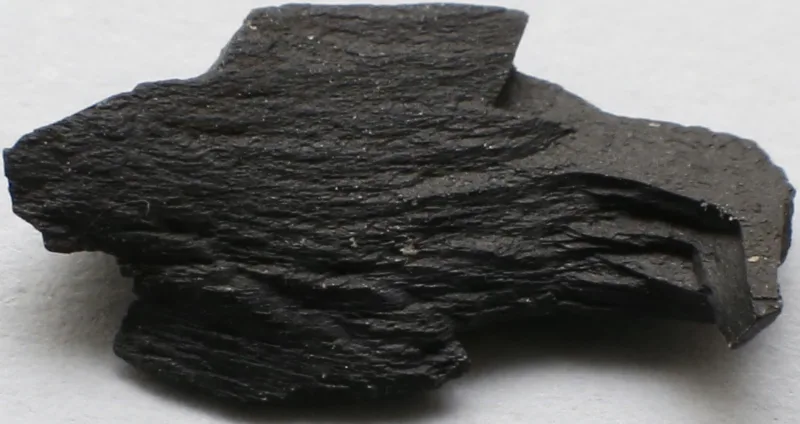
Jet
Jet is fossil wood. Driftwood from trees of the monkey-puzzle family sank into seafloor mud about 180 million years ago, was buried without oxygen and compressed, and became a hard black coal that carves, polishes and takes a shine. It is not a mineral — it is a variety of lignite — and it is the reason English has the phrase jet black. It is very light for its size, about one and a third times the weight of water, and it warms in the hand within seconds.
Two grades are recognised where it is worked. Hard jet formed in salt water and is tough and stable; soft jet formed in fresh water and crazes and splits with age, which is why some Victorian pieces have survived perfectly and others have crumbled. Rubbed on cloth, jet takes a static charge and will lift a scrap of paper, a behaviour it shares with amber. The Greeks knew it as gagates, after the river Gagas in Lycia, and that word is the ancestor of jet, of the Spanish azabache and of the German Gagat.
In short
- Colour
- Dark
- Mineral
- Organic, not a mineral
- Formula
- C, H, O, S
- Hardness
- 2.5–4 on the Mohs scale
- Crystal system
- None — it is organic
- Found in
- Whitby in North Yorkshire is the classic locality, from the Jurassic shales of the coast. Asturias in Spain produces azabache; Erzurum in Turkey produces oltu taşı, carved into prayer beads; there is also jet in Poland, France, Germany, Russia, and in Utah and New Mexico.
- Element
- Earth
- Planet
- Saturn
- Chakra
- Root
- Handling
- Keep out of water
How it forms
Wood waterlogged and buried in anoxic mud does not rot. Pressure and gentle heat drive off water and volatiles over millions of years and concentrate the carbon, stopping short of true coal. The wood grain survives the process and can be seen on a polished surface as faint parallel lines, and occasionally a piece shows the outline of a branch or a knot.
In human hands
Jet has been worked in Britain since the Bronze Age, and Roman York had an industry in it. Medieval pilgrims to Santiago de Compostela bought azabache badges. The famous chapter is Victorian: Albert died in 1861, Victoria wore Whitby jet in mourning for the rest of her life, court mourning rules made black jewellery obligatory for long periods, and by the 1870s something like 1,500 people in a small Yorkshire town made their living cutting it. When mourning fashions relaxed, the trade collapsed almost overnight.
Varieties and trade names
- Whitby jet
- The English hard jet, from the Yorkshire coast; the material of the Victorian mourning trade.
- Azabache
- Asturian jet, carved in Spain since the Middle Ages, notably into the fig-hand amulet for children.
- Oltu stone
- Turkish jet from near Erzurum, softer, worked into prayer beads and pipe stems.
- Soft jet
- Freshwater-formed material; it looks identical when new and crazes within a generation.
- French jet
- Black glass, not jet at all; a Victorian substitute that is cold to the touch and much heavier.
Telling it from a fake
Weight and warmth do most of it: jet is very light and takes body heat at once, where black glass and onyx stay cold and feel dense. Rubbed briskly on wool it picks up paper. Its streak on unglazed porcelain is brown, not black. A hot needle on a hidden spot smells of coal — vulcanite smells of burnt rubber and plastic smells of plastic — but that is a destructive test and a last resort. Under a loupe, real jet often shows wood grain.
None of this needs a laboratory, and none of it is proof. A shop that will not say whether a stone is treated has answered the question; ask, and have the answer written on the receipt.
What it is said to do
Jet belongs to mourning and to protection, and the two go together: it was worn to carry grief in public, and long before that it was burnt or worn to keep harm away, a use Pliny records. Modern books read it as a stone for absorbing grief and for grounding someone who is going through something. It is given to Saturn, to Capricorn and Cancer, and to the root.
Living with it
Soft, 2.5 to 4, and it carves with a knife, so it scratches easily. Its enemies are heat and dryness: a radiator, a car dashboard or a sunny sill will dry a piece until it cracks. Keep it out of water as well, wipe it with a soft cloth, and give an antique piece an occasional touch of a light oil, which is what the Whitby workshops did.
In magic
Jet is mourning and protection at once. In Roman Britain jet pendants carved with the head of Medusa were worn against the evil eye, Victorian widows wore Whitby jet, and pilgrims brought jet figas — a fist with the thumb between two fingers — home from Santiago. In modern Wicca it is the dark half of the high priestess's amber-and-jet necklace. Keep it out of water and heat.
- Energy
- Receptive
- Day
- Saturday
- Worked for
- Protection · Comfort and recovery
More of this colour
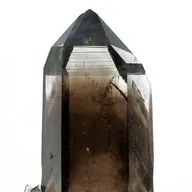 Smoky quartz
Quartz turned brown by the radioactivity of its own bedrock.
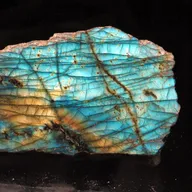 Labradorite
A dull grey stone until you turn it, and then it is peacock blue.
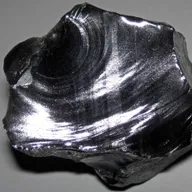 Obsidian
Volcanic glass with an edge finer than a surgical steel blade.
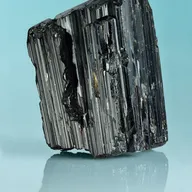 Black tourmaline
The stone that pulls ash out of a pipe when you warm it.
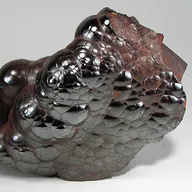 Hematite
Black as a mirror, and it leaves a blood-red line on anything you scratch it against.
Agni manitite
A black glass from Java, sold as a tektite; volcanic, as it turns out.
 Arfvedsonite
A black amphibole with a blue flash, named for the man who found lithium.
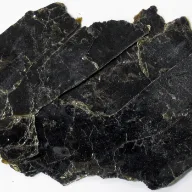 Biotite
Black mica: the flakes in every granite, and sheets big enough to roof a shed.
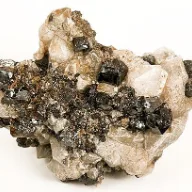 Brookite
Titanium dioxide in its rarest shape: thin red-brown blades grown in Alpine cracks.
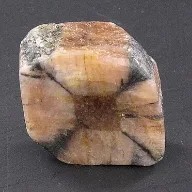 Chiastolite
An andalusite that grows a dark cross inside itself, and was sold for centuries as a Christian charm.
Columbianite
Colombian volcanic glass, sold as a tektite it is not.
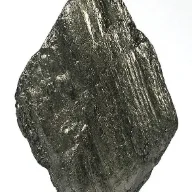 Graphite
Carbon in its soft form: the same element as diamond, stacked in sheets that slide.
 Aegirine
Black pyroxene needles from the strangest rocks on the planet.
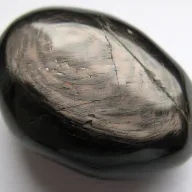 Hypersthene
A bronze-sheened pyroxene whose name the mineralogists retired.
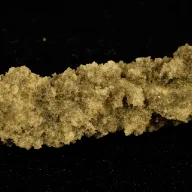 Fulgurite
Sand struck by lightning and fused, in a second, into hollow glass.
Indigo gabbro
A Madagascan rock sold under a wizard name it was given in 2010.
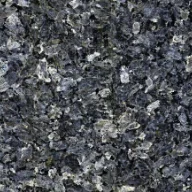 Larvikite
Norway's national rock, and the blue flash on half the shop fronts in Europe.
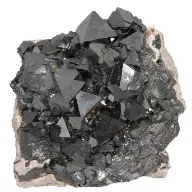 Magnetite
The most magnetic mineral there is, and the first compass.
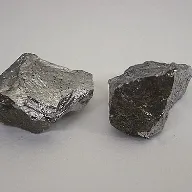 Manganese
The metal that makes steel tough, and that never occurs native.
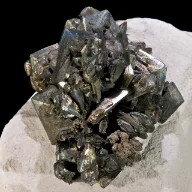 Marcasite
Pyrite's unstable twin, which eats itself in a damp drawer.
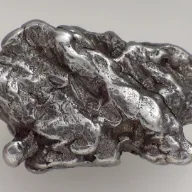 Campo del Cielo
An iron meteorite that fell on the Argentine Chaco four thousand years ago.
 Nuummite
Three-billion-year-old Greenlandic rock that flashes gold and copper.
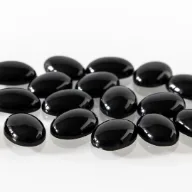 Onyx
Straight-banded chalcedony, and the black stone that is nearly always dyed.
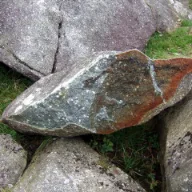 Preseli bluestone
The spotted dolerite of Stonehenge, from a Welsh hillside 250 kilometres away.
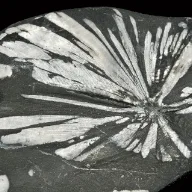 Chrysanthemum stone
Black rock with white mineral flowers that are not fossils.
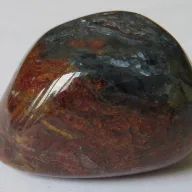 Pietersite
Tiger's eye smashed and cemented back together, so the light swirls.
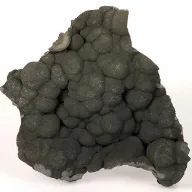 Psilomelane
A field name for the hard black manganese ores, kept alive by lapidaries.
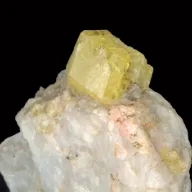 Rhodizite
A caesium borate as hard as topaz, and about as rare as minerals get.
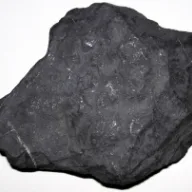 Shungite
Two-billion-year-old carbon rock from Karelia, and a great deal of nonsense.
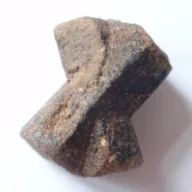 Staurolite
Two crystals grown through each other at sixty degrees, which comes out as a cross.
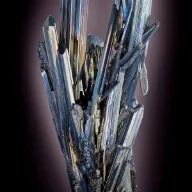 Stibnite
Steel-grey swords in a spray, soft enough to mark with a fingernail, and poisonous.
 Terahertz stone
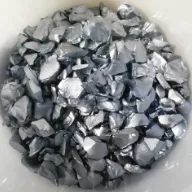
Furnace silicon, cut into beads and sold on a claim about radiation it does not emit.