 Lunarya
Aegirine
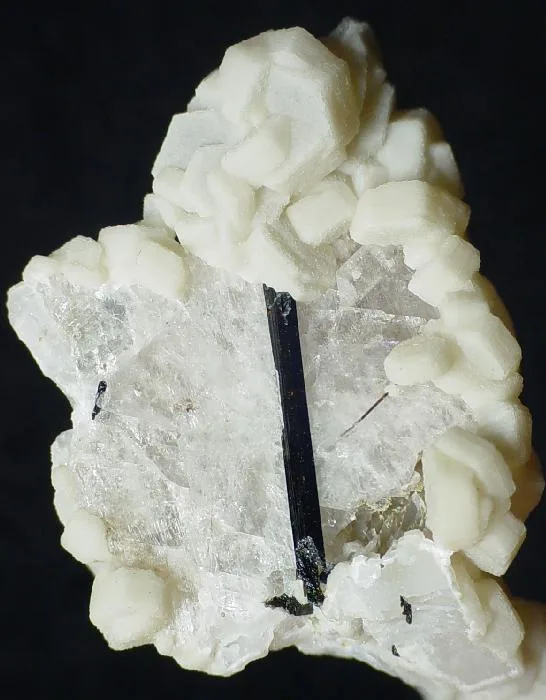
Aegirine is the sodium-iron end of the pyroxene family, NaFe³⁺Si₂O₆. It grows in long black or very dark green prisms, glassy, striated down their length and often finishing in a steep wedge of faces. Jens Esmark described it from southern Norway in 1835 and named it for Ægir, the Norse god of the sea, whose stretch of coast it came from.
It is the marker mineral of the alkaline igneous rocks: syenites and nepheline syenites, poor in silica and loaded with sodium. That chemistry produces a cast of minerals almost nobody else meets, and aegirine keeps company with all of them — eudialyte, astrophyllite, arfvedsonite, catapleiite, nepheline. It forms a complete series with augite through aegirine-augite, and like every pyroxene it has two cleavages meeting at close to ninety degrees, which is the quickest way to tell it from the amphiboles it grows beside.
In short
- Colour
- Dark
- Mineral
- Pyroxene
- Formula
- NaFe³⁺Si₂O₆
- Hardness
- 5.5–6 on the Mohs scale
- Crystal system
- Monoclinic
- Found in
- The Langesundsfjord and Larvik district of southern Norway is the type area. Mount Malosa in Malawi produces the long lustrous crystals the trade knows; others come from the Kola Peninsula in Russia, Mont Saint-Hilaire in Quebec, the Ilímaussaq complex in Greenland, Colorado, Kenya and Nigeria.
- Element
- Fire
- Planet
- Mars
- Chakra
- Root
- Handling
- Water and light are both fine
How it forms
It crystallises from sodium-rich, silica-poor magma and, better, from the pegmatites and hydrothermal veins such a magma sheds at the end of its life, where crystals had room and time. A little also grows in metamorphosed iron formations and in soda-rich alteration zones. Every good specimen comes from one of the few dozen alkaline complexes on Earth, which is why the same localities keep repeating.
In human hands
The name is almost two centuries old, and the mineral stayed a specialist interest for most of that time: too dark for jewellery, too soft for industry, too rare for anything else. Malawian material arriving in the 1990s and 2000s changed that. Sprays of black crystals standing in smoky quartz and feldspar reached the mineral shows in quantity, and the crystal trade attached to them the protective readings it usually gives black stones.
Varieties and trade names
- Malawi aegirine
- Mount Malosa crystals, often standing in smoky quartz and microcline; the specimens most people have seen.
- Aegirine with astrophyllite
- Black needles crossing bronze astrophyllite blades, from Kola and from Greenland.
- Aegirine-augite
- The middle of the series with augite, greener and stubbier than true aegirine.
- Acmite
- An old name, still on museum labels, for the brown pointed crystals; the same mineral.
- Aegirine on amazonite
- Black sprays on blue-green microcline, from Colorado and from the Kola Peninsula.
Telling it from a fake
Black tourmaline is the usual confusion. Schorl has a rounded triangular cross-section, no cleavage and a hardness of 7; aegirine has a four-sided cross-section, two cleavages at a right angle, and a hardness near 6, so a knife will just mark it. Arfvedsonite and hornblende are amphiboles, with cleavages meeting at 56 and 124 degrees, and arfvedsonite shows a faint blue-green in a strong light. Aegirine is glassy rather than resinous, and its striations run the length of the crystal.
None of this needs a laboratory, and none of it is proof. A shop that will not say whether a stone is treated has answered the question; ask, and have the answer written on the receipt.
What it is said to do
The modern reading is protective: a stone for boundaries, for shaking off an influence one has taken on, for the moment of deciding that something has gone on long enough. It is filed at the root, under Mars, with Aries and Scorpio. All of this arrived with the specimens in the last thirty years. There is no older tradition, and the rocks it comes from were not quarried by anybody before geologists went looking for them.
Living with it
Hard enough for handling but brittle across the needles, and a knocked crystal snaps rather than chips. Water and sunlight do no harm. Keep a specimen where nothing can fall on it, dust it with a soft brush rather than a cloth that will catch on the points, and do not put it loose in a bag with tumbled stones.
In magic
Aegirine, named for Ægir, the Norse god of the sea, is used in modern practice for protection and for shaking off an influence one has taken on: carried through a difficult period, set by the door, used in cleansing workings for a home. All of it is recent. Water and light do it no harm, but the needles snap.
- Energy
- Projective
- Day
- Tuesday
- Worked for
- Protection · Cleansing
More of this colour
 Smoky quartz
Quartz turned brown by the radioactivity of its own bedrock.
 Labradorite
A dull grey stone until you turn it, and then it is peacock blue.
 Obsidian
Volcanic glass with an edge finer than a surgical steel blade.
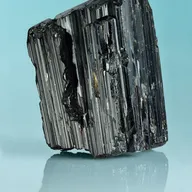 Black tourmaline
The stone that pulls ash out of a pipe when you warm it.
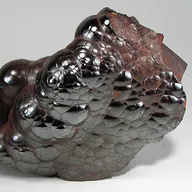 Hematite
Black as a mirror, and it leaves a blood-red line on anything you scratch it against.
Agni manitite
A black glass from Java, sold as a tektite; volcanic, as it turns out.
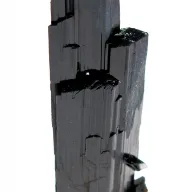 Arfvedsonite
A black amphibole with a blue flash, named for the man who found lithium.
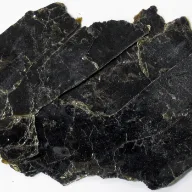 Biotite
Black mica: the flakes in every granite, and sheets big enough to roof a shed.
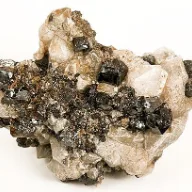 Brookite
Titanium dioxide in its rarest shape: thin red-brown blades grown in Alpine cracks.
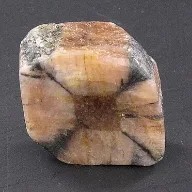 Chiastolite
An andalusite that grows a dark cross inside itself, and was sold for centuries as a Christian charm.
Columbianite
Colombian volcanic glass, sold as a tektite it is not.
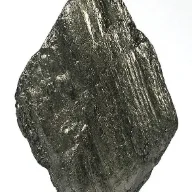 Graphite
Carbon in its soft form: the same element as diamond, stacked in sheets that slide.
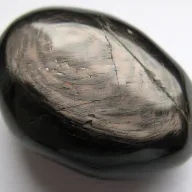 Hypersthene
A bronze-sheened pyroxene whose name the mineralogists retired.
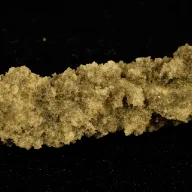 Fulgurite
Sand struck by lightning and fused, in a second, into hollow glass.
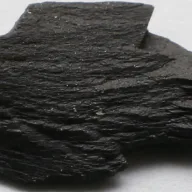 Jet
Fossil driftwood, black and warm in the hand, and Victorian mourning.
Indigo gabbro
A Madagascan rock sold under a wizard name it was given in 2010.
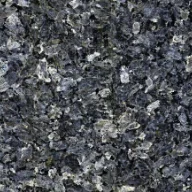 Larvikite
Norway's national rock, and the blue flash on half the shop fronts in Europe.
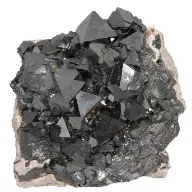 Magnetite
The most magnetic mineral there is, and the first compass.
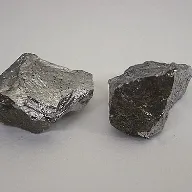 Manganese
The metal that makes steel tough, and that never occurs native.
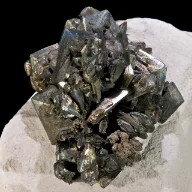 Marcasite
Pyrite's unstable twin, which eats itself in a damp drawer.
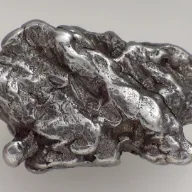 Campo del Cielo
An iron meteorite that fell on the Argentine Chaco four thousand years ago.
 Nuummite
Three-billion-year-old Greenlandic rock that flashes gold and copper.
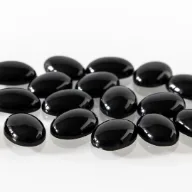 Onyx
Straight-banded chalcedony, and the black stone that is nearly always dyed.
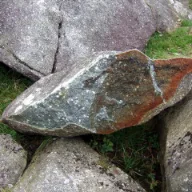 Preseli bluestone
The spotted dolerite of Stonehenge, from a Welsh hillside 250 kilometres away.
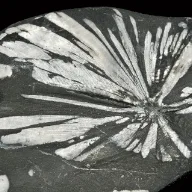 Chrysanthemum stone
Black rock with white mineral flowers that are not fossils.
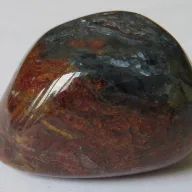 Pietersite
Tiger's eye smashed and cemented back together, so the light swirls.
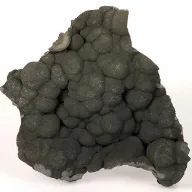 Psilomelane
A field name for the hard black manganese ores, kept alive by lapidaries.
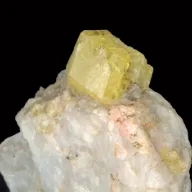 Rhodizite
A caesium borate as hard as topaz, and about as rare as minerals get.
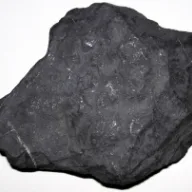 Shungite
Two-billion-year-old carbon rock from Karelia, and a great deal of nonsense.
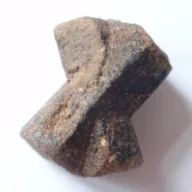 Staurolite
Two crystals grown through each other at sixty degrees, which comes out as a cross.
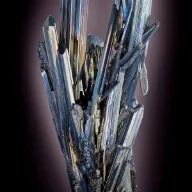 Stibnite
Steel-grey swords in a spray, soft enough to mark with a fingernail, and poisonous.
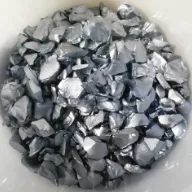 Terahertz stone
Furnace silicon, cut into beads and sold on a claim about radiation it does not emit.