 Lunarya
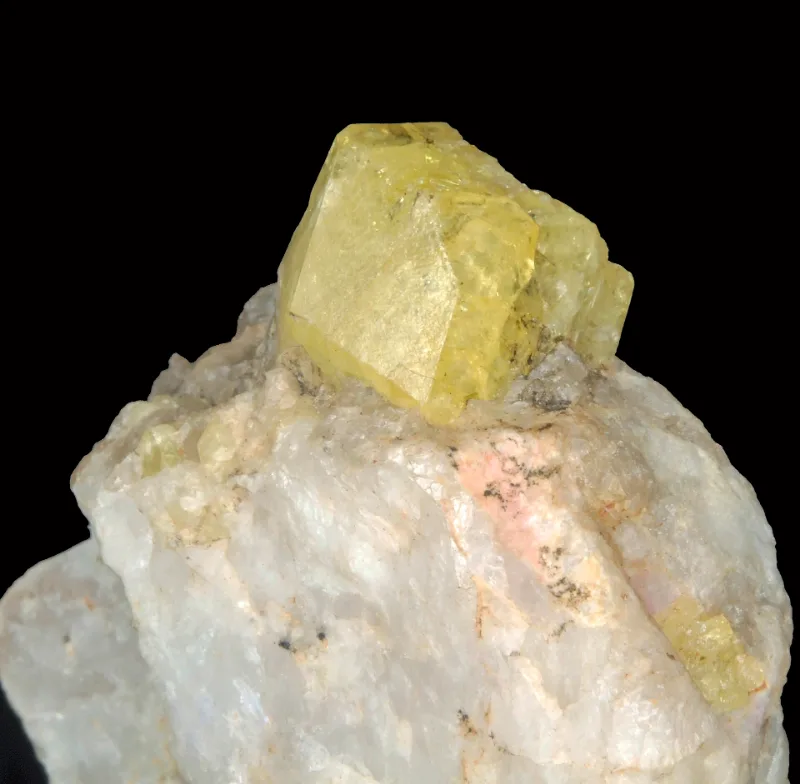
Rhodizite
Rhodizite is a caesium aluminium beryllium borate with a formula most people decline to read out loud: CsAl₄Be₄(B,Be)₁₂O₂₈. It grows in small, sharp, cubic-system crystals — usually tetrahedra and dodecahedra a few millimetres across — in colourless, pale yellow, honey and greenish shades, and it is hard, 8 to 8.5, which puts it just below corundum and above topaz.
The name comes from the Greek rhodizein, to be rose-red, which has nothing to do with the colour of the mineral and everything to do with the caesium in it: a fragment held in a flame turns the flame red. Caesium is a very scarce element that concentrates only at the tail end of a granite pegmatite, which is why rhodizite is scarce too. The closely related londonite, in which caesium exceeds potassium, was split off as a separate species in 1999, and a good deal of what is sold as rhodizite is really londonite.
In short
- Colour
- Dark
- Mineral
- Borate
- Formula
- CsAl₄Be₄(B,Be)₁₂O₂₈
- Hardness
- 8–8.5 on the Mohs scale
- Crystal system
- Cubic
- Found in
- The Sahatany valley and the Antandrokomby pegmatite in Madagascar, which have produced almost all known crystals; and Sarapulka and Shaitanka in the Urals, the type locality, where it was described in 1834. There is essentially nowhere else.
- Element
- Fire
- Planet
- The Sun
- Chakra
- Solar plexus
- Handling
- Water and light are both fine
How it forms
The very last of a lithium-caesium-tantalum pegmatite: a pocket where the leftover melt has concentrated the elements that fit nowhere else — caesium, beryllium, boron, lithium, tantalum — and where crystals can grow into open space. Rhodizite sits with elbaite tourmaline, danburite, spodumene and pollucite, and the tiny crystals are often perched on a cleavelandite feldspar blade.
In human hands
Described by Gustav Rose in 1834 from Ural material. It stayed an obscurity known to a few hundred collectors until the 1990s, when the crystal literature took it up and began describing it as an amplifier for other stones. Prices followed, which is notable for a mineral that had no jewellery use and crystals rarely bigger than a grain of rice. Faceted rhodizite exists; the stones are tiny and go straight into collections.
Varieties and trade names
- Madagascan rhodizite
- Sharp yellow to honey crystals from the Sahatany valley, on white feldspar; the material collectors buy.
- Londonite
- The caesium-dominant sibling, split off as a species in 1999; visually identical and often sold as rhodizite.
- Uralian rhodizite
- From the type locality, historic and small; most of it is in nineteenth-century museum drawers.
- Faceted rhodizite
- Cut stones, usually well under a carat, colourless to yellow; a curiosity rather than a gem.
- Rhodizite with tourmaline
- Pocket specimens where the crystals sit against pink or green elbaite; the prettiest way it occurs.
Telling it from a fake
Hardness and habit together. A crystal that scratches quartz and topaz, sits in a pegmatite pocket and has the flat triangular faces of a tetrahedron is a short list. Danburite is softer and orthorhombic. Yellow beryl is hexagonal. Spinel is cubic but occurs in different rocks and is usually darker. Given the prices, the honest advice is to buy small pieces from dealers who label londonite as londonite.
None of this needs a laboratory, and none of it is proof. A shop that will not say whether a stone is treated has answered the question; ask, and have the answer written on the receipt.
What it is said to do
The crystal literature treats it as an amplifier — a stone said to strengthen whatever it is placed with, which is the same role given to clear quartz and to a handful of other rarities. It is given to the Sun, to Leo and Aries, and to the solar plexus. That reputation, and not any jewellery use, is what created a market for grain-sized crystals, and it dates from the 1990s.
Living with it
Hard, chemically stable and untroubled by water or light; the practical problem is size. These are small crystals on fragile matrix, and the usual loss is not damage to the rhodizite but the crystal falling off the feldspar. Keep specimens in a padded box, handle by the matrix, and do not tumble or ultrasonic them.
In magic
Rhodizite has no older magic. Since the 1990s it has been sold as an amplifier, a stone to strengthen whatever it is set beside, much as clear quartz is used, and practitioners put a tiny crystal at the centre of a grid. It is hard and stable, but its crystals fall off their matrix, so it is handled by the rock.
- Energy
- Projective
- Day
- Sunday
- Worked for
- Study and clear thinking
More of this colour
 Smoky quartz
Quartz turned brown by the radioactivity of its own bedrock.
 Labradorite
A dull grey stone until you turn it, and then it is peacock blue.
 Obsidian
Volcanic glass with an edge finer than a surgical steel blade.
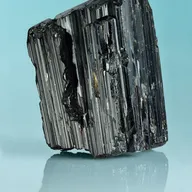 Black tourmaline
The stone that pulls ash out of a pipe when you warm it.
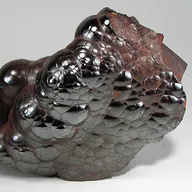 Hematite
Black as a mirror, and it leaves a blood-red line on anything you scratch it against.
Agni manitite
A black glass from Java, sold as a tektite; volcanic, as it turns out.
 Arfvedsonite
A black amphibole with a blue flash, named for the man who found lithium.
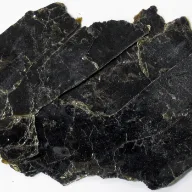 Biotite
Black mica: the flakes in every granite, and sheets big enough to roof a shed.
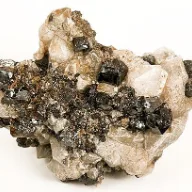 Brookite
Titanium dioxide in its rarest shape: thin red-brown blades grown in Alpine cracks.
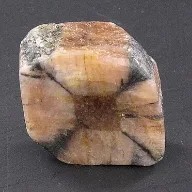 Chiastolite
An andalusite that grows a dark cross inside itself, and was sold for centuries as a Christian charm.
Columbianite
Colombian volcanic glass, sold as a tektite it is not.
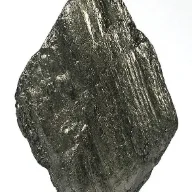 Graphite
Carbon in its soft form: the same element as diamond, stacked in sheets that slide.
 Aegirine
Black pyroxene needles from the strangest rocks on the planet.
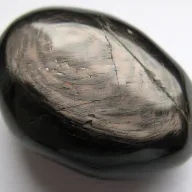 Hypersthene
A bronze-sheened pyroxene whose name the mineralogists retired.
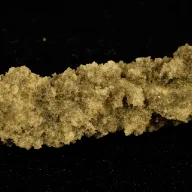 Fulgurite
Sand struck by lightning and fused, in a second, into hollow glass.
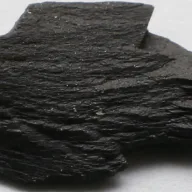 Jet
Fossil driftwood, black and warm in the hand, and Victorian mourning.
Indigo gabbro
A Madagascan rock sold under a wizard name it was given in 2010.
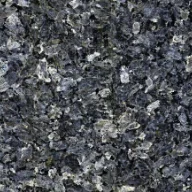 Larvikite
Norway's national rock, and the blue flash on half the shop fronts in Europe.
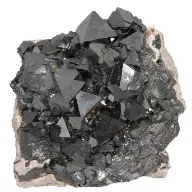 Magnetite
The most magnetic mineral there is, and the first compass.
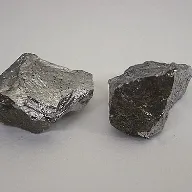 Manganese
The metal that makes steel tough, and that never occurs native.
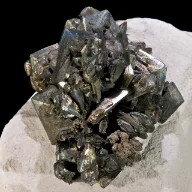 Marcasite
Pyrite's unstable twin, which eats itself in a damp drawer.
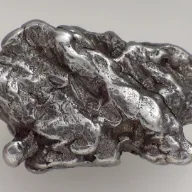 Campo del Cielo
An iron meteorite that fell on the Argentine Chaco four thousand years ago.
 Nuummite
Three-billion-year-old Greenlandic rock that flashes gold and copper.
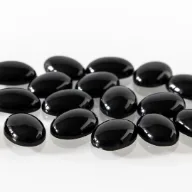 Onyx
Straight-banded chalcedony, and the black stone that is nearly always dyed.
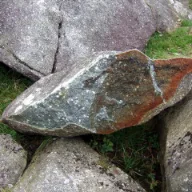 Preseli bluestone
The spotted dolerite of Stonehenge, from a Welsh hillside 250 kilometres away.
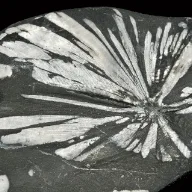 Chrysanthemum stone
Black rock with white mineral flowers that are not fossils.
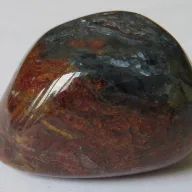 Pietersite
Tiger's eye smashed and cemented back together, so the light swirls.
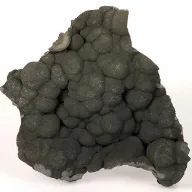 Psilomelane
A field name for the hard black manganese ores, kept alive by lapidaries.
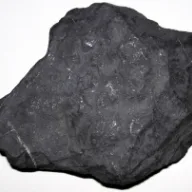 Shungite
Two-billion-year-old carbon rock from Karelia, and a great deal of nonsense.
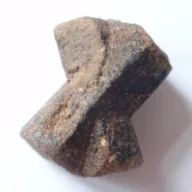 Staurolite
Two crystals grown through each other at sixty degrees, which comes out as a cross.
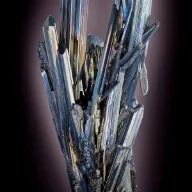 Stibnite
Steel-grey swords in a spray, soft enough to mark with a fingernail, and poisonous.
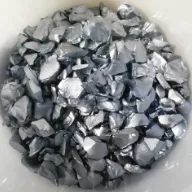 Terahertz stone
Furnace silicon, cut into beads and sold on a claim about radiation it does not emit.