 Lunarya
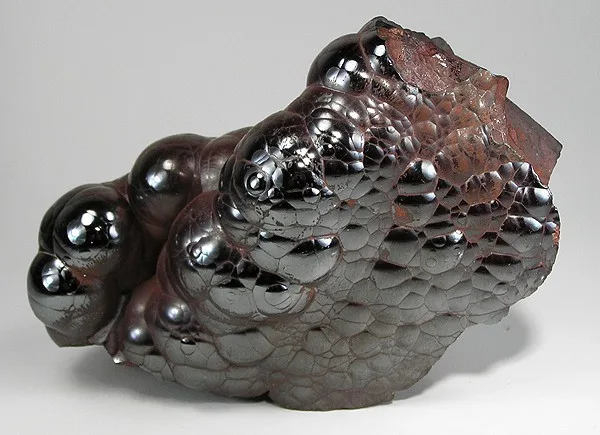
Hematite
Iron oxide, and the principal ore of iron: heavy in the hand, metallic grey to black when polished, and named from the Greek haima, blood, because however dark the stone is, its powder is red. Drag a piece across unglazed porcelain and the streak comes off rust red every time — the simplest identification test in mineralogy.
The red is the point of hematite historically: ground to ochre it is the oldest pigment humans used, on cave walls, on bodies and in burials going back well over a hundred thousand years. The banded iron formations it comes from were laid down over two billion years ago, when the first oxygen produced by living things met the iron dissolved in the seas and precipitated it. Most of the steel in the world started out as this. The shiny magnetic "hematite" beads in bead shops are usually a synthetic material called hematine, since real hematite is only weakly magnetic.
In short
- Colour
- Dark
- Mineral
- Oxide
- Formula
- Fe₂O₃
- Hardness
- 5.5–6.5 on the Mohs scale
- Crystal system
- Trigonal
- Found in
- Brazil, Australia, China, Canada and the Lake Superior region.
- Element
- Earth
- Planet
- Mars
- Chakra
- Root
- Handling
- Keep out of water
How it forms
Hematite is iron oxide, the main ore of iron, and most of it was laid down between two and a half and two billion years ago, when photosynthesis first filled the oceans with oxygen and the dissolved iron rusted out of the sea in layers: the banded iron formations of Australia, Brazil, Lake Superior and Kursk are that event, written in rock. It also grows in hydrothermal veins as the metallic kidney ore of Cumbria and the iron roses of the Alps and Elba, and as the red ochre in soil. Whatever the lump looks like, its streak is red, which is where the name comes from; Mars is red with it, and only faintly magnetic.
In human hands
Ochre is the oldest pigment there is: a kit for grinding it, a hundred thousand years old, was found at Blombos Cave in South Africa, and it painted Lascaux and coloured the burials of the Ice Age. The Etruscans and Romans smelted the hematite of Elba, and the Mesabi Range fed the steel mills of Pittsburgh. Polished, it was the black stone of Victorian men's rings and intaglios, and the Aztecs made mirrors of it. Jeweller's rouge, which puts the last polish on gold and silver, is hematite ground fine, and the kidney ore of the Egremont mines in Cumbria, closed in 2007, is the specimen collectors still want.
Varieties and trade names
- Kidney ore
- Rounded, metallic, botryoidal hematite, like a cluster of grapes; the classic came from Cumbria and the piece in the photograph is that kind.
- Specularite
- Hematite in glittering metallic flakes, from Michigan and Brazil, that sparkles like a road in the rain.
- Iron rose
- Rosettes of flat plates from Alpine clefts and Elba, and the pride of a Swiss strahler's cabinet.
- Rainbow hematite
- An iridescent film on the surface, natural on some Brazilian pieces and sprayed on to many others.
Telling it from a fake
Nearly every shiny black bead and bracelet sold as hematite is a ceramic magnet: sintered iron oxide, made in a factory, that sticks hard to a fridge door. Real hematite is barely magnetic, and it is heavy — noticeably heavier than it looks, five times the weight of water — and cold. Rub the piece on the unglazed back of a tile: hematite leaves a red-brown streak, the ceramic a grey-black one. Victorian hematite rings and intaglios are the real thing. Rust on the surface of a specimen is not a fake, just a damp one, and rainbow hematite may be natural or may be sprayed.
None of this needs a laboratory, and none of it is proof. A shop that will not say whether a stone is treated has answered the question; ask, and have the answer written on the receipt.
What it is said to do
The grounding and steadying stone, and an old one: Roman soldiers are said to have rubbed it on themselves before battle, and it has carried a reputation for courage, blood and composure ever since.
Living with it
Keep it dry — raw hematite rusts, and polished pieces lose their mirror in damp air. Wipe with a dry cloth, and do not be surprised if a cheap magnetic piece turns out not to be hematite at all.
In magic
Hematite has been a magical stone since Babylon, where it was a favourite material for cylinder seals, and its name, from the Greek for blood, gave it to Mars and to war: Roman soldiers are said to have rubbed it on their bodies before battle. Modern practice uses it for grounding, held at the end of a ritual, and for courage and composure. It rusts if left wet, so it stays out of baths.
- Energy
- Receptive
- Day
- Tuesday
- Worked for
- Grounding and endurance · Courage and drive
More of this colour
 Smoky quartz
Quartz turned brown by the radioactivity of its own bedrock.
 Labradorite
A dull grey stone until you turn it, and then it is peacock blue.
 Obsidian
Volcanic glass with an edge finer than a surgical steel blade.
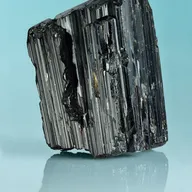 Black tourmaline
The stone that pulls ash out of a pipe when you warm it.
Agni manitite
A black glass from Java, sold as a tektite; volcanic, as it turns out.
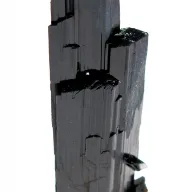 Arfvedsonite
A black amphibole with a blue flash, named for the man who found lithium.
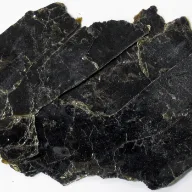 Biotite
Black mica: the flakes in every granite, and sheets big enough to roof a shed.
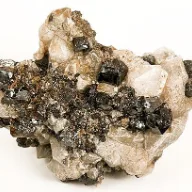 Brookite
Titanium dioxide in its rarest shape: thin red-brown blades grown in Alpine cracks.
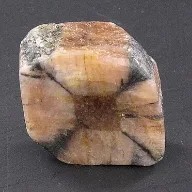 Chiastolite
An andalusite that grows a dark cross inside itself, and was sold for centuries as a Christian charm.
Columbianite
Colombian volcanic glass, sold as a tektite it is not.
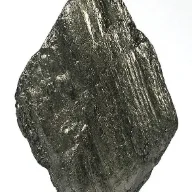 Graphite
Carbon in its soft form: the same element as diamond, stacked in sheets that slide.
 Aegirine
Black pyroxene needles from the strangest rocks on the planet.
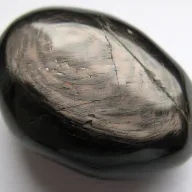 Hypersthene
A bronze-sheened pyroxene whose name the mineralogists retired.
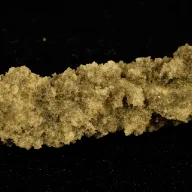 Fulgurite
Sand struck by lightning and fused, in a second, into hollow glass.
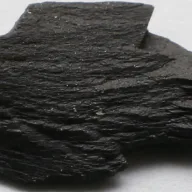 Jet
Fossil driftwood, black and warm in the hand, and Victorian mourning.
Indigo gabbro
A Madagascan rock sold under a wizard name it was given in 2010.
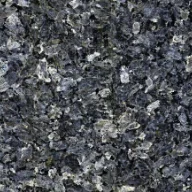 Larvikite
Norway's national rock, and the blue flash on half the shop fronts in Europe.
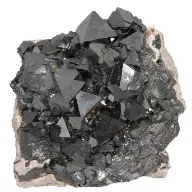 Magnetite
The most magnetic mineral there is, and the first compass.
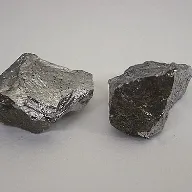 Manganese
The metal that makes steel tough, and that never occurs native.
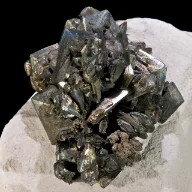 Marcasite
Pyrite's unstable twin, which eats itself in a damp drawer.
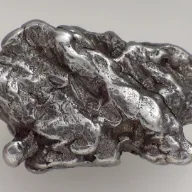 Campo del Cielo
An iron meteorite that fell on the Argentine Chaco four thousand years ago.
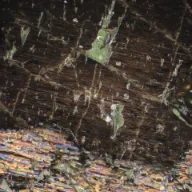 Nuummite
Three-billion-year-old Greenlandic rock that flashes gold and copper.
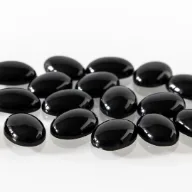 Onyx
Straight-banded chalcedony, and the black stone that is nearly always dyed.
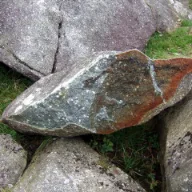 Preseli bluestone
The spotted dolerite of Stonehenge, from a Welsh hillside 250 kilometres away.
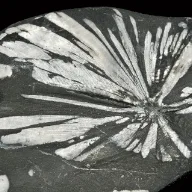 Chrysanthemum stone
Black rock with white mineral flowers that are not fossils.
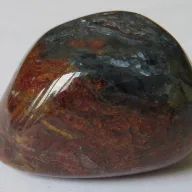 Pietersite
Tiger's eye smashed and cemented back together, so the light swirls.
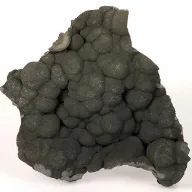 Psilomelane
A field name for the hard black manganese ores, kept alive by lapidaries.
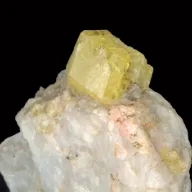 Rhodizite
A caesium borate as hard as topaz, and about as rare as minerals get.
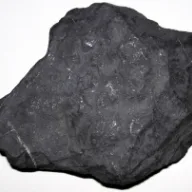 Shungite
Two-billion-year-old carbon rock from Karelia, and a great deal of nonsense.
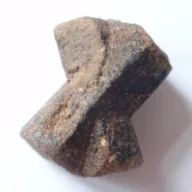 Staurolite
Two crystals grown through each other at sixty degrees, which comes out as a cross.
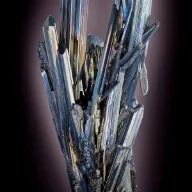 Stibnite
Steel-grey swords in a spray, soft enough to mark with a fingernail, and poisonous.
 Terahertz stone
Furnace silicon, cut into beads and sold on a claim about radiation it does not emit.