 Lunarya
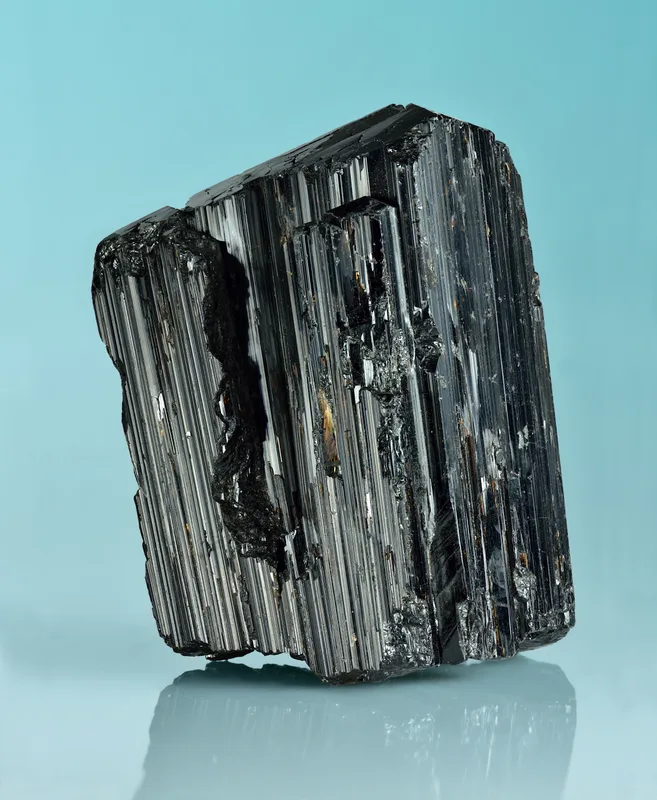
Black tourmaline
Black tourmaline — schorl to a mineralogist — is the commonest member of a large and chemically baroque borosilicate family, which has a page of its own here. It grows in long striated prisms with a rounded triangular cross-section, and it is genuinely hard, 7 to 7.5, which sets it apart from the other black stones on this page.
Tourmaline is both piezoelectric and pyroelectric: heat a crystal and the two ends take opposite electrical charges, strongly enough to attract ash and dust. Dutch traders in the eighteenth century used tourmaline to clean out meerschaum pipes and called it aschentrekker, the ash-puller, which is the first European record of the property. The same effect makes tourmaline useful in pressure sensors.
In short
- Colour
- Dark
- Mineral
- Silicate
- Formula
- NaFe₃Al₆(BO₃)₃Si₆O₁₈(OH)₄
- Hardness
- 7–7.5 on the Mohs scale
- Crystal system
- Trigonal
- Found in
- Brazil, Pakistan, Afghanistan, Madagascar and Maine.
- Element
- Earth
- Planet
- Saturn
- Chakra
- Root
- Handling
- Water and light are both fine
How it forms
Tourmaline is a family of more than thirty boron silicates, and schorl, the black, iron-rich one, is nineteen parts in twenty of all of it. It grows in granite and its pegmatites, and in the surrounding rock where boron-rich fluids have soaked in, as long prisms with a rounded triangular cross-section and deep grooves along their length, sometimes radiating from a point in a tourmaline sun. It has an odd trick: warmed, it takes an electric charge, and the Dutch who imported it in the 1700s called it the ash-puller, because a warm piece drew the ash out of a pipe. Cornwall, Brazil, Namibia, Madagascar, Pakistan and the Alps have it in quantity.
In human hands
Schorl is the oldest name in the family, from the village of Zschorlau in Saxony, where miners were cursing it as waste in the tin veins before 1400. Tourmaline is Sinhalese, turamali, mixed stones, and came with the Dutch parcels of 1703. Its charge on warming was described by Linnaeus, who called it the electric stone, and the Curie brothers found in 1880 that pressing it produced a charge too, in the same experiments as quartz; tourmaline pressure gauges measured the blasts of depth charges in the Second World War. The Victorians wore it in mourning, with jet, and the shops today sell it for the door.
Varieties and trade names
- Dravite
- The brown magnesium tourmaline, often mistaken for schorl until it is held to a lamp.
- Elbaite
- The gem species, in every colour: rubellite in red, indicolite in blue, and the neon Paraíba of Brazil, the most expensive tourmaline there is.
- Watermelon tourmaline
- Elbaite that grew pink in the middle and green at the rim, sold as slices cut across the crystal.
- Tourmalinated quartz
- Clear quartz with black needles of schorl through it; two stones in one, and an honest stone at any price.
Telling it from a fake
Schorl is cheap and rarely faked as a specimen, but the beads and tumbles sold as black tourmaline are often black glass or dyed chalcedony sold as onyx. Schorl shows deep parallel grooves along its length and a rounded triangle in cross-section, splinters lengthwise rather than in curved shells, scratches glass, and is neither heavy like hematite nor magnetic like the ceramic sold as hematite. Warm a piece with a hairdryer and it picks up scraps of paper and dust, a party trick no glass can do. Onyx beads are smooth, faintly waxy, and have no grooves at all.
None of this needs a laboratory, and none of it is proof. A shop that will not say whether a stone is treated has answered the question; ask, and have the answer written on the receipt.
What it is said to do
The standard protective stone of the modern cabinet, kept by doors and desks and read as absorbing or deflecting whatever is coming at you. The ash-pulling is almost certainly where the reputation for drawing things off started, which makes it one of the few pieces of crystal lore with a traceable physical origin.
Living with it
Hard, safe in water, and indifferent to light — one of the best stones here for carrying. Raw crystals shed tiny splinters along their striations, so keep a rough piece in a dish rather than a pocket.
In magic
Black tourmaline is the standard protection stone of modern witchcraft: set at the four corners of a house or by the front door, put into protection jars with salt, nails and rosemary, carried through difficult places. Its reputation for drawing things off has a physical root: warmed by a fire it pulls the ash towards it, which is why Dutch traders called it aschentrekker. It is safe in water and light.
- Energy
- Receptive
- Day
- Saturday
- Worked for
- Protection · Cleansing
More of this colour
 Smoky quartz
Quartz turned brown by the radioactivity of its own bedrock.
 Labradorite
A dull grey stone until you turn it, and then it is peacock blue.
 Obsidian
Volcanic glass with an edge finer than a surgical steel blade.
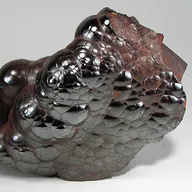 Hematite
Black as a mirror, and it leaves a blood-red line on anything you scratch it against.
Agni manitite
A black glass from Java, sold as a tektite; volcanic, as it turns out.
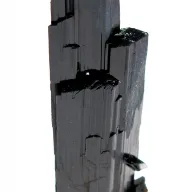 Arfvedsonite
A black amphibole with a blue flash, named for the man who found lithium.
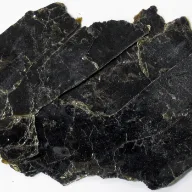 Biotite
Black mica: the flakes in every granite, and sheets big enough to roof a shed.
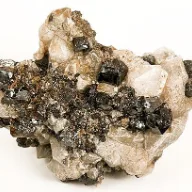 Brookite
Titanium dioxide in its rarest shape: thin red-brown blades grown in Alpine cracks.
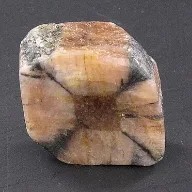 Chiastolite
An andalusite that grows a dark cross inside itself, and was sold for centuries as a Christian charm.
Columbianite
Colombian volcanic glass, sold as a tektite it is not.
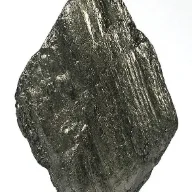 Graphite
Carbon in its soft form: the same element as diamond, stacked in sheets that slide.
 Aegirine
Black pyroxene needles from the strangest rocks on the planet.
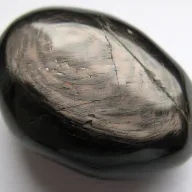 Hypersthene
A bronze-sheened pyroxene whose name the mineralogists retired.
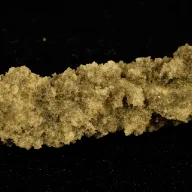 Fulgurite
Sand struck by lightning and fused, in a second, into hollow glass.
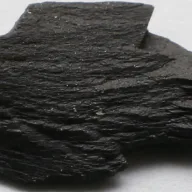 Jet
Fossil driftwood, black and warm in the hand, and Victorian mourning.
Indigo gabbro
A Madagascan rock sold under a wizard name it was given in 2010.
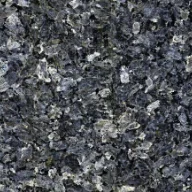 Larvikite
Norway's national rock, and the blue flash on half the shop fronts in Europe.
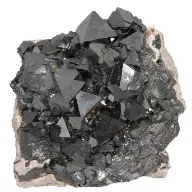 Magnetite
The most magnetic mineral there is, and the first compass.
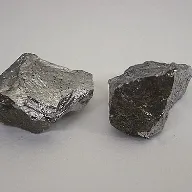 Manganese
The metal that makes steel tough, and that never occurs native.
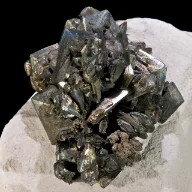 Marcasite
Pyrite's unstable twin, which eats itself in a damp drawer.
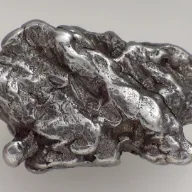 Campo del Cielo
An iron meteorite that fell on the Argentine Chaco four thousand years ago.
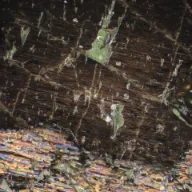 Nuummite
Three-billion-year-old Greenlandic rock that flashes gold and copper.
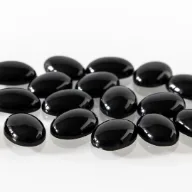 Onyx
Straight-banded chalcedony, and the black stone that is nearly always dyed.
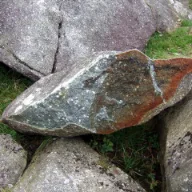 Preseli bluestone
The spotted dolerite of Stonehenge, from a Welsh hillside 250 kilometres away.
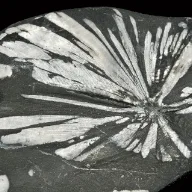 Chrysanthemum stone
Black rock with white mineral flowers that are not fossils.
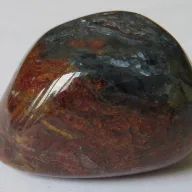 Pietersite
Tiger's eye smashed and cemented back together, so the light swirls.
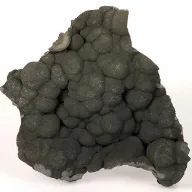 Psilomelane
A field name for the hard black manganese ores, kept alive by lapidaries.
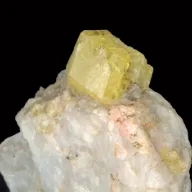 Rhodizite
A caesium borate as hard as topaz, and about as rare as minerals get.
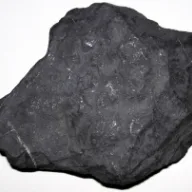 Shungite
Two-billion-year-old carbon rock from Karelia, and a great deal of nonsense.
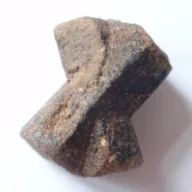 Staurolite
Two crystals grown through each other at sixty degrees, which comes out as a cross.
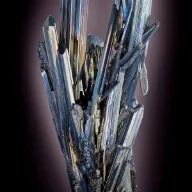 Stibnite
Steel-grey swords in a spray, soft enough to mark with a fingernail, and poisonous.
 Terahertz stone
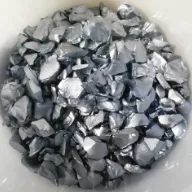
Furnace silicon, cut into beads and sold on a claim about radiation it does not emit.