 Lunarya
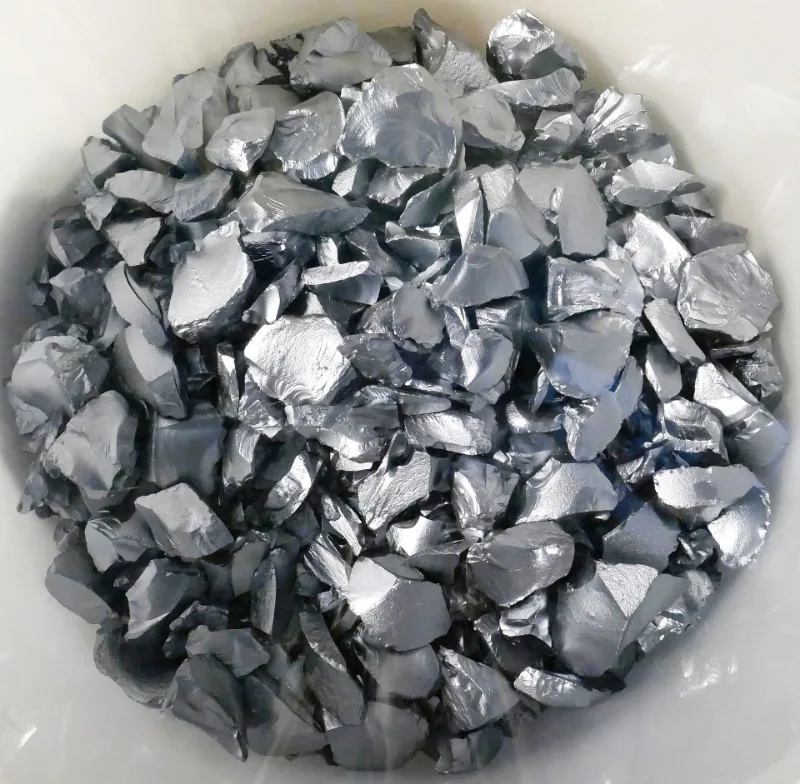
Terahertz stone
Terahertz stone is not a mineral and not a rock. It is silicon — the element, smelted in an electric furnace from quartz and carbon and then cast, sawn and polished into beads and palm stones. It is steel grey with a bright metallic-glassy lustre, about 7 on the Mohs scale, brittle, and it breaks with the conchoidal fracture of glass. It appeared in the crystal trade around 2010 and is now everywhere.
The name comes from the selling claim: that the stone emits terahertz radiation, the band between microwaves and infrared, and that this does something for circulation and fatigue. It does not. Every object above absolute zero radiates across a broad thermal spectrum, and a silicon bead at body temperature radiates like anything else at body temperature — mostly in the infrared, with no special terahertz output and nothing distinguishable from a pebble of the same warmth. This page says that plainly because no page that sells the claim will.
In short
- Colour
- Dark
- Mineral
- Man-made, not a mineral
- Formula
- Si
- Hardness
- 6.5–7 on the Mohs scale
- Crystal system
- Cubic
- Found in
- It is manufactured, chiefly in China, with some Japanese material; the original marketing was Japanese. Metallurgical-grade silicon is produced in quantity in China, Norway, Brazil, the United States and France, and the beads come from the same industrial stream that feeds solar panels and chip foundries.
- Element
- Earth
- Planet
- Mercury
- Chakra
- Solar plexus
- Handling
- Water and light are both fine
How it forms
Quartz sand and a carbon source — coke, coal, wood chips — are fed into a submerged-arc furnace and heated to about 1900 degrees. The carbon strips the oxygen off the silica and leaves molten silicon, which is tapped, cooled and broken up. What comes out is about 98 to 99 per cent pure and polycrystalline, with visible grain boundaries and a metallic sheen. The material for electronics goes on to be purified enormously further; the material for terahertz beads does not, which is why the stones often show pits, voids and a slightly sooty surface where the grain is open.
In human hands
Silicon was isolated by Berzelius in 1824 and industrial smelting began in the late nineteenth century; the terahertz stone is a marketing idea laid over a century-old industrial product. Terahertz research itself is genuine and interesting — the band is used in security scanners, in astronomy and in materials testing — and the stone's name borrows that legitimacy without any connection to it. The trade sometimes adds that the material was developed by NASA, which is not true of this or of any other stone sold with that line.
Varieties and trade names
- Polished beads
- The commonest form: grey, mirror-bright, sold as bracelets. The shine is a polish on silicon, and it scratches less easily than it looks.
- Rough silicon
- Broken furnace lumps with angular faces and a blue-grey metallic glitter; the honest version of the material, and cheap.
- Blue terahertz
- Sold as a superior grade. The blue is a surface oxide or coating, not a different material, and it wears off.
- Terahertz with quartz
- Beads with white or clear patches, which are unreduced silica left in the melt; a manufacturing residue rather than a feature.
- Glass and ceramic imitations
- Some cheap strands are neither silicon nor stone but grey glass. They are lighter, warmer to the touch and lack the metallic lustre.
Telling it from a fake
Silicon is unusually light for something that looks metallic — density 2.33, about the same as quartz — so a bead that looks like steel and weighs like glass is right. It is brittle and chips to a glassy conchoidal surface. Under a loupe the polished face shows grain boundaries, small pits and sometimes a faint iridescence, all signs of a cast material. Hematite is much heavier and gives a red streak; grey glass has no grain structure at all.
None of this needs a laboratory, and none of it is proof. A shop that will not say whether a stone is treated has answered the question; ask, and have the answer written on the receipt.
What it is said to do
The trade gives it focus, circulation and physical energy, and it is worn on the wrist for exactly that. Here it is given to earth, to Mercury, to Aquarius and Virgo, and to the solar plexus, on the strength of what it actually is: a refined, deliberately made material at the centre of modern technology. That is a fair enough image to hold. What it is not is a source of terahertz radiation, and any claim about health effects from that radiation should be read as advertising.
Living with it
Hard, inert and stable: water, soap and sunlight are all harmless, and it will not rust or fade. It is brittle, so it chips on a hard floor and the polished faces scratch against harder stones in a bag. Do not grind, cut or sand it without proper dust control. It is safe to wear and safe to handle; the only thing to be careful with is the claim attached to it.
In magic
Terahertz is a factory product, refined silicon, sold since the 2010s with health claims about a radiation it does not give off. The practitioners who use it anyway use it as a symbol of focus and of technology, in workings for study and for drive. That is an honest use, and the only one; it is inert and safe in any ritual.
- Energy
- Receptive
- Day
- Wednesday
- Worked for
- Study and clear thinking · Courage and drive
More of this colour
 Smoky quartz
Quartz turned brown by the radioactivity of its own bedrock.
 Labradorite
A dull grey stone until you turn it, and then it is peacock blue.
 Obsidian
Volcanic glass with an edge finer than a surgical steel blade.
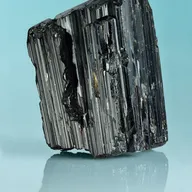 Black tourmaline
The stone that pulls ash out of a pipe when you warm it.
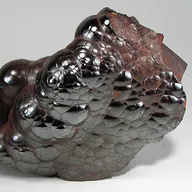 Hematite
Black as a mirror, and it leaves a blood-red line on anything you scratch it against.
Agni manitite
A black glass from Java, sold as a tektite; volcanic, as it turns out.
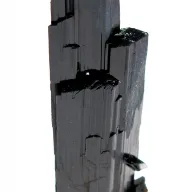 Arfvedsonite
A black amphibole with a blue flash, named for the man who found lithium.
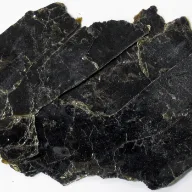 Biotite
Black mica: the flakes in every granite, and sheets big enough to roof a shed.
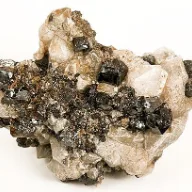 Brookite
Titanium dioxide in its rarest shape: thin red-brown blades grown in Alpine cracks.
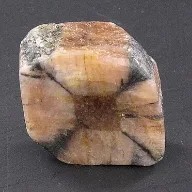 Chiastolite
An andalusite that grows a dark cross inside itself, and was sold for centuries as a Christian charm.
Columbianite
Colombian volcanic glass, sold as a tektite it is not.
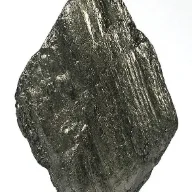 Graphite
Carbon in its soft form: the same element as diamond, stacked in sheets that slide.
 Aegirine
Black pyroxene needles from the strangest rocks on the planet.
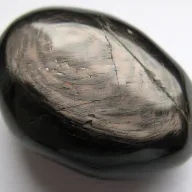 Hypersthene
A bronze-sheened pyroxene whose name the mineralogists retired.
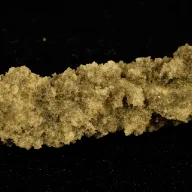 Fulgurite
Sand struck by lightning and fused, in a second, into hollow glass.
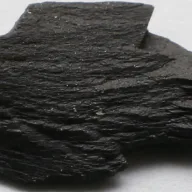 Jet
Fossil driftwood, black and warm in the hand, and Victorian mourning.
Indigo gabbro
A Madagascan rock sold under a wizard name it was given in 2010.
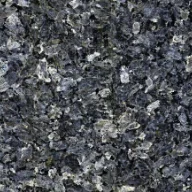 Larvikite
Norway's national rock, and the blue flash on half the shop fronts in Europe.
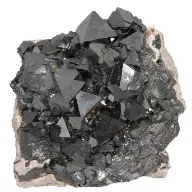 Magnetite
The most magnetic mineral there is, and the first compass.
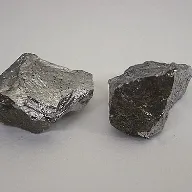 Manganese
The metal that makes steel tough, and that never occurs native.
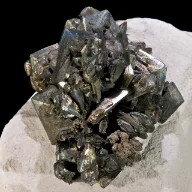 Marcasite
Pyrite's unstable twin, which eats itself in a damp drawer.
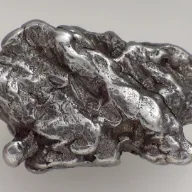 Campo del Cielo
An iron meteorite that fell on the Argentine Chaco four thousand years ago.
 Nuummite
Three-billion-year-old Greenlandic rock that flashes gold and copper.
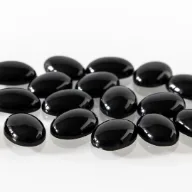 Onyx
Straight-banded chalcedony, and the black stone that is nearly always dyed.
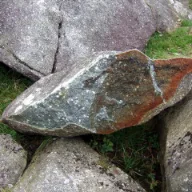 Preseli bluestone
The spotted dolerite of Stonehenge, from a Welsh hillside 250 kilometres away.
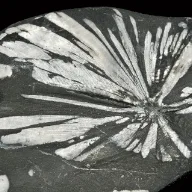 Chrysanthemum stone
Black rock with white mineral flowers that are not fossils.
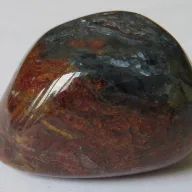 Pietersite
Tiger's eye smashed and cemented back together, so the light swirls.
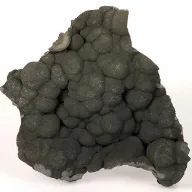 Psilomelane
A field name for the hard black manganese ores, kept alive by lapidaries.
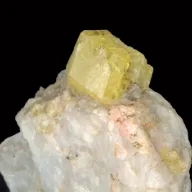 Rhodizite
A caesium borate as hard as topaz, and about as rare as minerals get.
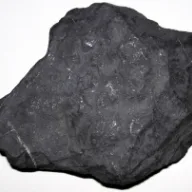 Shungite
Two-billion-year-old carbon rock from Karelia, and a great deal of nonsense.
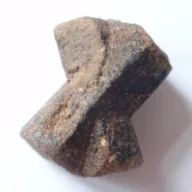 Staurolite
Two crystals grown through each other at sixty degrees, which comes out as a cross.
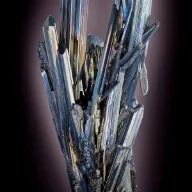 Stibnite
Steel-grey swords in a spray, soft enough to mark with a fingernail, and poisonous.