 Lunarya
Onyx
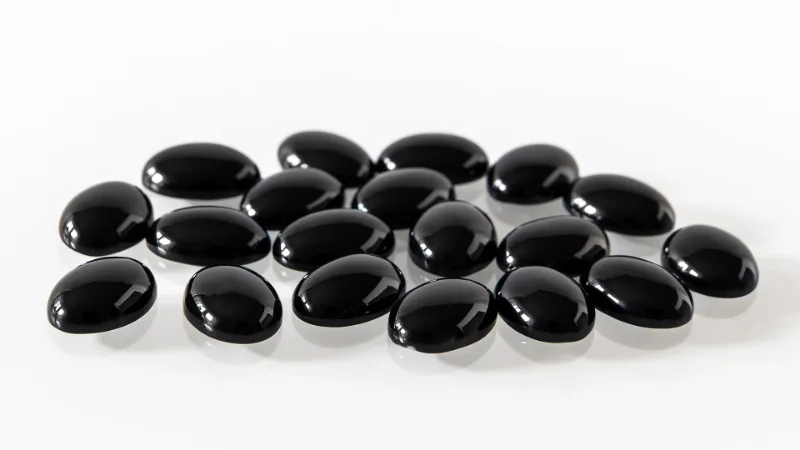
Onyx is chalcedony banded in straight parallel layers, as against agate, which is banded in curves. Strictly the bands are black and white; when they are red-brown and white the stone is sardonyx. That is the mineralogical definition, and almost nothing sold as onyx today meets it: the plain glossy black stone in every jeweller's window is grey chalcedony that has been dyed, by a recipe that has been in use since antiquity.
The recipe is sugar and acid. The porous chalcedony is soaked in a sugar solution, then in hot sulfuric acid, which chars the sugar to carbon inside the pores and turns the stone an even permanent black. Pliny describes a version of it in the first century, so this is not a modern deception — it is a two-thousand-year-old technique, and the resulting stone is stable and honest enough as long as nobody claims it grew that way. Hardness 6.5 to 7, no cleavage, and it takes a mirror polish.
In short
- Colour
- Dark
- Mineral
- Chalcedony
- Formula
- SiO₂
- Hardness
- 6.5–7 on the Mohs scale
- Crystal system
- Trigonal
- Found in
- Brazil, India, Madagascar and Uruguay supply most of the grey chalcedony that becomes black onyx. Genuinely banded black-and-white onyx is far scarcer and comes mainly from Brazil, India and Yemen. Historic sardonyx came from India and Arabia.
- Element
- Earth
- Planet
- Saturn
- Chakra
- Root
- Handling
- Water and light are both fine
How it forms
Like agate: silica-rich water filling a cavity in volcanic rock, depositing chalcedony layer by layer. What makes onyx rather than agate is the geometry — layers that build up flat on a floor rather than following the curved wall of a bubble, which happens when the cavity fills from the bottom or when the banding forms in a crack rather than a void.
In human hands
One of the great stones of the ancient world, because straight parallel bands of two colours are exactly what a cameo carver wants: cut away the top layer and the figure stands white against black. The Romans made cameos and seal rings of it by the thousand, and the technique was revived in the Renaissance and again in the nineteenth century. Victorian mourning jewellery used black onyx beside jet. The name is Greek for fingernail, from the pale banding.
Varieties and trade names
- Black onyx
- Dyed grey chalcedony, even and glossy; the standard jeweller's stone and by far the most common.
- Banded onyx
- The real thing: straight black and white layers, used for cameos and much less often seen loose.
- Sardonyx
- Red-brown and white in straight bands; one of August's birthstones, and it has a page of its own here.
- Onyx marble
- Not onyx at all: banded calcite from caves, soft enough to scratch with a knife, sold as Mexican or Pakistani onyx.
- Cameo and intaglio
- The two carving styles the stone exists for, one raised and one cut into the surface.
Telling it from a fake
Hardness separates the real confusion. True onyx is chalcedony and will not be scratched by a knife; onyx marble is calcite, marks easily, and fizzes with a drop of vinegar. Black glass is warm to the touch and often bubbled. Jet is very light and warms in the hand at once, where onyx stays cool. As for dye, assume it: plain even black chalcedony is dyed, and a dealer who insists otherwise is guessing or worse.
None of this needs a laboratory, and none of it is proof. A shop that will not say whether a stone is treated has answered the question; ask, and have the answer written on the receipt.
What it is said to do
Read as a stone of holding the line: boundaries, self-control, carrying grief without being swept along by it, and finishing something difficult. It is given to Saturn, to Capricorn and Leo, and to the root. Classical opinion was more divided — some Roman writers thought onyx caused bad dreams and quarrels, which is a reminder that the tradition has never been as unanimous as the shelf labels suggest.
Living with it
Easy. Water and sunlight do nothing, it wears well in a ring, and warm soapy water cleans it. The dye is stable, but avoid bleach, strong solvents and ultrasonic tanks on cheap material, which is sometimes fracture-filled as well as dyed. Onyx marble, if that is what you have, wants no water at all.
In magic
Onyx is a stone of boundaries in modern practice: used in protection and banishing workings, for self-control, and for carrying grief without being carried off by it, often on a Saturday as the moon wanes. Older opinion was darker — Roman and medieval writers said it brought nightmares and quarrels — which is why some practitioners still keep it out of the bedroom. Water and light do it no harm.
- Energy
- Receptive
- Day
- Saturday
- Worked for
- Protection · Grounding and endurance
More of this colour
 Smoky quartz
Quartz turned brown by the radioactivity of its own bedrock.
 Labradorite
A dull grey stone until you turn it, and then it is peacock blue.
 Obsidian
Volcanic glass with an edge finer than a surgical steel blade.
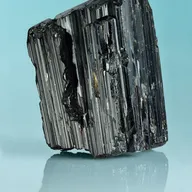 Black tourmaline
The stone that pulls ash out of a pipe when you warm it.
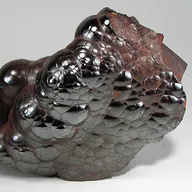 Hematite
Black as a mirror, and it leaves a blood-red line on anything you scratch it against.
Agni manitite
A black glass from Java, sold as a tektite; volcanic, as it turns out.
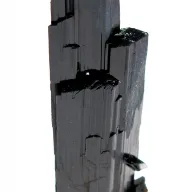 Arfvedsonite
A black amphibole with a blue flash, named for the man who found lithium.
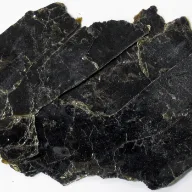 Biotite
Black mica: the flakes in every granite, and sheets big enough to roof a shed.
 Brookite
Titanium dioxide in its rarest shape: thin red-brown blades grown in Alpine cracks.
 Chiastolite
An andalusite that grows a dark cross inside itself, and was sold for centuries as a Christian charm.
Columbianite
Colombian volcanic glass, sold as a tektite it is not.
 Graphite
Carbon in its soft form: the same element as diamond, stacked in sheets that slide.
 Aegirine
Black pyroxene needles from the strangest rocks on the planet.
 Hypersthene
A bronze-sheened pyroxene whose name the mineralogists retired.
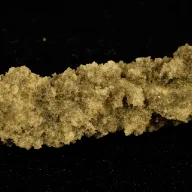 Fulgurite
Sand struck by lightning and fused, in a second, into hollow glass.
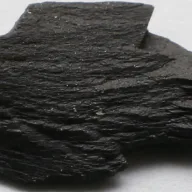 Jet
Fossil driftwood, black and warm in the hand, and Victorian mourning.
Indigo gabbro
A Madagascan rock sold under a wizard name it was given in 2010.
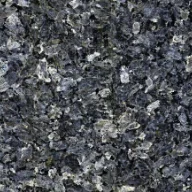 Larvikite
Norway's national rock, and the blue flash on half the shop fronts in Europe.
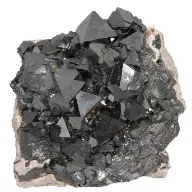 Magnetite
The most magnetic mineral there is, and the first compass.
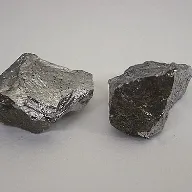 Manganese
The metal that makes steel tough, and that never occurs native.
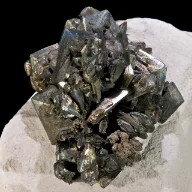 Marcasite
Pyrite's unstable twin, which eats itself in a damp drawer.
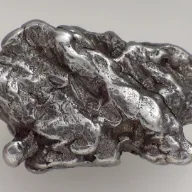 Campo del Cielo
An iron meteorite that fell on the Argentine Chaco four thousand years ago.
 Nuummite
Three-billion-year-old Greenlandic rock that flashes gold and copper.
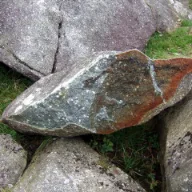 Preseli bluestone
The spotted dolerite of Stonehenge, from a Welsh hillside 250 kilometres away.
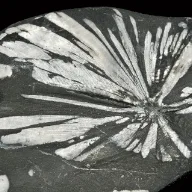 Chrysanthemum stone
Black rock with white mineral flowers that are not fossils.
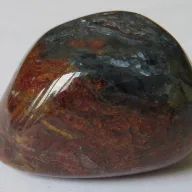 Pietersite
Tiger's eye smashed and cemented back together, so the light swirls.
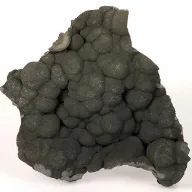 Psilomelane
A field name for the hard black manganese ores, kept alive by lapidaries.
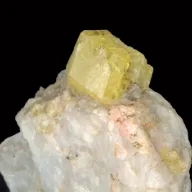 Rhodizite
A caesium borate as hard as topaz, and about as rare as minerals get.
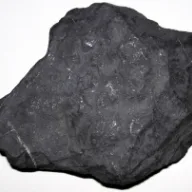 Shungite
Two-billion-year-old carbon rock from Karelia, and a great deal of nonsense.
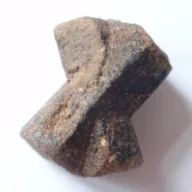 Staurolite
Two crystals grown through each other at sixty degrees, which comes out as a cross.
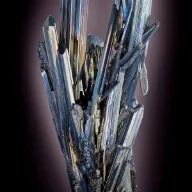 Stibnite
Steel-grey swords in a spray, soft enough to mark with a fingernail, and poisonous.
 Terahertz stone
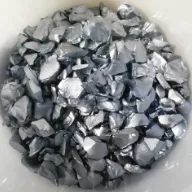
Furnace silicon, cut into beads and sold on a claim about radiation it does not emit.